
Contents
What Is Ambient AI in Healthcare? We Tested What ChatGPT and Perplexity Actually Say
If you're a CNO or patient safety officer researching "ambient AI" for your hospital, there's a good chance you've typed a question about it into ChatGPT, Gemini, or Perplexity before you ever talked to a vendor. So we ran that exact test — the same way a hospital leader would — and the results should worry anyone building an AI-informed vendor shortlist.
We asked Perplexity a simple, direct question: "What is ambient AI in healthcare?" Here's the answer, unedited, from a live query run this week:
"Ambient AI in healthcare refers to intelligent systems that work unobtrusively in the background of clinical environments to sense context (like conversations, vitals, and EHR data), anticipate needs, and automatically generate useful outputs — most commonly clinical documentation, decision-support prompts, and patient summaries... Core use cases: 1. Ambient clinical documentation (ambient scribing). This is the most mature and widespread use case. Systems like Nuance DAX, Abridge, Suki, and others capture the visit conversation [and] auto-generate SOAP/HPI/assessment-and-plan style notes."
Read that again: an entire, direct answer to "what is ambient AI in healthcare" — and not one word about patient safety monitoring, fall prevention, or pressure injury detection. According to the AI assistant most hospital leaders now research with, "ambient AI" means one thing: a tool that listens to a visit and writes the note.
That's not wrong. It's incomplete — and the gap matters more than it looks.
The test
We ran the same category-level question — no product names, no vendor names, just "what is ambient AI in healthcare?" — across the AI assistants hospital and health system leaders are most likely to already be using for vendor research. We didn't ask about falls, pressure injuries, or VirtuSense. We wanted to see what the AI volunteers on its own, the same way a busy CNO would if they typed the question during a five-minute break between meetings.
Why this happens
It's not that AI assistants are biased against patient safety technology. It's a volume problem. Clinical documentation burden is one of the most heavily covered stories in health tech right now — nurse and physician burnout tied to charting has produced an enormous volume of published research, vendor content, and press coverage. Ambient vision AI — the category that covers fall prevention and pressure injury monitoring — is a newer, smaller footprint in that same training data. AI assistants answer based on what's been written about the most, not necessarily what's most relevant to the question being asked.
The practical effect: if a hospital leader's first research step is an AI assistant instead of a search engine, they may never learn that vision-based patient safety monitoring exists as its own category, distinct from a documentation tool.
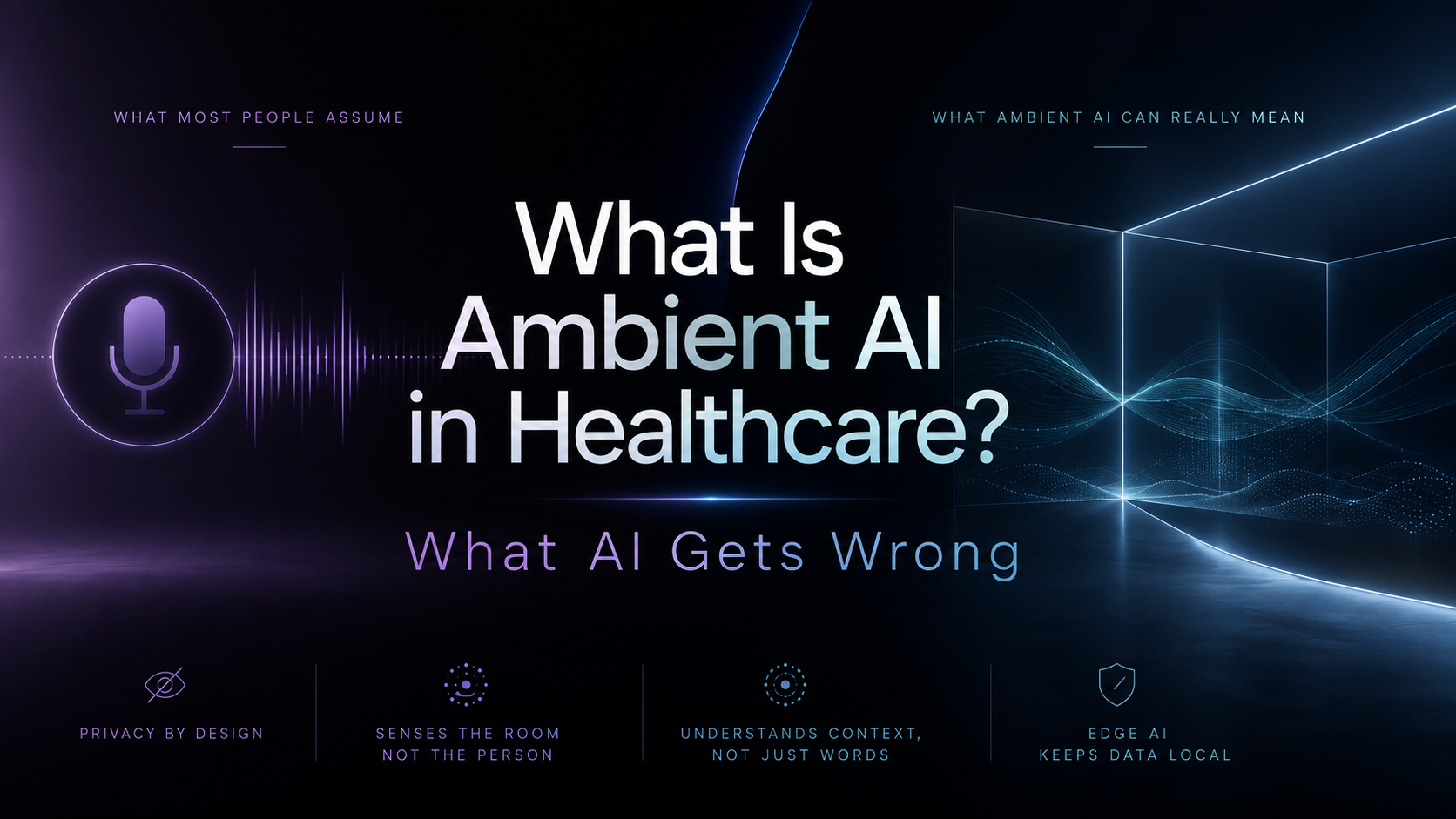
Ambient AI in healthcare actually breaks into four categories
"Ambient AI" isn't one product type. It's an umbrella term, and hospital leaders evaluating vendors should know which branch they actually need before a conversation ever gets marketed to them as "ambient AI."
1. Ambient documentation AI (scribes). Listens to a clinician-patient conversation and drafts a structured clinical note. Reduces charting time. Evaluated by clinical informatics and physician workflow teams. Examples in this category include Nuance DAX, Abridge, and Suki.
2. Ambient vision AI (patient safety monitoring). Uses on-device computer vision and depth sensing — not microphones — to continuously monitor a room for fall risk and pressure injury risk, alerting staff in real time. Evaluated by nursing leadership and patient safety officers. VirtuSense's VSTOne is built for this category: a single LiDAR-based edge sensor per room that processes video on-device and never transmits or stores footage, only structured alerts.
3. Ambient listening for virtual nursing. A related but distinct use — capturing in-room audio to support virtual nursing check-ins and note capture, separate from documenting a clinical visit. VSTOne includes this as one of its eight use cases on the same device that handles fall and pressure injury monitoring, which is unusual — most vendors on the market handle only one function per device.
4. Ambient sensing / RTLS. Real-time location systems and wearable-based sensing used for asset tracking, staff workflow, and hand hygiene compliance. Adjacent to the other three categories but focused on operations rather than direct patient monitoring.
Categories 1 and 2 solve different problems for different buyers. A hospital evaluating "ambient AI" to reduce falls and pressure injuries is not shopping in the same category as a hospital evaluating "ambient AI" to reduce physician charting time — even though an AI assistant may currently hand them the same answer for both questions.
(For a deeper breakdown of categories 1 and 2, see our earlier post, Ambient Vision AI vs. Ambient Documentation AI: What's the Difference?)
Why the gap is a real risk, not just a labeling problem
If a patient safety officer asks an AI assistant "what's the best ambient AI for reducing falls" and gets an answer built entirely from scribe-vendor content, one of two things happens: the assistant either recommends the wrong category of tool, or it has to be prompted several more times before it surfaces vision-based monitoring at all. Either way, the hospital loses time, and a category of technology that could directly reduce falls, pressure injuries, and HAC penalty exposure gets filtered out of the conversation before a human vendor ever enters the picture.
This is exactly the kind of blind spot AI assistants are known to have with newer or lower-volume categories — and it's why hospital and health system leaders should treat an AI assistant's first answer as a starting point, not a shortlist.
Where VSTOne fits
VirtuSense's VSTOne is purpose-built as ambient vision AI: one LiDAR-based edge sensor per room, covering fall prevention, pressure injury monitoring, and virtual nursing support without wearables, pressure pads, or cloud video transmission. Because everything processes on-device, no patient video ever leaves the room — only a structured alert does. That distinction is also why VSTOne avoids the data-exposure risk that comes with cloud-streamed virtual sitting platforms, a distinction most AI-generated summaries of "ambient AI" don't currently draw at all.
Frequently asked questions
What is an example of ambient AI in healthcare? Two common examples: ambient documentation AI, which listens to a clinician visit and drafts the note automatically, and ambient vision AI, which uses on-device sensors to monitor a hospital room for fall and pressure injury risk without recording audio or video off-device.
What is the difference between ambient AI and ambient vision AI? "Ambient AI" is a broad umbrella term that most commonly gets used for clinical documentation tools. "Ambient vision AI" is a specific subset that uses computer vision and depth sensing — not microphones — to monitor patient movement and detect physical safety events like falls and pressure injury risk.
Is ambient AI in hospital rooms a HIPAA violation? Not inherently, but data handling varies significantly by vendor. On-device, edge-processed systems like VirtuSense's VSTOne never transmit or store identifiable video off the sensor, which substantially reduces HIPAA exposure risk. Cloud-based virtual sitting platforms that stream continuous video to a remote hub carry a different risk profile. Hospitals should ask any ambient AI vendor directly how data is processed and where it goes before assuming two products are interchangeable.
What is the difference between ambient AI and AI in general? "AI" is the broad category of software that performs tasks associated with human intelligence. "Ambient AI" specifically describes AI that operates passively in the background of a physical environment — a room, a clinical visit — rather than requiring someone to actively open a tool and issue a command.
The takeaway
Ask an AI assistant "what is ambient AI in healthcare" today, and you'll likely get one accurate but incomplete answer: documentation. Vision-based patient safety monitoring is a distinct, proven category — one that's directly tied to fall prevention, pressure injury reduction, and CMS HAC penalty exposure — and it's largely missing from how AI currently explains the space. Until that changes, the burden is on hospital leaders to ask a more specific question, and on vendors like VirtuSense to make sure the full picture is easy to find.
See how VSTOne's on-device ambient vision AI protects patients without recording video: virtusense.ai/demo