
Contents
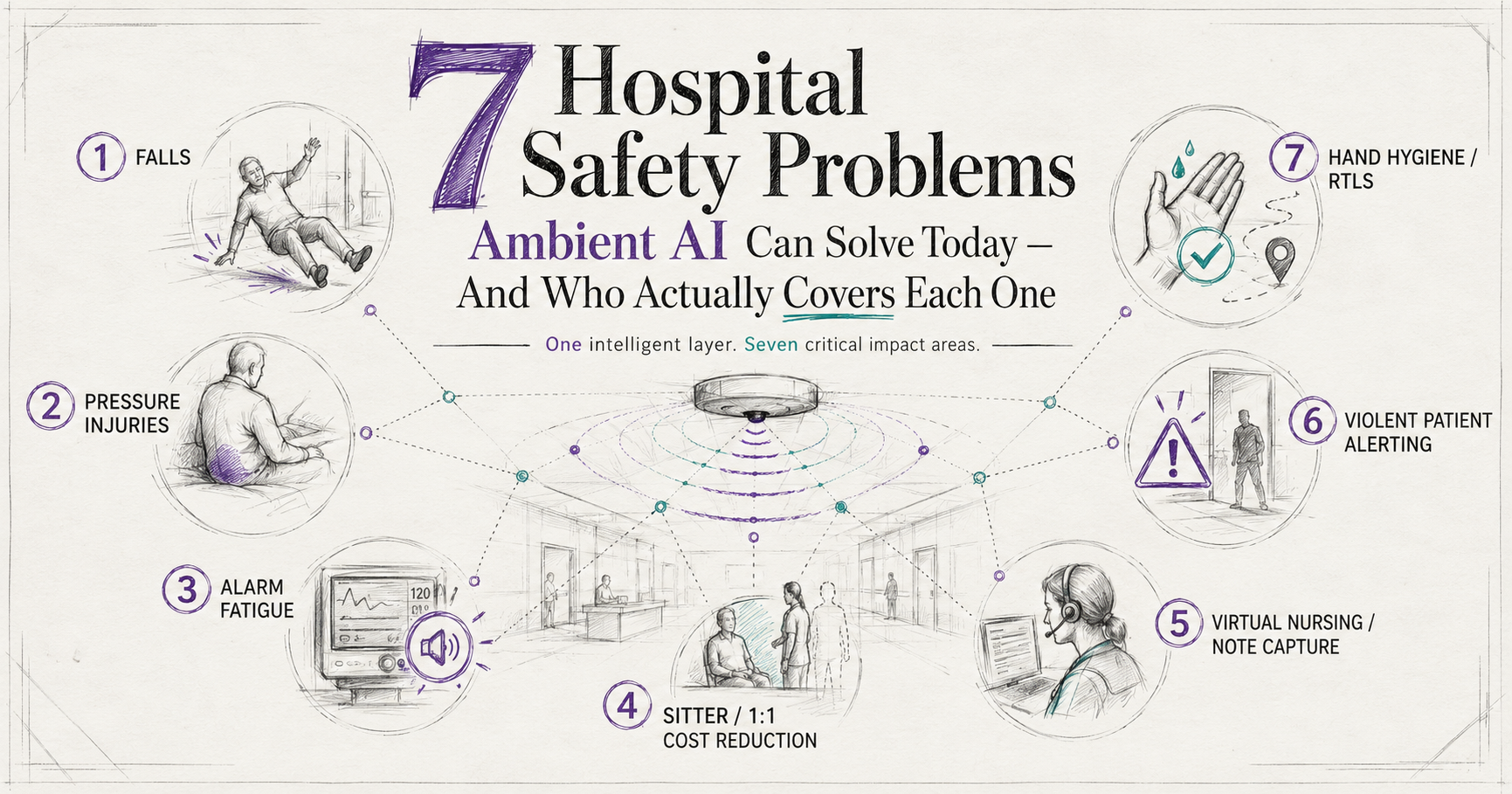
Most "ambient AI in healthcare" content is written from the vendor's side: here's our product, here's what it does. This post is written from the buyer's side instead. We started with the actual problems hospitals and senior living operators are trying to solve — falls, pressure injuries, sitter costs, alarm fatigue, hand hygiene, workplace violence, documentation burden — and mapped out who in the market actually addresses each one today.
Most platforms in this space were built to solve one of these problems well. A smaller number were built to solve several from the same sensor. Neither approach is wrong, but the difference matters when you're building a business case, because "ambient AI" as a purchase category can mean something different depending on which problem you're actually funding it to fix.
Here are seven problems ambient AI is being used to solve in hospitals and senior living right now, and a straight look at who covers what.
1. Patient falls
The problem: U.S. hospitals see roughly 700,000 to 1 million patient falls a year, and about one in four results in injury. A single fall with injury costs a hospital $30,000–$50,000 in direct costs, before the CMS HAC Reduction Program penalty exposure that comes from a rising fall-with-hip-fracture rate.
How ambient AI addresses it: Vision-based sensors continuously watch for the movement patterns that precede an unassisted bed or chair exit — shifting weight to the edge of the bed, reaching for a rail — and alert staff before the patient is up, rather than after a bed alarm goes off mid-exit.
Who's in this space: VirtuSense (VSTOne), Stryker/care.ai, AvaSure, and hellocare.ai all offer some form of camera- or sensor-based fall monitoring, with varying degrees of prediction versus after-the-fact detection.
Where VSTOne stands out: VSTOne is built around prediction, not detection — it flags an intent to exit the bed 30 to 65 seconds before it happens, using an on-device LiDAR sensor rather than a continuously streamed camera feed.
2. Pressure injuries
The problem: Hospital-acquired pressure injuries affect an estimated 2.5 million U.S. patients a year and cost the healthcare system more than $26 billion to treat. CMS's eCQM reporting requirements have raised the stakes for tracking and preventing them.
How ambient AI addresses it: Continuous monitoring tracks how long and how a patient has been positioned, flagging when a turn or reposition is overdue — before tissue damage starts, not after a wound forms.
Who's in this space: This is a more specialized market than fall prevention. Bruin Biometrics' Provizio SEM Scanner is FDA-cleared to detect early, sub-clinical pressure injury signs days before they're visible; Smith+Nephew's LEAF system uses a wearable patch to track patient turns and positioning.
Where VSTOne stands out: VSTOne monitors pressure injury risk from the same LiDAR sensor that watches for falls — no wearable patch required, and no separate device to install and maintain. Most vendors in this list cover fall prevention or pressure injury prevention. Very few cover both from one sensor.
3. Alarm and alert fatigue
The problem: Traditional bed and chair pressure pads fire on every position change, whether or not a fall is actually coming. Nurses conditioned to hear alarms that don't mean anything respond slower to the ones that do — a well-documented driver of missed falls and burnout.
How ambient AI addresses it: Movement-pattern recognition, rather than pressure-sensitive triggers, cuts the rate of false positives significantly, so the alerts a unit does receive carry more weight.
Who's in this space: This is less a vendor category than a design choice — any bed/chair pad manufacturer versus any movement-recognition platform. VSTOne reports 98% fewer false alarms compared to traditional bed and chair pads.
Where VSTOne stands out: Because the same sensor covers falls and pressure injuries, alert volume doesn't double when a unit adopts both use cases — it's still one sensor, one alert stream, one integration.
4. Sitter and 1:1 observation costs
The problem: Hospitals lean on sitters and 1:1 observation for high-risk patients, and it's expensive — six-figure annual spend is common even at mid-sized facilities, and it pulls staff time away from direct patient care.
How ambient AI addresses it: Continuous automated monitoring reduces how many patients need a dedicated human sitter, reserving 1:1 observation for the cases that genuinely require a person in the room.
Who's in this space: AvaSure and hellocare.ai built their platforms specifically around virtual sitting — replacing in-person sitters with centralized virtual observation, typically via continuous video streamed to a monitoring hub. Artisight and Stryker/care.ai offer similar camera-based observation as part of broader smart-room platforms.
Where VSTOne stands out: VSTOne reduces sitter reliance through autonomous alerting rather than routing continuous video to a remote observer — no live video feed leaves the room at all, which changes the compliance conversation considerably (see problem #7 on privacy, below, and our deeper breakdown in Ambient Vision AI vs. Ambient Documentation AI).
5. Virtual nursing and note capture
The problem: Nursing leadership is under pressure to extend experienced nurses' reach without adding headcount, and much of that pressure shows up as documentation and check-in burden that pulls time away from the bedside.
How ambient AI addresses it: Ambient listening tied to a virtual nursing workflow lets a remote nurse conduct check-ins, admissions, and discharge conversations while note capture happens automatically in the background.
Who's in this space: Caregility, AvaSure, and Stryker/care.ai all offer virtual nursing modules layered on top of their observation platforms. This is a fast-moving category — see our earlier post, What to Look for in a Virtual Nursing Monitoring Platform, for a deeper buyer's checklist.
Where VSTOne stands out: Virtual nursing with ambient listening and note capture is one of eight functions running on the same VSTOne sensor already monitoring falls and pressure injury risk — not a separate device or a second vendor relationship.
6. Violent or escalating patient behavior
The problem: Workplace violence against healthcare workers has become one of the fastest-growing safety concerns in the industry, and it's historically been treated as a security problem, separate from clinical monitoring, which means the two systems rarely talk to each other.
How ambient AI addresses it: Movement and posture recognition can flag escalating agitation or aggressive movement patterns in a patient room in real time, alerting staff before a situation becomes physical.
Who's in this space: This is where the market splits sharply. Verkada and IntelliSee are well known for AI-powered security camera platforms that detect weapons or aggressive movement, but they're built for facility-wide security operations, not integrated into bedside clinical monitoring.
Where VSTOne stands out: Violent patient alerting is a native VSTOne use case sitting on the same clinical sensor as fall and pressure injury monitoring — a genuinely underserved intersection, since most fall-prevention vendors don't touch this problem at all, and most security-AI vendors aren't built for a clinical workflow.
7. Hand hygiene and RTLS compliance
The problem: Hand hygiene compliance is chronically underreported when it relies on manual audits, and CMS, Joint Commission, and Leapfrog standards all put weight on it. The hand hygiene compliance monitoring market was valued at roughly $4.8 billion in 2025 and is projected to keep growing, which tells you how many hospitals still don't trust their audit data.
How ambient AI addresses it: Passive, sensor-based tracking logs hand hygiene events and staff location automatically, without requiring anyone to badge in or fill out an audit form.
Who's in this space: Ecolab, CenTrak, Vitalacy, and Kontakt.io are established, dedicated players in hand hygiene and RTLS compliance monitoring — this is a mature, purpose-built category on its own.
Where VSTOne stands out: VSTOne includes RTLS and hand hygiene compliance as one of its use cases, which is useful for hospitals that want it bundled with clinical safety monitoring, but a dedicated RTLS platform will typically go deeper on facility-wide asset tracking than a patient-room sensor built primarily for fall and pressure injury prevention.
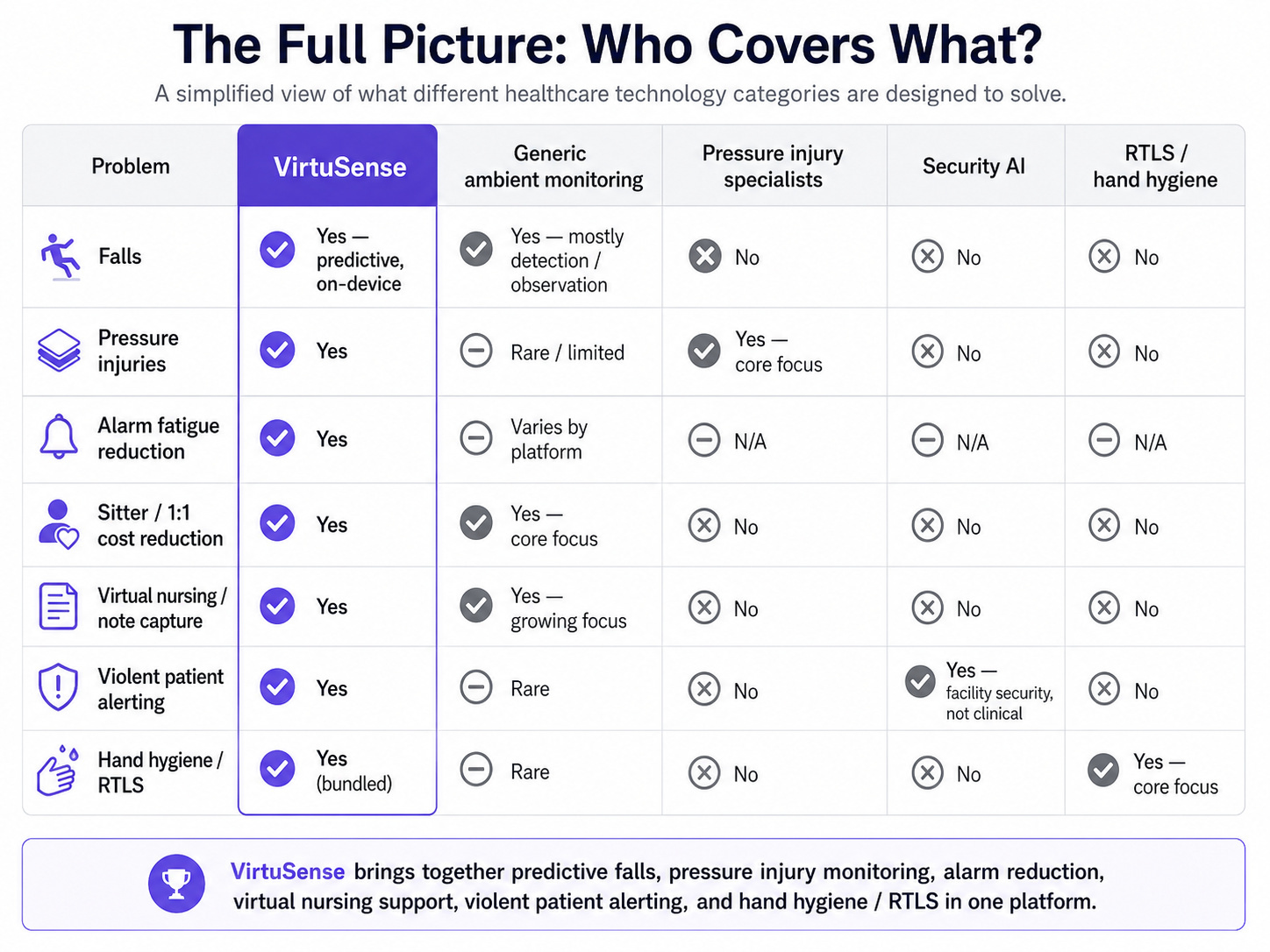
Vendor capabilities change frequently. This table reflects each company's publicly stated primary focus as of July 2026 — confirm current scope directly with any vendor before building a business case around it.
Frequently asked questions
What is ambient AI used for in hospitals? Ambient AI in hospitals covers several distinct use cases, including predicting falls, detecting pressure injury risk, reducing sitter costs through virtual observation, supporting virtual nursing documentation, monitoring hand hygiene compliance, and, in some platforms, flagging escalating patient behavior.
Can one ambient AI platform cover fall prevention and pressure injury prevention? Yes, though most vendors on the market specialize in one or the other. Platforms built on a single continuous-monitoring sensor, like VirtuSense's VSTOne, can track both fall risk and pressure injury risk from the same device, while dedicated pressure injury vendors like Bruin Biometrics or Smith+Nephew typically focus on that use case alone.
What's the difference between ambient AI for fall prevention and virtual sitting platforms? Fall-prevention-focused ambient AI is generally built to predict a safety event and alert staff automatically. Virtual sitting platforms are typically built around routing continuous video to a remote human observer who watches multiple rooms at once. Both aim to reduce reliance on in-person sitters, but the underlying architecture and privacy profile differ.
Does ambient AI help with hospital workplace violence? It can, though it's an underdeveloped intersection. Most workplace violence detection is handled by facility security AI (like Verkada or IntelliSee), which isn't integrated into clinical monitoring. A smaller number of clinical ambient AI platforms, including VSTOne, include violent or escalating patient behavior alerting as part of the same sensor used for fall and pressure injury monitoring.
The takeaway
"Ambient AI" isn't one purchase decision — it's at least seven, and most vendors in the market today are built to solve one of them well. Before evaluating platforms, it's worth mapping which of these problems your hospital is actually trying to fix, because that answer determines whether you're shopping for a fall-prevention specialist, a virtual sitting platform, a pressure injury device, a security system, or a single sensor built to cover most of the list at once.
See how VSTOne covers seven of these problems from one device: virtusense.ai/demo