
Ambient Vision AI vs. Ambient Documentation AI: What's the Difference?
Contents
Search "ambient AI in healthcare" today and most results are about clinical scribes — tools that listen to a patient visit and write the note for you. That's a real and useful category. But it's not the only thing "ambient AI" means, and the overlap in terminology is creating real confusion for hospital and senior living leaders trying to evaluate patient safety technology.
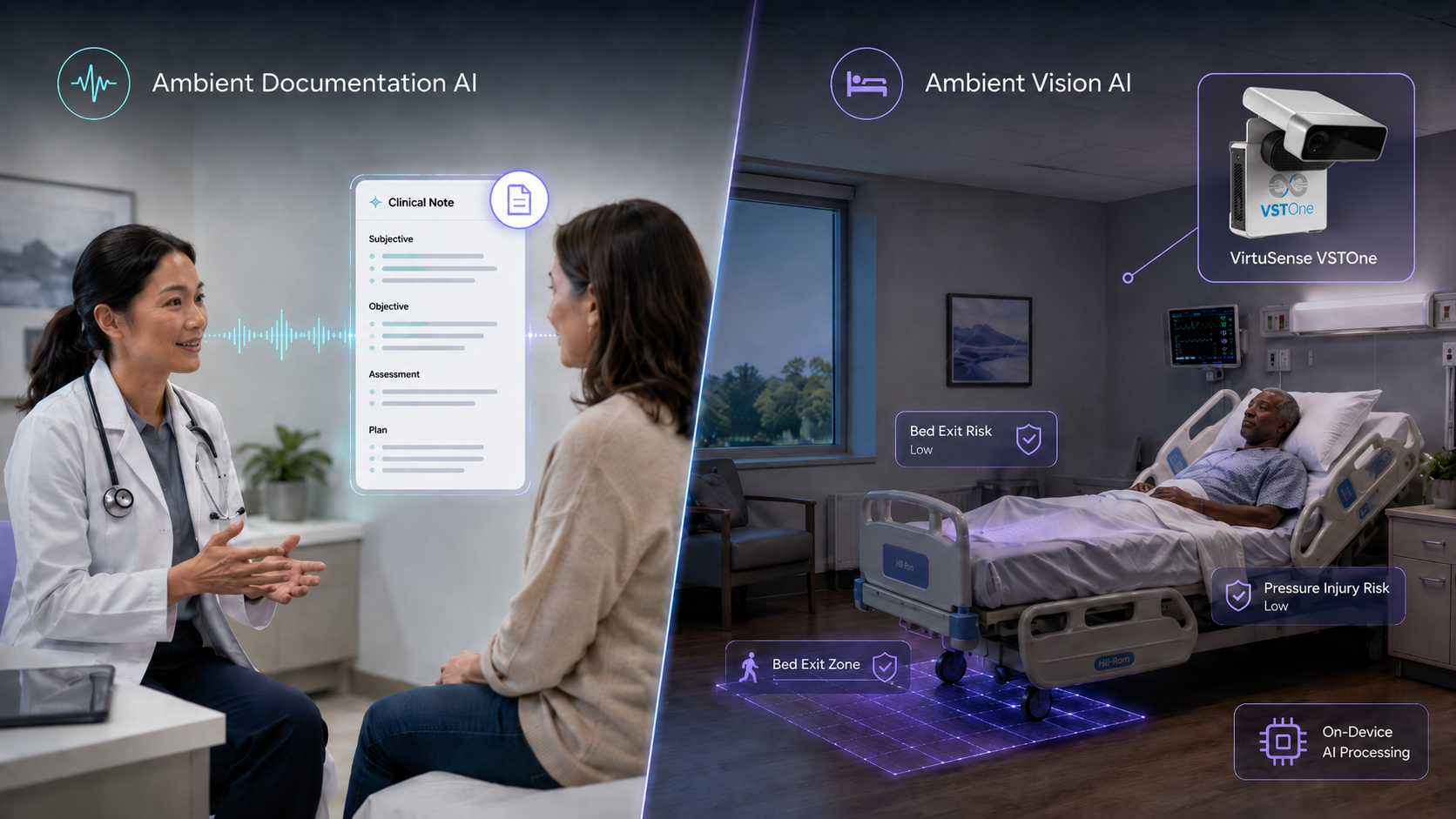
Ambient vision AI is a separate category entirely. It uses on-device sensors — typically LiDAR and computer vision, not microphones — to continuously observe a room and detect physical events like a patient beginning to exit a bed or shifting position in a way that raises pressure injury risk. It doesn't listen to conversations, and in systems like VirtuSense's VSTOne, it doesn't record or transmit video at all. Everything is processed at the bedside, in real time.
This post breaks down what separates the two categories, why the distinction matters for patient privacy and compliance, and how to know which one (or both) your organization actually needs.
What Is Ambient Documentation AI?
Ambient documentation AI listens to a clinician-patient conversation and turns it into a structured clinical note automatically. It's built to reduce charting time, not to monitor a room for safety events.
These tools typically run on audio captured during a visit, transcribe it, and use natural language processing to draft a note in the format a clinician's EHR expects. The clinician reviews and signs off before it becomes part of the record. The value proposition is administrative: less time typing, more time with the patient in front of them.
Ambient documentation AI has grown quickly because clinician burnout tied to documentation burden is a well-documented problem. But it solves a workflow problem, not a patient safety problem — it has nothing to say about whether a patient is at risk of falling or developing a pressure injury after the visit ends.
What Is Ambient Vision AI?
Ambient vision AI is a category of continuous monitoring technology that uses on-device computer vision and depth sensing to detect physical safety events — falls, bed exits, and pressure injury risk — without recording or transmitting identifiable video.
Where documentation AI is audio-in, text-out, ambient vision AI is visual-in, alert-out. A sensor mounted in the room continuously interprets a patient's movement and posture. When it detects a pattern associated with an imminent fall or bed exit, it alerts nursing staff in real time — VirtuSense's VSTOne, for example, can flag an intent to exit the bed 30 to 65 seconds before it happens. For pressure injury risk, the same sensor tracks how long and how a patient has been positioned, flagging when it's time for a turn or reposition.
The "ambient" in both categories refers to the same idea: technology that observes passively in the background rather than requiring a person to actively operate it. But what they observe, and what they do with that data, are completely different.
Key Differences Hospitals Should Know
- Input type. Documentation AI processes audio and language. Vision AI processes movement and depth data from a sensor, not a standard camera feed.
- Primary use case. Documentation AI reduces charting burden for clinicians. Vision AI prevents falls and pressure injuries for patients.
- Who evaluates it. Documentation AI purchases typically run through clinical informatics or physician workflow teams. Vision AI purchases typically run through nursing leadership and patient safety officers.
- Data handling. Documentation AI generates a text transcript that becomes part of the clinical record. Edge-based ambient vision AI, like VSTOne, processes video on-device and never stores or transmits it — the alert is the only output that leaves the room.
- Compliance profile. Because on-device ambient vision AI never transmits patient video off the sensor, it avoids the data exposure risk that comes with cloud-based video streaming or storage.
Why On-Device Processing Matters for Ambient Vision AI
Not all camera-based monitoring is built the same way, and this is where hospitals should look closely. Some virtual observation and virtual sitting platforms work by streaming live video to a remote monitoring hub, where a person — not an algorithm — watches multiple rooms at once. That approach still involves continuous video transmission and, often, storage.
VirtuSense's VSTOne takes a different approach: edge AI. The sensor processes video locally and only ever sends a structured alert, not footage, off the device. No patient video leaves the room, no cloud transmission is required, and there's no wearable or pressure pad on the patient. That distinction matters for two reasons. First, it removes a major category of HIPAA exposure risk that comes with transmitting or storing video. Second, it changes how the technology is perceived by nursing staff — an alert system is a different thing to work alongside than a system that streams and stores footage for someone else to review.
Research on ambient AI in clinical settings continues to expand quickly, and the distinction between passive-listening and passive-vision approaches is still new enough that hospital buyers should ask vendors directly how data is processed and where it goes before assuming two "ambient AI" tools are interchangeable.
How VirtuSense's VSTOne Addresses This
VSTOne is purpose-built as ambient vision AI, covering both fall prevention and pressure injury risk on a single edge device — most alternatives handle only one of the two. Northwell Health has reported a 4x ROI using VSTOne, driven by fewer falls and reduced sitter costs. Emory Healthcare has seen similar results and highlighted its VSTOne program in a breakout session at AONL 2026, reflecting growing interest from nursing leadership in edge-based approaches to patient safety monitoring.
Because VSTOne doesn't rely on wearables, pressure pads, or continuous video transmission, it's deployable across both acute care units and senior living settings without the infrastructure or privacy trade-offs that come with cloud-dependent monitoring.
Frequently Asked Questions
Q: What is the difference between ambient AI and ambient vision AI? A: "Ambient AI" is often used to describe clinical documentation tools that listen to conversations and generate notes. "Ambient vision AI" is a distinct category that uses computer vision and depth sensing to monitor patient movement for safety events like falls and pressure injuries. The two solve different problems and shouldn't be evaluated as interchangeable.
Q: Does ambient vision AI record patient video? A: It depends on the vendor's architecture. Edge-based systems like VirtuSense's VSTOne process video on-device and never store or transmit identifiable footage — only structured alerts leave the sensor. Cloud-based virtual sitting platforms, by contrast, typically stream continuous video to a remote monitoring hub.
Q: Can hospitals use both ambient documentation AI and ambient vision AI together? A: Yes. The two address different workflows — documentation AI reduces clinician charting time during visits, while ambient vision AI like VSTOne continuously monitors for fall and pressure injury risk between visits. Many hospitals are evaluating or adopting both as separate, complementary investments.
Q: Is ambient vision AI HIPAA compliant? A: On-device, edge-processed systems reduce HIPAA exposure risk significantly because no identifiable video is transmitted or stored off the sensor. Hospitals should still confirm a vendor's specific data handling architecture, since not all products marketed as "ambient AI" or "smart room" technology process video the same way.
The Takeaway
"Ambient AI" isn't one thing — it's a label covering both conversation-based documentation tools and vision-based patient safety monitoring, and confusing the two can lead a hospital to evaluate the wrong vendor for the problem it's actually trying to solve. If the goal is reducing falls, pressure injuries, and sitter costs, the right category to evaluate is ambient vision AI, built on edge processing rather than cloud-streamed video.
See how VSTOne's on-device ambient vision AI protects patients without recording video: https://www.virtusense.ai/request-a-demo