
Contents
Stryker entered ambient monitoring through its 2024 acquisition of care.ai, folding it into Stryker's Smart Care business unit and its broader SmartHospital platform, which also spans virtual nursing, communications, and workflow automation. It's a serious entrant backed by one of the largest medical device companies in the world. But size and scope aren't the same thing as fit — and hospitals evaluating Stryker's Ambient Monitoring against a purpose-built platform like VirtuSense's VSTOne are often comparing two different kinds of products wearing similar labels.
Ambient vision AI is a category of monitoring technology that uses on-device sensors — LiDAR or computer vision — to continuously observe a patient room and detect safety events like falls or pressure injury risk without a person watching a live feed. Both Stryker and VirtuSense operate in this category. Where they diverge is in scope, hardware, and how many separate products it takes to cover fall prevention and pressure injury together.
This post compares VSTOne to Stryker's Ambient Monitoring (via care.ai) across clinical focus, hardware requirements, deployment model, and data handling. Every claim about Stryker below is sourced to Stryker's own published product materials or on-the-record statements from Stryker executives in trade press, so you can verify each one yourself.
Is Stryker's Ambient Monitoring the Same as care.ai?
Yes. Stryker acquired care.ai in 2024 and now markets its ambient sensing technology as "Ambient Monitoring," sold through Stryker's Smart Care business unit as part of its SmartHospital platform.
Stryker's own site describes Ambient Monitoring as "AI-driven, always-aware ambient sensors" that "continuously interpret activity, conditions and behaviors in the healthcare environment." Stryker has also described the underlying hardware as a camera-based sensor mounted in the patient room. The technology and branding trace back to care.ai, which Stryker folded into its broader SmartHospital portfolio alongside its existing bed, communications (Vocera), and virtual care products.
Does Stryker's Platform Cover Both Falls and Pressure Injuries?
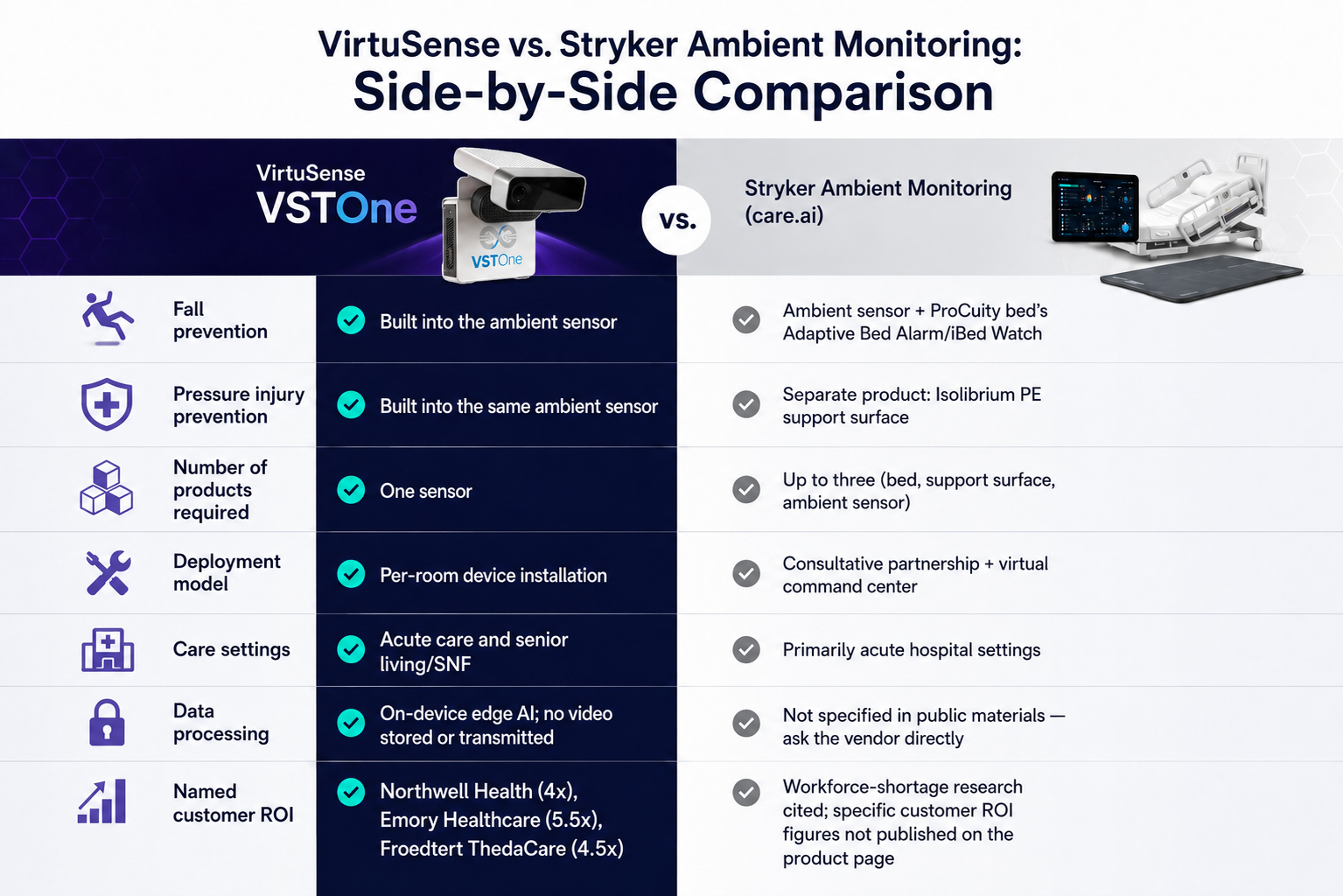
Not from a single sensor. Stryker splits fall prevention and pressure injury prevention across three separate product lines rather than one ambient sensor.
According to Stryker's published product pages:
- Fall prevention runs primarily through the ProCuity bed series: its Adaptive Bed Alarm uses load-cell technology to sense patient position and weight and trigger an exit alarm, while a separate feature, iBed Watch, monitors bed configuration (siderails, height, head-of-bed angle) for compliance with safe settings.
- Pressure injury prevention is handled by dedicated support surfaces — Stryker's Isolibrium PE, which integrates specifically with its ICU-focused ProCuity ZMX bed, and its more broadly compatible IsoAir surface — separate hardware purchases from the bed and the ambient sensor.
- Ambient Monitoring (the care.ai-derived sensor) is a third, separate product focused more broadly on workflow use cases: patient movement and fall/agitation monitoring, bed-alarm and turning-protocol compliance alerts, bed occupancy tracking, and voice-driven workflows like rounding and staff duress alerts. Its own product page frames pressure-injury-adjacent work as monitoring adherence to a turning schedule, not detecting pressure injury risk directly.
VirtuSense's VSTOne takes a different approach: one ambient sensor per room detects both fall risk and pressure injury risk directly, without requiring a specific bed model or a separate support surface.
How Do the Deployment Models Differ?
Stryker positions Ambient Monitoring as a "consultative partnership" built around custom workflows and a virtual command center model. VirtuSense's VSTOne is designed as a single-device installation per room.
Stryker's own product materials list "Consultative Partnership" and "Virtual Command Center" as core product highlights alongside the ambient sensors themselves. In public interviews, Stryker executives have described the command-center model concretely: remote nurses can monitor, assess, and support up to 10 patients at once using real-time data from the ambient sensors. That's a meaningfully different operating model from a sensor that alerts the bedside team directly. VSTOne, by contrast, is built to be installed room by room and routes alerts to the existing nursing workflow, without requiring a hospital to staff a new virtual command center.
Neither approach is wrong — a health system already investing in a broader smart-hospital transformation may want the consultative model. A hospital or senior living operator solving specifically for falls and pressure injuries may prefer a more contained deployment.
What About Data Privacy and On-Device Processing?
VirtuSense's VSTOne processes video entirely on-device using edge AI — no video is stored or transmitted off the sensor. In the Stryker and care.ai materials reviewed for this post (Stryker's product page and a recent executive interview), we didn't find a public statement specifying whether Ambient Monitoring's video is processed on-device or transmitted elsewhere — that doesn't mean no such disclosure exists, only that it wasn't part of the public-facing materials we checked.
Stryker states its sensors "continuously monitor activity to autonomously detect presence, motion and behavior without intruding on patient privacy," which is a meaningful design commitment. But since remote nurses in Stryker's virtual command center model do view real-time data from the ambient sensors to support patients, hospitals should ask directly what that data includes — is it live video, derived alerts, or something else — and where it's processed and stored. VirtuSense encourages the same direct question be asked of any ambient monitoring vendor, including itself.
How VirtuSense's VSTOne Compares in Practice
Northwell Health has reported a 4x ROI using VSTOne, and Emory Healthcare — a 5.5x ROI customer — hosted a VSTOne breakout session at the 2026 AONL conference. Both results come from a single-sensor deployment covering fall and pressure injury risk together, without a separate bed or support-surface purchase.
For a hospital comparing the two platforms, the practical question isn't which company is bigger — Stryker's global scale is real — it's how many separate purchases and integration steps it takes to get the same fall-and-pressure-injury coverage, and whether that coverage needs to extend into senior living and post-acute settings where Stryker's bed-centric approach is less commonly deployed.
Frequently Asked Questions
Q: What is Stryker's Ambient Monitoring product? A: Stryker's Ambient Monitoring is an AI-driven ambient sensing product built on technology from its 2024 acquisition of care.ai. It's sold through Stryker's Smart Care business unit as part of the broader SmartHospital platform and focuses on use cases like patient movement monitoring, bed-alarm and turning-protocol compliance, and workflow automation such as rounding and staff duress alerts.
Q: Does Stryker's ambient monitoring cover pressure injury prevention? A: Stryker's Ambient Monitoring sensor supports monitoring compliance with turning protocols, but dedicated pressure injury prevention is handled by separate support-surface products — Isolibrium PE (paired with its ICU-focused ProCuity ZMX bed) or the more broadly compatible IsoAir surface. VirtuSense's VSTOne, by comparison, detects pressure injury risk directly from the same ambient sensor used for fall prevention.
Q: What's the difference between VirtuSense VSTOne and Stryker's care.ai Ambient Monitoring? A: VSTOne is a single ambient sensor that detects both fall and pressure injury risk and processes video on-device. Stryker's Ambient Monitoring is one part of a broader multi-product approach — bed, support surface, and sensor sold separately — with a deployment model that can include a virtual command center staffed by remote nurses.
Q: Is ambient monitoring the same across all Stryker products? A: No. Stryker's fall prevention, pressure injury prevention, and ambient sensing capabilities are addressed by separate products: the ProCuity bed series, dedicated support surfaces like Isolibrium PE and IsoAir, and the care.ai-derived Ambient Monitoring sensor — rather than one unified sensor covering all three.
The Bottom Line
Stryker's scale and its multi-product smart-hospital vision are real advantages for health systems already standardizing on Stryker's bed fleet and pursuing a broader workflow transformation. But for a hospital or senior living operator specifically solving fall prevention and pressure injury risk, VirtuSense's VSTOne delivers both from a single ambient sensor, with on-device processing and a deployment model that doesn't require a new virtual command center or a bed-fleet refresh.
See how VSTOne compares for your facility — Request a Demo
For more on how VSTOne stacks up against other approaches, see our comparison of [VirtuSense vs. AvaSure].