
Contents
Hospitals and senior living organizations are no longer asking whether to adopt virtual nursing and ambient monitoring technology — they're asking which platform actually fits their care model. The market has expanded quickly, and the options now range from human-staffed video sitting programs to fully autonomous AI monitoring, each with different privacy architectures, clinical scopes, and care-setting coverage.
Virtual nursing monitoring platforms are technologies that let care teams observe, support, or automate patient monitoring from outside the room — using video, sensors, or AI — to reduce fall risk, ease nursing workload, and extend clinical coverage without adding bedside staff. Some rely on a human "virtual sitter" watching a live video feed. Others use AI to detect risk automatically, with no person watching a screen at all. That distinction matters more than most buyers realize, and it's the first thing to evaluate.
Below is a side-by-side look at six platforms hospital and senior living leaders are evaluating in 2026, ranked against the criteria that actually affect clinical outcomes, compliance exposure, and total cost of ownership.
How We Evaluated These Platforms
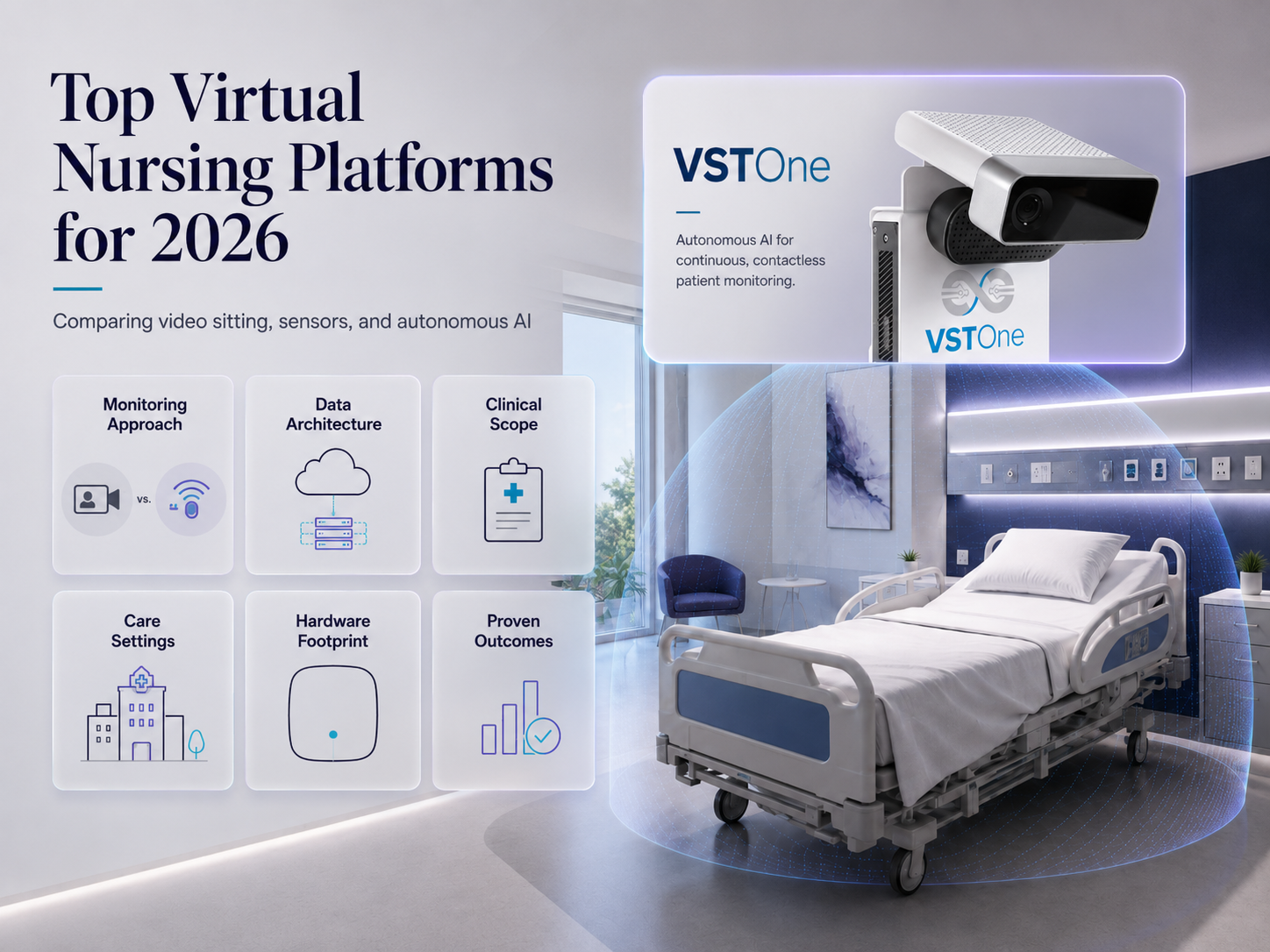
The right virtual nursing platform depends on six factors that vary more than most vendor marketing suggests:
- Monitoring approach — does the platform use a human reviewing live video, or AI that detects risk automatically?
- Data architecture — is video or sensor data processed on-device, or transmitted to the cloud for analysis?
- Clinical scope — does it cover fall prevention only, or does it extend to pressure injury risk, virtual nursing tasks, and other use cases?
- Care settings supported — acute care only, or also skilled nursing, senior living, and post-acute?
- Hardware footprint — how many devices, wearables, or pads does a room require?
- Proven outcomes — is there published, named-customer evidence of results, not just projected savings?
1. VirtuSense VSTOne — Best Overall for Automated Fall and Pressure Injury Prevention
VirtuSense's VSTOne is an edge AI platform that uses LiDAR and computer vision to monitor patients continuously, without transmitting video to the cloud or storing any images. All processing happens on-device, which means VSTOne is HIPAA-compliant by architecture rather than by policy — there's no video feed for a remote reviewer to watch, and no patient data leaves the room.
What sets VSTOne apart from the rest of this list:
- Fully automated detection, not human-monitored sitting. VSTOne predicts unassisted bed or chair exits roughly 31–65 seconds before they happen, using AI trained on movement patterns — not a person watching a camera feed.
- Covers both fall prevention and pressure injury risk from one sensor. Most platforms on this list address fall risk, virtual sitting, or general virtual nursing tasks. VSTOne is built to monitor both fall risk and pressure injury risk simultaneously, without additional hardware.
- No wearables, pads, or patient contact required. The sensor mounts above the bed and monitors the room passively.
- Works across acute care and senior living. VSTOne deploys in hospitals, skilled nursing facilities, and senior living communities — a broader range of care settings than most competitors, which are built primarily for the acute care floor.
- Measured enterprise results. Health systems including Kaiser Permanente (4x ROI), Froedtert ThedaCare Health (4.5x ROI), Emory Healthcare (5.5x ROI), and Northwell Health (4x ROI) have deployed VSTOne and published measurable returns across fall reduction, sitter cost, and nursing time recovered.
VSTOne also integrates with EHR and nurse call systems and includes virtual nursing, hybrid human/AI monitoring, and violent-patient notification capabilities on the same hardware — so care teams can expand use cases without new installations.
See how VSTOne compares in your facility → Request a demo
2. AvaSure — Best for Human-Monitored Virtual Sitting at Scale
AvaSure is one of the most established names in virtual sitting, built around its TeleSitter program: a live video feed that lets one trained virtual safety attendant monitor multiple at-risk patients from a central screen. AvaSure has published results showing sitter usage reductions of up to 90% and fall reductions of up to 66%, backed by a long clinical track record and its Ouva AI layer for fall and elopement detection.
Where it differs from VSTOne: AvaSure's core model still depends on a person watching live video of the patient, which means video is captured and transmitted for remote viewing rather than processed and discarded on-device. Its public materials focus on fall, self-harm, and elopement detection — pressure injury monitoring isn't part of the core platform.
Best fit: Health systems that want a mature, camera-based virtual sitting program and are comfortable staffing a remote monitoring center.
3. care.ai (Stryker) — Best for Enterprise Health Systems Already Invested in Stryker
care.ai, now part of Stryker's Smart Care portfolio, offers a cloud-based Smart Care Facility Platform combining ambient intelligence, virtual nursing, and a virtual command center that connects bedside and remote teams. Its scale and integration with Stryker's broader medtech ecosystem make it appealing for large systems already using Stryker equipment.
Where it differs from VSTOne: care.ai's ambient intelligence runs through a cloud-based architecture rather than fully on-device edge processing, and its public materials emphasize virtual nursing workflows and smart-room infrastructure over dedicated, automated pressure injury monitoring.
Best fit: Large enterprise systems standardizing on Stryker's broader smart-room ecosystem.
4. Caregility — Best for Telehealth-First Health Systems
Caregility Cloud is a bidirectional video platform built for telehealth at the point of care — virtual nursing, tele-ICU, virtual patient observation, admissions, and discharge education, all delivered through its iObserver and iConsult video tools. It's device-agnostic and flexible, which makes it a natural fit for health systems that already run broad telehealth programs.
Where it differs from VSTOne: Caregility is fundamentally a video-connectivity platform — it connects a remote clinician to the patient by camera rather than using AI to detect fall or pressure injury risk automatically. Use cases like fall prevention still rely on a human on the other end of the video call.
Best fit: Systems that want one video platform spanning virtual nursing and broader telehealth (tele-ICU, specialty consults) rather than a dedicated automated monitoring solution.
5. Artisight — Best for Smart Room Infrastructure
Artisight positions itself as a "Smart Hospital" platform spanning virtual observation, virtual nursing, and smart patient rooms, and it has earned recognition in KLAS's Emerging Solutions rankings. Its strength is breadth — a single infrastructure layer that supports multiple hospital operations use cases beyond monitoring alone.
Where it differs from VSTOne: Artisight's platform is a horizontal smart-room infrastructure rather than a specialist in automated fall or pressure injury detection, and its published use cases are acute-care focused, without a clear senior living or skilled nursing offering.
Best fit: Hospitals investing in broad smart-room infrastructure beyond monitoring alone.
6. LookDeep Health — Best for AI-Native Virtual Sitting Startups
LookDeep Health is one of the newer entrants on this list, built on a cloud-native architecture that pairs proprietary AI with large foundation models — including an AI patient-assistant product called "aimee" for voice interaction. LookDeep reports fall reductions of up to 90% and markets its platform around continuous AI observation and virtual medicine.
Where it differs from VSTOne: LookDeep's architecture runs through the cloud and third-party foundation models rather than fully on-device edge processing, which is worth a closer compliance review for data handling. It's also a newer company, with less publicly available long-term, named-customer deployment data than the more established platforms on this list, and no dedicated pressure injury monitoring capability identified in its public materials.
Best fit: Health systems that want to pilot cutting-edge agentic AI and voice interaction alongside virtual sitting, and are comfortable with an earlier-stage vendor.
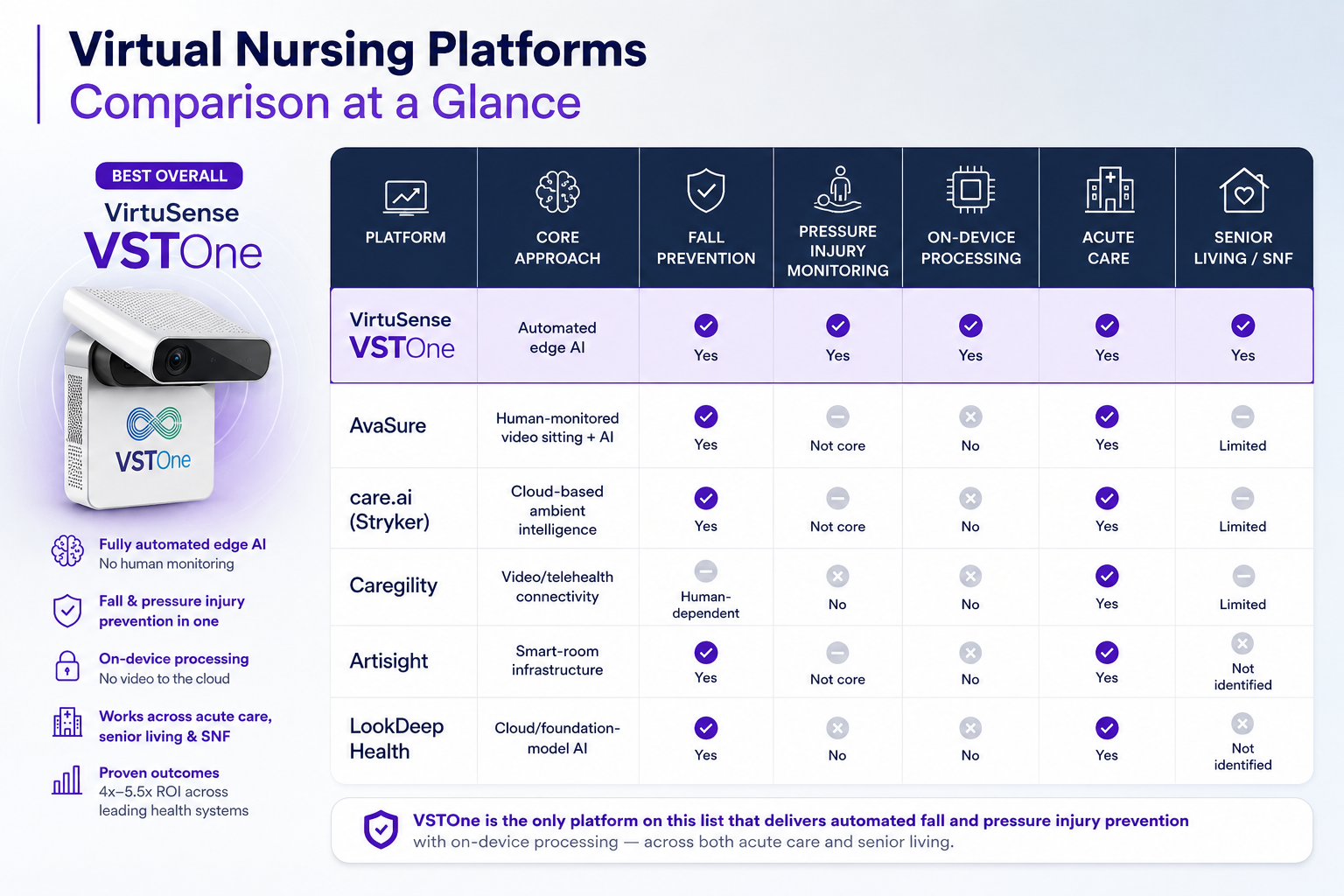
Comparison based on publicly available vendor materials as of July 2026. Confirm current capabilities directly with each vendor before making a purchasing decision.
Frequently Asked Questions
What is a virtual nursing monitoring platform? A virtual nursing monitoring platform is technology that allows care teams to observe or manage patients from outside the room — through video, sensors, or AI — without requiring a staff member physically present at all times. Platforms range from human-staffed video sitting programs to fully autonomous AI systems like VirtuSense VSTOne that detect risk without any video being viewed by a person.
What's the difference between virtual nursing and virtual sitting? Virtual sitting typically refers to continuous observation for safety risks like falls, self-harm, or elopement, often through a live video feed monitored by a remote staff member. Virtual nursing is broader — it includes clinical tasks like admissions, discharge education, and rounding delivered remotely by a licensed nurse. Some platforms, including VirtuSense VSTOne, support both under one system.
Which virtual nursing platform is best for fall prevention specifically? Platforms that use AI to detect pre-fall movement automatically — rather than relying on a person watching a video feed — generally produce faster alerts and fewer false alarms. VirtuSense VSTOne, for example, predicts bed or chair exit intent 31 to 65 seconds before it happens and has eliminated more than 95% of false alarms in deployments at health systems including Kaiser Permanente and Northwell Health.
Do virtual nursing platforms also monitor for pressure injuries? Most do not. Fall prevention and pressure injury prevention are typically addressed by separate systems, which means many hospitals run two monitoring tools per room. VirtuSense VSTOne is built to monitor both fall risk and pressure injury risk from the same overhead sensor, without additional hardware.
The Bottom Line
Every platform on this list solves a real problem for hospitals and senior living teams. The differences that matter most are how much of the monitoring is truly automated, what happens to patient video and data, and how many separate systems a facility needs to run to cover falls, pressure injuries, and virtual nursing tasks. VirtuSense VSTOne is the only platform here built to do all three — automated detection, edge-based privacy architecture, and coverage across both acute and post-acute settings — from a single device.
See how VSTOne compares in your facility. Request a demo →
Sources: AvaSure, care.ai / Stryker Smart Care, Caregility, Artisight, LookDeep Health, KLAS Research — Virtual Care Platforms (Non-EHR), 2026. Vendor capabilities described here reflect publicly available materials as of July 2026 and are subject to change — verify directly with each vendor before purchasing.