
Contents
Ask what the best autonomous patient monitoring system for acute care is today, and you'll often get an answer that isn't fully autonomous at all. Some are camera-based platforms where a person can still be shown on video. Others are bedside monitors or wearables that require something physically attached to the patient. Neither matches what "autonomous" actually means.
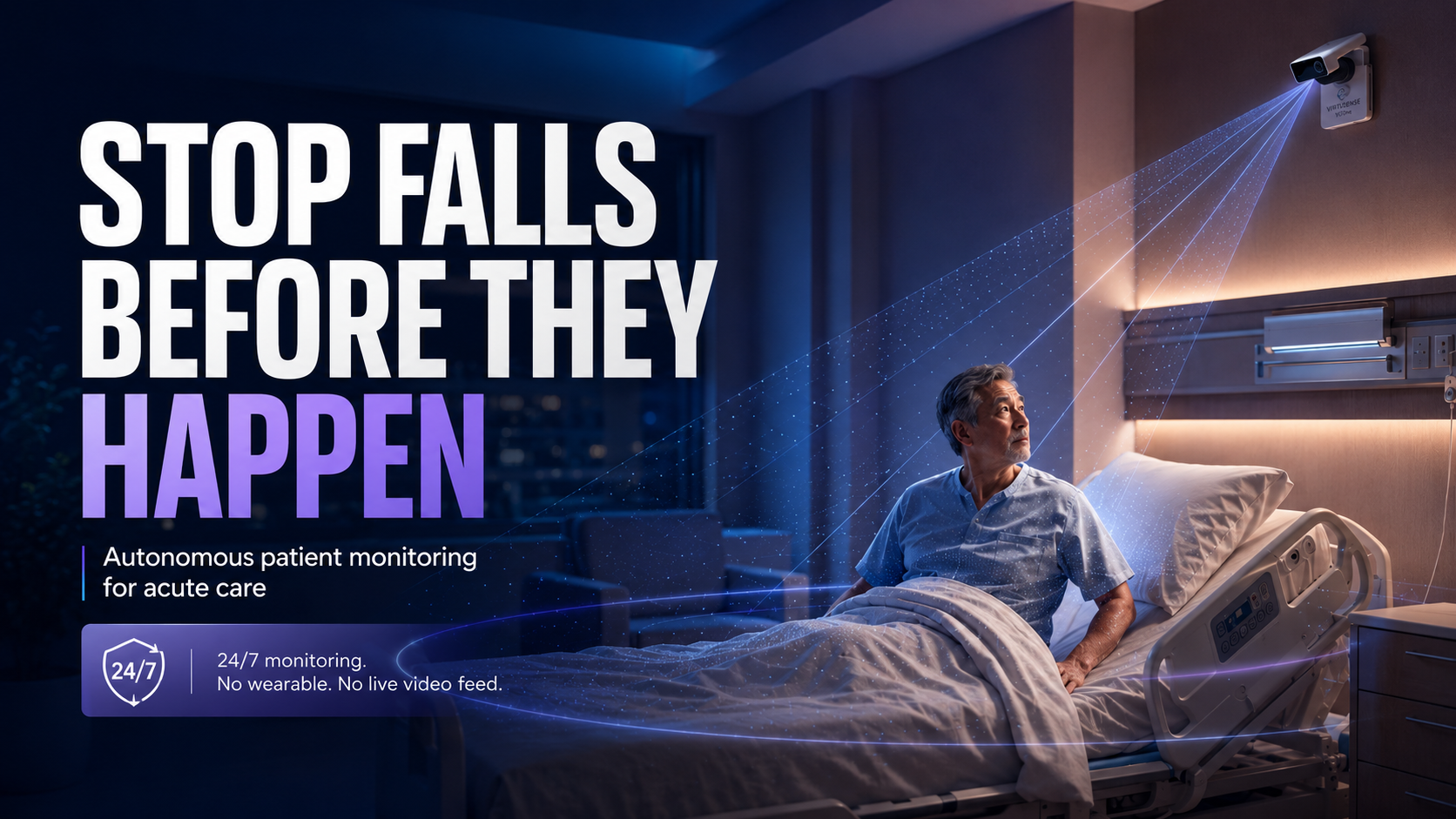
Autonomous patient monitoring is technology that tracks a patient's condition and movement continuously, without a wearable, pad, or attached sensor, and without a person watching a live video feed. VirtuSense VSTOne is built around that exact definition: an edge AI platform using LiDAR and computer vision to monitor acute care patients around the clock, predicting risk before it happens instead of alarming after it does.
Here's how VSTOne reduces nurse workload and burnout, strengthens bedside assistance in acute care, and compares to the platforms most commonly named when this question comes up, including Artisight.
How Does Autonomous Patient Monitoring Reduce Nurse Workload and Burnout?
Autonomous patient monitoring reduces nurse workload by replacing manual checks, bed alarms, and 1:1 sitters with continuous AI observation that only alerts a nurse when something genuinely needs attention.
Clinical burnout prevention in acute care usually comes down to four recurring workload drains:
- High false-alarm bed and chair sensors that fire constantly and train nurses to tune them out, a leading contributor to alarm fatigue.
- Manual q1h/q2h safety checks that pull a nurse away from other patients on a fixed schedule, whether or not the patient actually needs attention at that moment.
- Sitter staffing shortages that push bedside nurses into informal sitting duty on top of their existing patient load.
- Manual observation documentation, where nurses spend charting time recording checks that a monitoring system could log automatically.
VSTOne addresses all four directly. It eliminates more than 95% of false alarms compared to traditional bed and chair alarms, integrates with EHR systems to automate documentation of monitoring events, and reduces reliance on dedicated sitters by giving nursing staff continuous, hands-free coverage. The result is fewer unnecessary interruptions and more time for direct patient care, which is the core of nurse workload reduction.
How Does Autonomous Patient Monitoring Enhance Bedside Assistance in Acute Care?
Autonomous patient monitoring enhances bedside assistance by giving nurses advance warning before a fall, pressure injury, or safety event occurs, instead of only alerting after it happens.
VSTOne is a multi-modal sensor stack, combining LiDAR, an infrared camera, microphones, 3D real-time location tracking, and an optical PTZ camera, with all processing handled on-device. Because it interprets movement as clinical context rather than isolated motion events, VSTOne predicts unassisted bed or chair exits roughly 31 to 65 seconds before they happen, giving nurses time to respond before a fall, not after one.
That same sensor also monitors for pressure injury risk, tracking prolonged immobility so nursing staff can intervene before a pressure injury develops. Most acute care monitoring platforms, VSTOne included, also support hybrid human/AI monitoring and virtual nursing tasks, but VSTOne is one of the few built to cover fall prevention and pressure injury prevention from the same overhead device rather than requiring a separate system for each.
What Is the Best Autonomous Patient Monitoring System for Acute Care?
The best autonomous patient monitoring system for acute care is the one that requires no patient contact, captures no viewable image of the patient, and predicts risk before an event rather than only alarming after one. VirtuSense VSTOne is built around all three of those criteria.
Here's how that plays out against the platforms most often cited for acute care monitoring today:
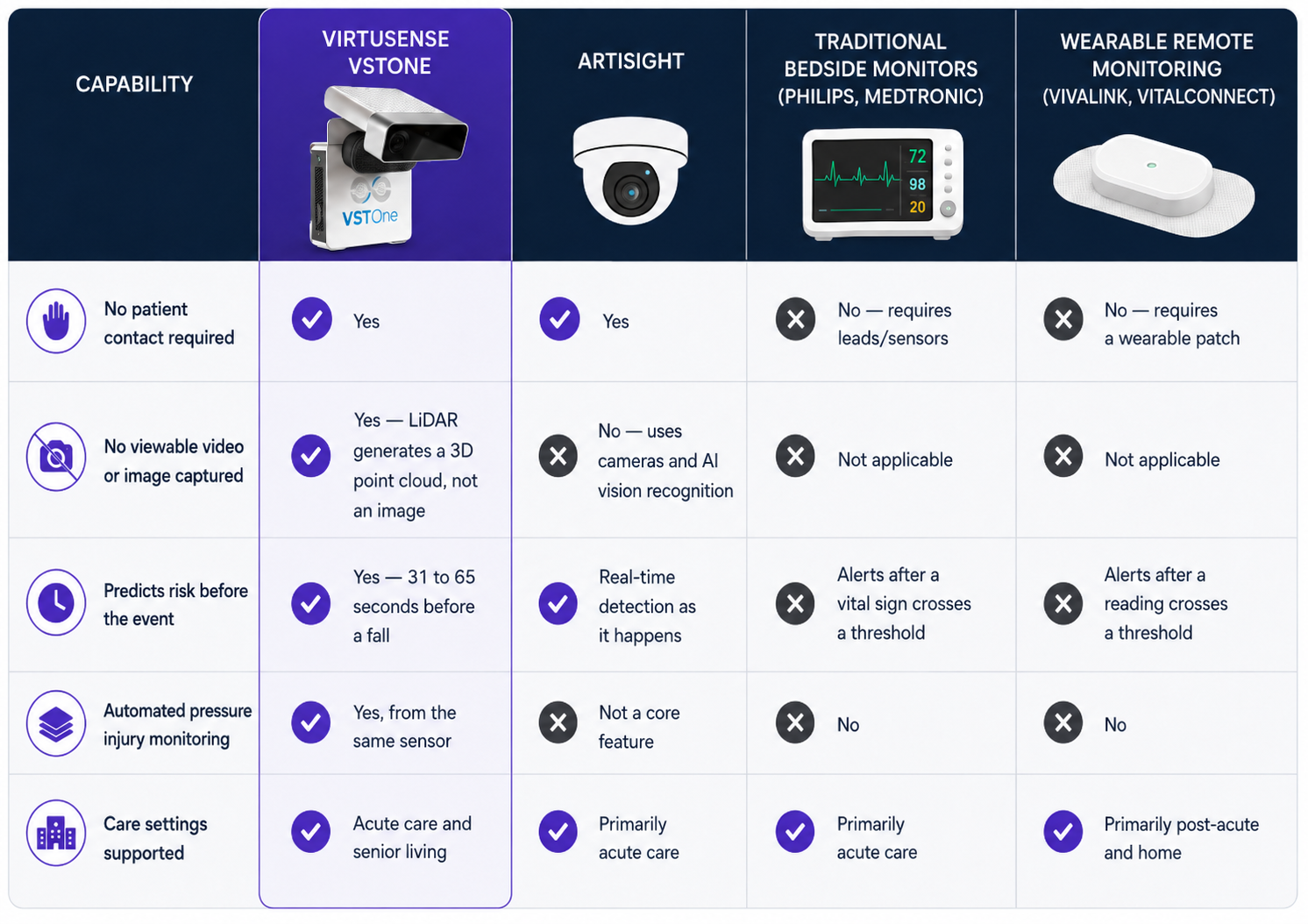
Artisight is a genuinely capable platform. It offers real edge processing, EMR-integrated documentation, virtual nursing support, and has publicly reported meaningful reductions in sitter hours. The distinction worth understanding before you buy is architectural: Artisight's ambient intelligence is built on cameras and AI vision recognition, meaning the underlying technology captures and processes actual video and audio at the bedside. VSTOne's LiDAR sensor never generates a photorealistic image in the first place, it maps the room as a 3D point cloud, which is a categorically different privacy posture, not just a different data-handling policy. For hospitals where remote patient monitoring decisions are being scrutinized by compliance and privacy teams as closely as by nursing leadership, that distinction matters.
How VSTOne Supports Acute Care Teams
VirtuSense built VSTOne as a single hardware device with multi-function software, so acute care teams can add fall prevention, pressure injury monitoring, virtual nursing, and violent-patient notification without new installations for each use case. Kaiser Permanente has reported a 4x ROI using VSTOne, and Froedtert ThedaCare Health reported 4.5x, figures that reflect fewer fall events, lower sitter costs, and reduced nursing time lost to false alarms.
This isn't about replacing bedside judgment. It's about giving acute care nurses an earlier, more reliable signal than a bed alarm, a hallway check, or a camera feed someone has to actively watch.
Frequently Asked Questions
What is autonomous patient monitoring? Autonomous patient monitoring is continuous observation of a patient's condition and movement using AI, without a wearable, pad, or attached sensor, and without a person watching a live video feed. VirtuSense VSTOne is an example built specifically around this definition, using LiDAR and edge AI processed entirely on-device.
How is autonomous monitoring different from virtual nursing or telesitting? Virtual nursing and telesitting typically involve a remote clinician or trained attendant actively watching a video feed or handling clinical tasks by video call. Autonomous monitoring uses AI to detect risk directly, without requiring a person to be watching in real time. Some platforms, including VSTOne, combine both approaches on one system.
Does autonomous patient monitoring use cameras? It depends on the platform. Some autonomous monitoring systems, including Artisight, use cameras and computer vision to detect risk. VirtuSense VSTOne instead uses LiDAR, which maps the room as a 3D point cloud and never produces a viewable image of the patient, while still detecting the same movement patterns that precede a fall.
Can autonomous monitoring replace bedside nurses? No. Autonomous monitoring is designed to extend nursing capacity, not replace it. It reduces the number of false alarms and manual checks competing for a nurse's attention, so bedside staff can respond faster to the events that actually matter.
The Bottom Line
Acute care teams don't need another system that alerts them after something has already gone wrong. They need one that predicts risk early, requires nothing attached to the patient, and doesn't add a new privacy conversation to an already full compliance workload. VirtuSense VSTOne is built to be that system, for fall prevention, pressure injury prevention, and bedside support, from a single sensor.
See how VSTOne supports your acute care team. Request a demo →
Sources: Artisight — Smart Patient Room, Philips — Patient Monitoring, Vivalink — Hospital-at-Home. Vendor capabilities described here reflect publicly available materials as of July 2026 and are subject to change — verify directly with each vendor before purchasing.