
Contents
This week, thousands of Epic users are gathering in Verona, Wisconsin for Epic's Users Group Meeting — and documentation burden is, as usual, one of the most discussed problems in the room. It's not hard to see why. Nurses spend an average of about 40% of a shift on documentation, according to the U.S. Surgeon General's Advisory, as cited by the American Association of Critical-Care Nurses, and a recent KLAS Research report found that 79% of acute care nurses report losing time to unproductive charting, with 34% spending three or more hours a week on it.
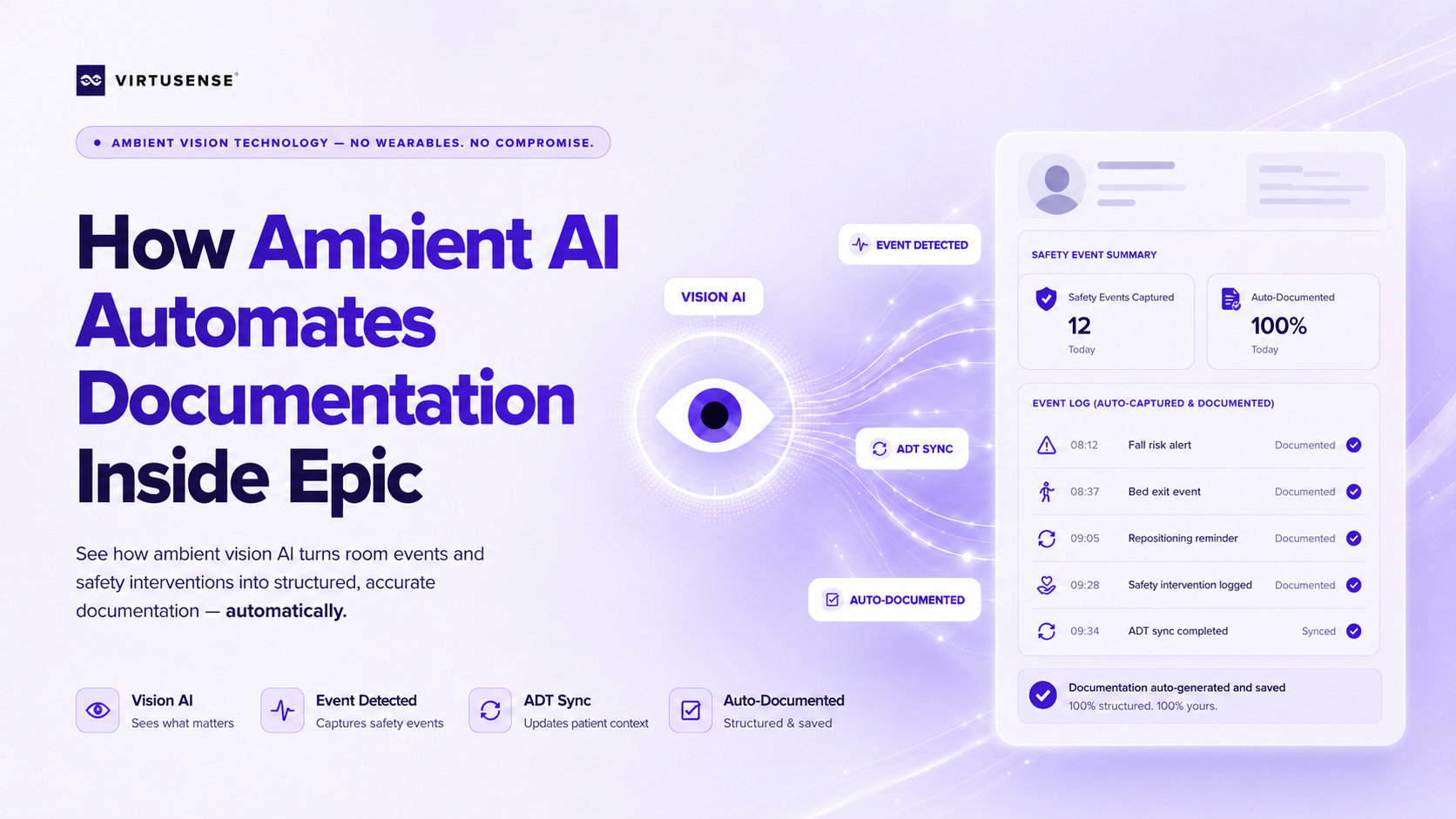
Automated EHR documentation is one concrete way to claw some of that time back — but the term gets used loosely. In the context of ambient vision AI, automated documentation means that a physical safety event detected in a patient's room, like a fall risk alert or a repositioning reminder, is logged into the patient's chart automatically, without a nurse stopping to type it in. That's different from "ambient documentation AI," a separate and increasingly well-known category of tool that listens to a clinician-patient conversation and drafts a visit note.
This post covers what automated EHR documentation actually means for ambient vision AI platforms, how that integration works technically, and what it's worth asking about if you're evaluating vendors this week. VirtuSense, an Epic Workshop Partner, is one vendor building toward this with its VSTOne platform — more on that below.
What Does "Automated EHR Documentation" Mean for Ambient Vision AI?
Automated EHR documentation means a monitoring system writes its own detected events directly into the patient record, closing the gap between a physical event and the chart without manual nurse entry. For ambient vision AI specifically, those events are things like a bed-exit alert, a fall risk flag, or a position-change reminder tied to pressure injury prevention.
It's worth being precise here because "ambient AI" has become a crowded term. Ambient documentation AI (the clinical scribe category) is audio-in, text-out: it transcribes a visit and drafts a note for a clinician to review and sign. Ambient vision AI is visual-in, alert-out: a sensor observes movement and posture in a room and generates a structured alert — not a transcript — when it detects risk. The two solve different problems and are typically evaluated by different teams inside a hospital: documentation AI usually runs through clinical informatics and physician workflow groups, while vision AI for patient safety usually runs through nursing leadership and patient safety officers.
How Does Automated Epic Documentation Actually Work?
It works through structured, bi-directional data exchange between the monitoring platform and Epic — not a screenshot or a manual export. Ambient vision AI platforms built for real EHR integration typically rely on:
- HL7 and FHIR-compliant data exchange to connect with Epic without requiring custom, one-off interfaces.
- Bi-directional ADT (Admission, Discharge, Transfer) feeds, so monitoring automatically activates when a patient is admitted to a room and deactivates on discharge or transfer — no manual setup per patient.
- Automated event logging, where a detected fall risk event or position-change alert is written into the patient's record as it happens, not reconstructed from memory at the end of a shift.
- Nurse call system routing, so alerts reach staff through infrastructure they already use instead of a separate app.
- No second login requirement — clinical staff work inside Epic and existing nurse call workflows rather than a standalone monitoring dashboard.
That last point is the one worth testing when you're comparing vendors. A platform that still requires a nurse to log into a separate system to see or acknowledge an alert isn't fully integrated — it's connected in name only.
Why Automated Documentation Matters Beyond Convenience
Automated documentation matters because the gap between a detected safety event and its record in the chart is where both risk and liability live. If a fall-risk alert isn't automatically documented, a hospital is relying on a nurse to reconstruct the timeline later — which is exactly the kind of gap that contributes to the broader nursing documentation burden already cited above (roughly 40% of a shift, per the Surgeon General's Advisory cited above).
Beyond time savings, automated documentation supports two things hospitals can't get from manual charting alone:
- Compliance and audit trails. Joint Commission and CMS reporting requirements around falls and pressure injuries depend on consistent, timestamped documentation — which is easier to produce when the system generates it than when it depends on end-of-shift recall.
- Consistency at scale. Pressure injury prevention specifically requires regular position-change documentation, which is difficult to sustain manually across a full unit but straightforward for a system that's already tracking patient position continuously.
What to Ask Vendors About Epic Integration This Week
If documentation burden and interoperability are on the agenda in your UGM conversations, a short evaluation checklist travels well:
- What data standards does the platform use? HL7 v2 or FHIR support is a good sign; proprietary formats mean more custom integration work and higher long-term maintenance cost.
- Does it require a second staff-facing app? If nurses still have to log into a separate system to see alerts, the "integration" is incomplete.
- How are ADT events handled? A platform that doesn't automatically respond to admissions, discharges, and transfers creates manual configuration work and monitoring gaps.
- Does the vendor have a clinical informatics team? Technical connectivity isn't enough — someone needs to map the data to your actual nursing workflows during implementation.
How VirtuSense's VSTOne Approaches This
VirtuSense is an Epic Workshop Partner. VSTOne's Epic integration spans multiple points of the record: Epic MyChart Bedside TV for in-room virtual visits, Epic ADT data that automatically adjusts a patient's monitoring profile on admission, transfer, or discharge, and HL7- and FHIR-based data exchange feeding into Epic Hyperspace, where clinicians already work. When VSTOne changes a monitoring setting or logs a safety intervention, that change is recorded in Epic automatically — no separate system to reconcile later. All of the underlying video processing happens on the sensor itself, so no footage is transmitted or stored off-device.
VirtuSense reports 98% detection accuracy and 95% fewer false alarms with VSTOne, and most hospitals have their Epic integration live within 2–4 weeks of starting implementation. VirtuSense and Epic continue to expand this integration — behavioral health monitoring and an in-room AI patient assistant connected through Epic MyChart are both in development.
Frequently Asked Questions
Q: Does VSTOne integrate with Epic?
A: Yes. VirtuSense is an Epic Workshop Partner, and VSTOne integrates with Epic MyChart Bedside TV, Epic ADT data, and Epic Hyperspace using HL7- and FHIR-based data exchange, so monitoring events and safety interventions are documented directly in the patient's Epic record.
Q: What does it mean that VirtuSense is an Epic Workshop Partner?
A: It means VirtuSense has built and validated a direct integration between VSTOne and Epic, spanning MyChart Bedside TV, ADT-driven patient profiles, and Epic Hyperspace. It reflects a working technical relationship, not just a stated compatibility claim.
Q: What's the difference between ambient vision AI and ambient documentation AI (clinical scribes)?
A: Ambient documentation AI listens to a clinician-patient conversation and drafts a visit note. Ambient vision AI, like VSTOne, uses on-device computer vision and depth sensing to detect physical safety events such as falls and pressure injury risk. They address different problems and are typically evaluated by different teams.
Q: Does automated EHR documentation replace nurse charting entirely?
A: No. It automates documentation of specific monitoring events — fall risk alerts, repositioning reminders — not full clinical assessments or notes. Nurses still document clinical judgment; automated documentation removes one repetitive, time-sensitive task from that workload.
Q: Is this kind of integration HIPAA-compliant?
A: Edge-processed ambient vision AI, where video is analyzed on-device and never transmitted or stored off the sensor, reduces HIPAA exposure risk significantly. Hospitals evaluating any "ambient AI" vendor should confirm the specific data-handling architecture directly, since not all products process video the same way.
The Bottom Line
Documentation burden isn't going away, and it's a fair bet it comes up in more than one hallway conversation at UGM this week. Automated EHR documentation through ambient vision AI won't solve charting burden on its own, but it removes one concrete, recurring task — logging physical safety events — from nurses already stretched thin, while giving hospitals a more reliable audit trail for fall and pressure injury compliance reporting.
See how VSTOne's Epic integration works — request a demo or learn more about VSTOne.
Epic is a registered trademark of Epic Systems Corporation.