
Contents
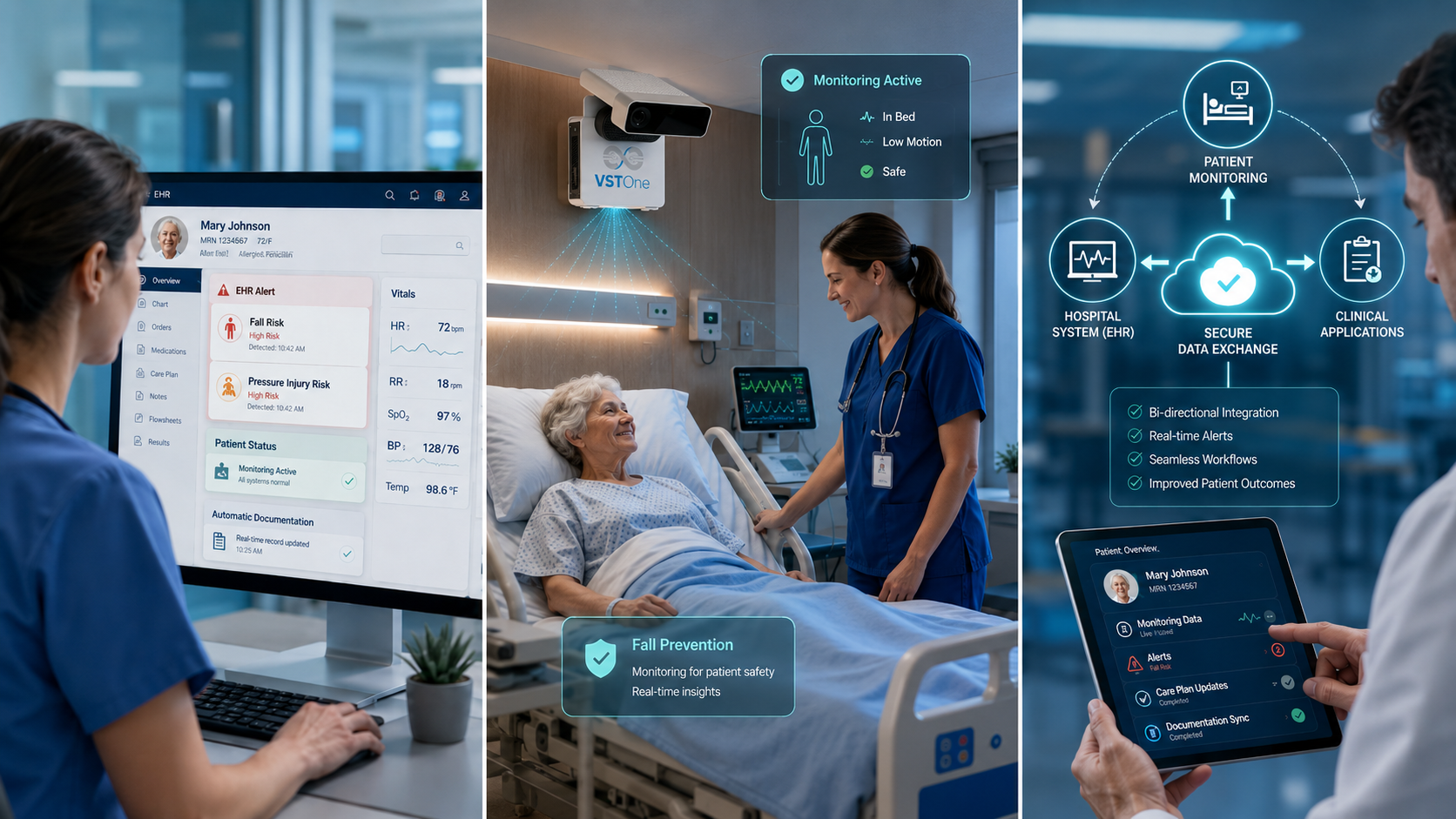
VSTOne integrates directly with hospital EHR systems to deliver real-time patient monitoring data — including fall risk assessments and pressure injury alerts — into the clinical workflows nurses and physicians already use. Rather than creating a separate monitoring silo, VSTOne surfaces actionable data inside platforms like Epic, Oracle Health, and Cerner, closing the gap between ambient AI detection and bedside clinical response.
What Is EHR Integration in Patient Monitoring?
EHR integration in patient monitoring means that data captured by a monitoring system — such as movement patterns, fall risk scores, or position change alerts — is automatically transmitted into a patient's electronic health record. Instead of requiring staff to check a separate dashboard, clinicians receive alerts and documentation updates within their existing EHR workflow.
For hospital systems evaluating patient monitoring platforms, true EHR integration means:
- Alerts appear inside the EHR, not in a standalone app
- Events are automatically documented, reducing manual charting
- Data is tied to the patient record, supporting compliance and audit trails
- Clinical response times decrease because notifications reach staff where they already work
How VSTOne Integrates with Hospital EHR Systems
VSTOne uses HL7 and FHIR-compliant data exchange to connect with major EHR platforms used across acute care hospitals and health systems. The integration is designed to require minimal IT configuration and align with existing clinical informatics workflows.
Key integration capabilities include:
- Bi-directional data flow — VSTOne sends fall risk events, position change alerts, and monitoring status into the EHR; ADT (Admission, Discharge, Transfer) feeds from the EHR automatically activate or deactivate monitoring for each patient
- Epic and Oracle Health compatibility — VSTOne is built to connect with the EHR platforms most commonly deployed across U.S. acute care hospitals
- Automated documentation — When VSTOne detects a patient movement event or triggers an alert, the event is logged in the patient record without requiring manual nurse entry
- Nurse call system integration — Alerts from VSTOne can route through existing nurse call infrastructure, reducing alarm fatigue and directing notifications to the right care team member
- No new logins required — Clinical staff receive and act on VSTOne data inside the EHR or nurse call systems they already use, reducing friction and training burden
Why EHR Integration Matters for Fall Prevention and Pressure Injury Monitoring
Without EHR integration, patient monitoring platforms create parallel documentation streams. Nurses must reconcile events from a separate system with the patient's official record, increasing documentation time and the risk of missed events.
VSTOne's integration closes this loop. When the system detects a high-fall-risk patient attempting to get out of bed, the alert reaches the nurse through the EHR or nurse call system — and the event is automatically documented. This matters because:
- Falls often occur in the gap between detection and response
- Documentation of monitoring activity supports Joint Commission and CMS compliance requirements
- Pressure injury prevention requires consistent position change documentation that is hard to sustain manually at scale
Across VSTOne deployments, health systems have documented an 83% reduction in falls with injury and a 60%+ reduction in hospital-acquired pressure injuries — outcomes that depend on the monitoring data reaching the right clinician, fast.
Which Electronic Health Record Systems Does VSTOne Support?
VSTOne is designed to integrate with the major EHR platforms in use across U.S. acute care hospitals and skilled nursing facilities, including:
- Epic — the most widely deployed EHR in U.S. hospitals
- Oracle Health (Cerner) — used across large health systems and VA facilities
- PointClickCare — the leading EHR platform for skilled nursing and post-acute care
Integration configurations are handled during deployment and supported by VirtuSense's clinical informatics team, which works directly with hospital IT and nursing informatics leadership to map VSTOne data to existing workflows.
How VSTOne Compares to Other Patient Monitoring Platforms on EHR Integration
Most remote patient monitoring platforms are built for outpatient or RPM use cases and bolt on EHR connectivity after the fact. VSTOne is purpose-built for acute care and post-acute environments where EHR integration is a clinical requirement, not a feature request.
What sets VSTOne apart:
- Ambient, passive monitoring — VSTOne uses LiDAR-based vision AI that monitors continuously without wearables or manual check-ins, so there is no gap in monitoring when a patient removes a device
- Edge AI processing — Data is processed on-device, not in the cloud, which supports hospital data governance requirements and reduces latency for real-time alerts
- Fall prevention + pressure injury in one platform — Most monitoring platforms address one use case; VSTOne addresses both, reducing the number of EHR integrations a hospital IT team must maintain
- Proven ROI across major health systems — documented outcomes include a 4× ROI at a large integrated health plan, 4.5× ROI at a regional health system, 5.5× ROI at an academic medical center, and 4× ROI at a large multi-hospital network
What Should Hospital IT Teams Know Before Implementing a Patient Monitoring EHR Integration?
Healthcare interoperability projects require coordination between clinical informatics, nursing leadership, and IT security. Before evaluating patient monitoring platforms for EHR integration, hospital teams should assess:
1. What data standards does the platform use?
Look for HL7 v2, HL7 FHIR, or direct ADT feed support. Proprietary data formats increase integration complexity and long-term maintenance burden.
2. Does the platform require a separate staff-facing application?
Integrations that still require nurses to log into a second system provide limited workflow benefit. True integration routes alerts and documentation through existing EHR or nurse call infrastructure.
3. How are ADT events handled?
A monitoring platform that doesn't automatically respond to patient admissions, transfers, and discharges creates manual configuration work for nursing staff and increases the risk of monitoring gaps.
4. What is the implementation timeline?
VSTOne deployments include a dedicated clinical informatics implementation phase. Integration with Epic or Oracle Health typically completes within the broader deployment timeline.
5. Does the vendor have a clinical informatics team?
Technical integration is necessary but not sufficient. The vendor should provide clinical workflow mapping support to ensure the monitoring data reaches the right people in the right format.
Frequently Asked Questions
Does VSTOne work with Epic?
Yes. VSTOne integrates with Epic using HL7-compliant data exchange, enabling automatic documentation of monitoring events and bi-directional ADT feed connectivity.
Can VSTOne send alerts directly to nurses inside the EHR?
VSTOne alerts can route through existing nurse call systems and EHR notification workflows, so nurses receive fall risk and position change alerts in the systems they already use.
Does VSTOne require a separate login for nursing staff?
No. VSTOne is designed to surface alerts and documentation within existing EHR and nurse call workflows. Nursing staff do not need to log into a separate monitoring platform during routine care.
What is the difference between EHR integration and nurse call integration?
EHR integration connects monitoring data to the patient's official medical record for documentation and compliance purposes. Nurse call integration routes real-time alerts to the nursing staff responsible for that patient. VSTOne supports both.
Is VSTOne compliant with HIPAA and hospital data governance requirements?
Yes. VSTOne uses edge AI processing, which means patient monitoring data is processed on-device rather than transmitted to the cloud. This architecture supports hospital data governance and security requirements.
See VSTOne EHR Integration in Action
VirtuSense works with hospital systems and health systems to configure VSTOne for their specific EHR environment. To learn how VSTOne integrates with your existing clinical systems, schedule a demo.
VirtuSense Technologies develops ambient AI monitoring solutions for acute care hospitals, skilled nursing facilities, and senior living environments. VSTOne is a vision AI platform using LiDAR technology for fall prevention and pressure injury monitoring.