
Contents
A single patient fall with injury costs a hospital between $30,000 and $50,000. Multiply that by a facility's annual fall rate — the national average is roughly 3–5 falls per 1,000 patient days — and the financial exposure adds up fast. Now layer in CMS penalty risk: hospitals in the bottom quartile of the HAC Reduction Program lose 1% of all Medicare payments annually.
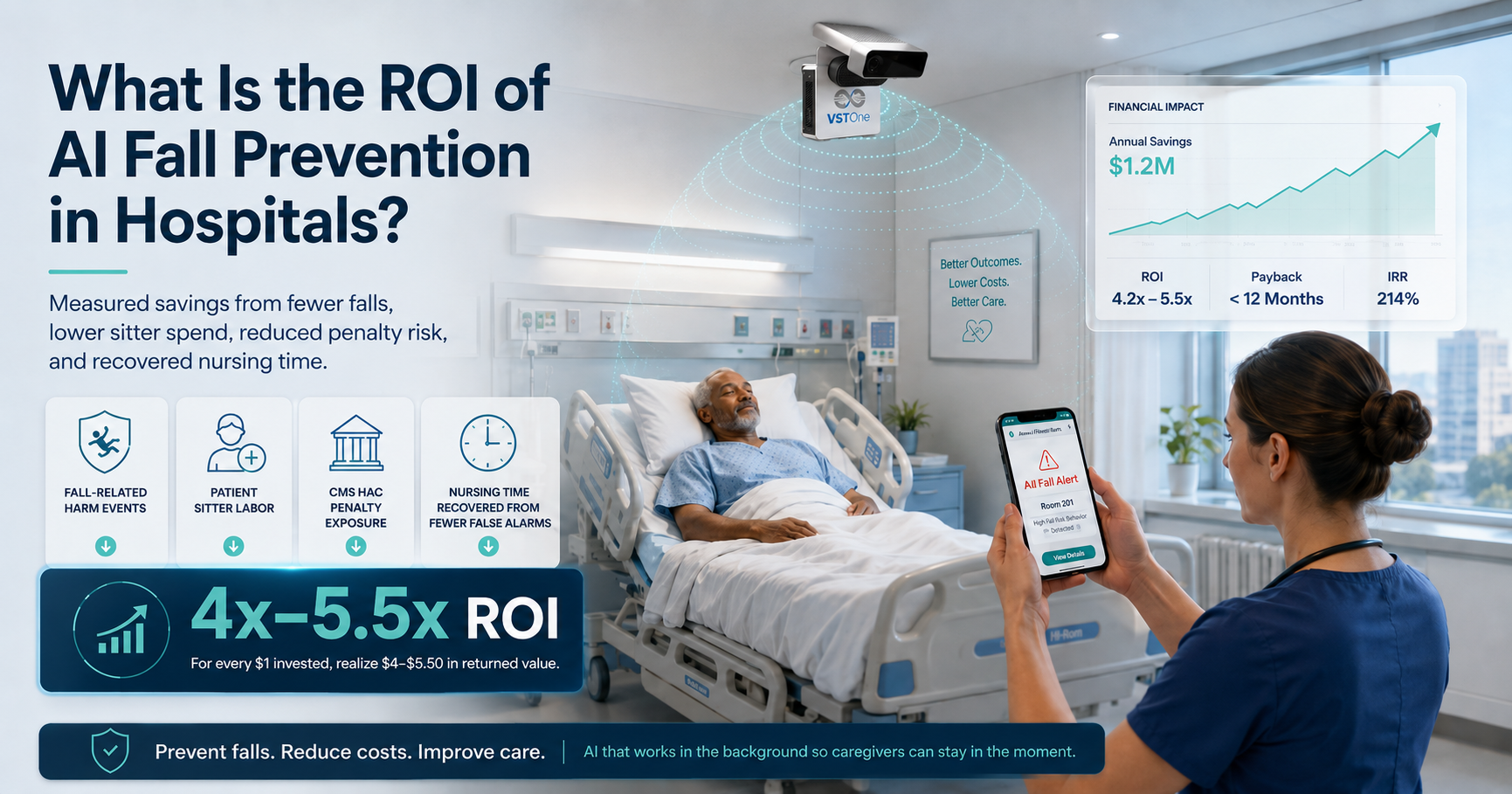
The ROI of AI fall prevention is the difference between what a health system was spending on falls, sitters, and penalties before deployment — and what it spends after. For health systems running ambient AI monitoring, that difference has been consistently measured in the 4x–5.5x range.
What is the ROI of AI fall prevention? The ROI of AI fall prevention is calculated by comparing the total cost of ambient AI deployment against measurable reductions in four cost categories: fall-related harm events, 1:1 patient sitter labor, CMS HAC penalty exposure, and nursing time lost to false alarms. Enterprise health systems deploying VirtuSense VSTOne have measured ROI between 4x and 5.5x over 12–24 months of deployment.
Here is how the math works — and what health systems are actually seeing.
The Four Cost Buckets That Drive Fall Prevention ROI
The ROI calculation for fall prevention AI is straightforward once you break it into four measurable categories. Each one represents real dollars already leaving your budget.
1. Fall-related harm events Track your fall rate (falls per 1,000 patient days) before and after deployment. Multiply the reduction by your average cost per fall event — typically $30,000–$50,000 for injuries, and significantly more for high-harm events like hip fractures. This is the most direct line item.
2. Patient sitter labor A 1:1 patient sitter costs a hospital $50,000–$75,000 per year in fully-loaded labor. Many facilities run 10–30 or more sitters at any given time. That is $500,000 to $2.25 million in annual sitter spend — a line item CFOs recognize immediately. Ambient AI replaces continuous human observation with automated monitoring that routes targeted alerts to bedside nurses. When sitter hours drop, the ROI is immediate and measurable.
3. CMS HAC penalty avoidance Hospitals in the bottom performance quartile of the CMS Hospital-Acquired Conditions Reduction Program lose 1% of all Medicare payments. For a mid-sized hospital with $150 million in annual Medicare revenue, that is $1.5 million. If your fall rates are keeping you near or inside that threshold, avoiding the penalty alone can justify the technology investment.
4. Nursing time recovered Every fall alarm that fires unnecessarily pulls a nurse away from other patients. Systems with high false-positive rates quietly erode nursing capacity across a shift. Ambient AI that monitors actual patient behavior — not just thresholds — generates fewer, more relevant alerts. The recovered time is real; quantify it by multiplying false alarm reduction by average response time per nurse per shift.
What Health Systems Are Measuring in Real Deployments
The ROI figures below come from enterprise health systems that have deployed VirtuSense VSTOne — an ambient vision AI platform that monitors patients continuously for both fall risk and pressure injury risk from a single overhead sensor, with no video recording and no cloud transmission.
- Froedtert ThedaCare Health: 4.5x ROI
- Kaiser Permanente: 4x ROI
- Emory Healthcare: 5.5x ROI
- Northwell Health: 4x ROI
These numbers reflect the combined impact across all four cost buckets above. They are not projections — they are measured outcomes from real deployments in acute care hospitals.
The consistency across health systems matters. When four unrelated enterprise organizations measure similar returns, the ROI range is credible enough to use as a baseline for your own business case.
Why Traditional Monitoring Doesn't Produce the Same Returns
Legacy fall prevention approaches — bed alarms, pressure mats, and video-based sitter programs — reduce one cost while maintaining or adding others. Bed alarms generate high false-positive rates, which accelerates alarm fatigue and reduces nurse responsiveness over time. Video-based monitoring still requires staffed remote observation — you are shifting labor costs, not eliminating them.
Ambient AI changes the economics because it removes cost lines that traditional monitoring keeps on the ledger:
- No remote monitoring staff required
- No per-patient wearable or pad consumables
- No cloud storage costs or breach liability exposure
- No separate system for pressure injury monitoring — VSTOne covers both fall prevention and pressure injury risk from a single device
When your technology investment eliminates existing costs rather than just adding capabilities, the ROI arithmetic is cleaner.
How VirtuSense VSTOne Works
VSTOne is an edge AI platform using LiDAR and computer vision. The sensor mounts above the patient bed and processes all data on-device — nothing is transmitted to the cloud and no video is stored. When a patient's movement pattern suggests fall risk or prolonged immobility (a pressure injury precursor), VSTOne sends an alert directly to the nurse's mobile device.
Because all processing happens on the device itself, VSTOne is HIPAA-compliant by architecture — not by policy. There is no third-party data exposure risk.
Frequently Asked Questions
What is a realistic ROI range for AI fall prevention technology? Enterprise health systems deploying ambient AI fall prevention have measured ROI in the 4x–5.5x range over 12–24 months. VirtuSense customers — including Froedtert ThedaCare Health, Kaiser Permanente, Emory Healthcare, and Northwell Health — have all reported returns in this range. The specific ROI for any facility depends on its baseline fall rate, current sitter spend, CMS performance tier, and nursing staffing model.
How do you calculate the ROI of hospital fall prevention AI? Start with four cost buckets: (1) fall-related harm events reduced, multiplied by average cost per event; (2) sitter labor hours eliminated, multiplied by fully-loaded hourly rate; (3) avoided CMS HAC penalties, calculated as a percentage of total Medicare payments; and (4) nursing time recovered through reduced false alarms. Most health systems find that sitter labor reduction alone produces a positive return within the first 12 months.
What does a hospital fall with injury cost? According to AHRQ, the direct cost of a hospital fall with injury averages $30,000 to $50,000 per event. High-harm falls — those resulting in hip fractures or head injuries — can exceed $100,000 when downstream treatment, litigation exposure, and extended length of stay are included. These costs are not reimbursed under the CMS Hospital-Acquired Conditions policy.
Does ambient AI fall prevention require remote monitoring staff? No. Ambient AI platforms like VirtuSense VSTOne route alerts directly to bedside nurses — no remote monitoring operations center is required. This is a key difference from video-based virtual nursing platforms, which shift labor costs rather than eliminate them. VSTOne monitors patients continuously and only surfaces an alert when clinical thresholds are crossed, keeping nursing interruptions targeted and relevant.
Start with Your Own Numbers
The business case for fall prevention AI is strongest when it reflects your facility's actual cost baseline. VirtuSense works with clinical and finance leaders to build a customized ROI projection before deployment — using your fall rate, sitter spend, and Medicare payment volume.
See the math for your facility. Request a demo →
Sources: CMS Hospital-Acquired Conditions Reduction Program (cms.gov/medicare/quality/hospital-acquired-conditions) | AHRQ Patient Safety — Falls (ahrq.gov/patient-safety/settings/hospital/fall-prevention)