
Contents
On September 23, 2026, Black Book Research released its State of AI in Hospital Nursing report. Among the 202 hospital nurses surveyed, 65% said they feel individually watched or tracked by at least one AI system. Another 63% said AI added new tasks without removing old ones.
That matters well beyond nurse morale. Hospitals build AI monitoring business cases on fewer falls, fewer sitter hours, and less alarm noise. Those savings only appear if nurses trust the system and act on it. Nurse adoption of AI monitoring is the variable most business cases leave out.
Patient-centered ambient monitoring is continuous, sensor-based observation of a patient's room. It detects fall and pressure injury risk and alerts caregivers. It is designed around the patient, not around evaluating staff. When processing happens on the device, no video or patient data leaves the room.
This post covers why nurses are pushing back, which monitoring models earn their trust, and how adoption shapes ROI.
Key Takeaway: Nurse pushback on AI centers on tools that track staff or add work. It is not aimed at tools that help nurses keep patients safe. Black Book found 73% of surveyed nurses say leaders emphasize ROI over nursing impact. Yet ROI depends on nurses actually using the system. Patient-centered, edge-processed monitoring like VirtuSense's VSTOne is built around the patient, which makes adoption, and the ROI that follows, achievable.
Why Are Nurses Pushing Back on AI Monitoring?
Nurses aren't rejecting AI. They're rejecting AI that watches them, adds tasks, or feeds performance reviews without their input.
The Black Book findings point to a specific kind of frustration:
- 51% said AI-derived data was used for coaching or performance review.
- 63% said they weren't clearly told about secondary workforce uses of AI data.
- Only 29% said they could inspect the information attributed to them.
- 49% reported using workarounds to reduce alerts or negative flags.
- About 48% said they were likely to seek roles with less AI-enabled monitoring.
Other research shows the same pattern. Elsevier's Clinician of the Future 2026: Nurses Edition found only 42% of nurses trust AI tools. And 41% said their voices are rarely heard in hospital decisions.
The findings also contain good news. Black Book reports that respondents supported AI that removes existing work, identifies clinically useful risks, and preserves nursing judgment. The report notes its findings are self-reported and don't show AI caused patient harm. Still, the message to leaders is clear: nurses judge AI by who it watches and whether it gives time back.
How Does Nurse Adoption Affect AI Patient Monitoring ROI?
AI patient monitoring ROI comes from changes in behavior on the unit. If nurses silence alerts, keep sitters "just in case," or work around the system, the projected savings never appear.
Nurse adoption shows up in four places in the ROI math:
- Fall-related harm events. Falls drop only when nurses trust alerts enough to act on them quickly.
- Sitter hours. Hospitals release 1:1 sitters only when bedside teams believe the technology is reliable.
- Alarm burden. A tool that adds low-value alerts adds work. That was Black Book's most common complaint.
- Retention. Replacing a single bedside RN costs tens of thousands of dollars. Tools that push nurses toward other units or employers erode savings fast.
There's also a regulatory reason to get adoption right. CMS's Hospital Harm – Falls with Injury eCQM measures inpatient falls with moderate or major injury. Hospitals can report it voluntarily in 2026, and requirements expand from 2027. Poor adoption today becomes reportable fall data tomorrow.
For a full breakdown of the cost categories, see What Is the ROI of AI Fall Prevention in Hospitals?
Which AI Monitoring Models Earn Nurse Adoption?
The monitoring models nurses adopt focus on the patient, keep data in the room, and replace work instead of adding it. Here's how common approaches compare:
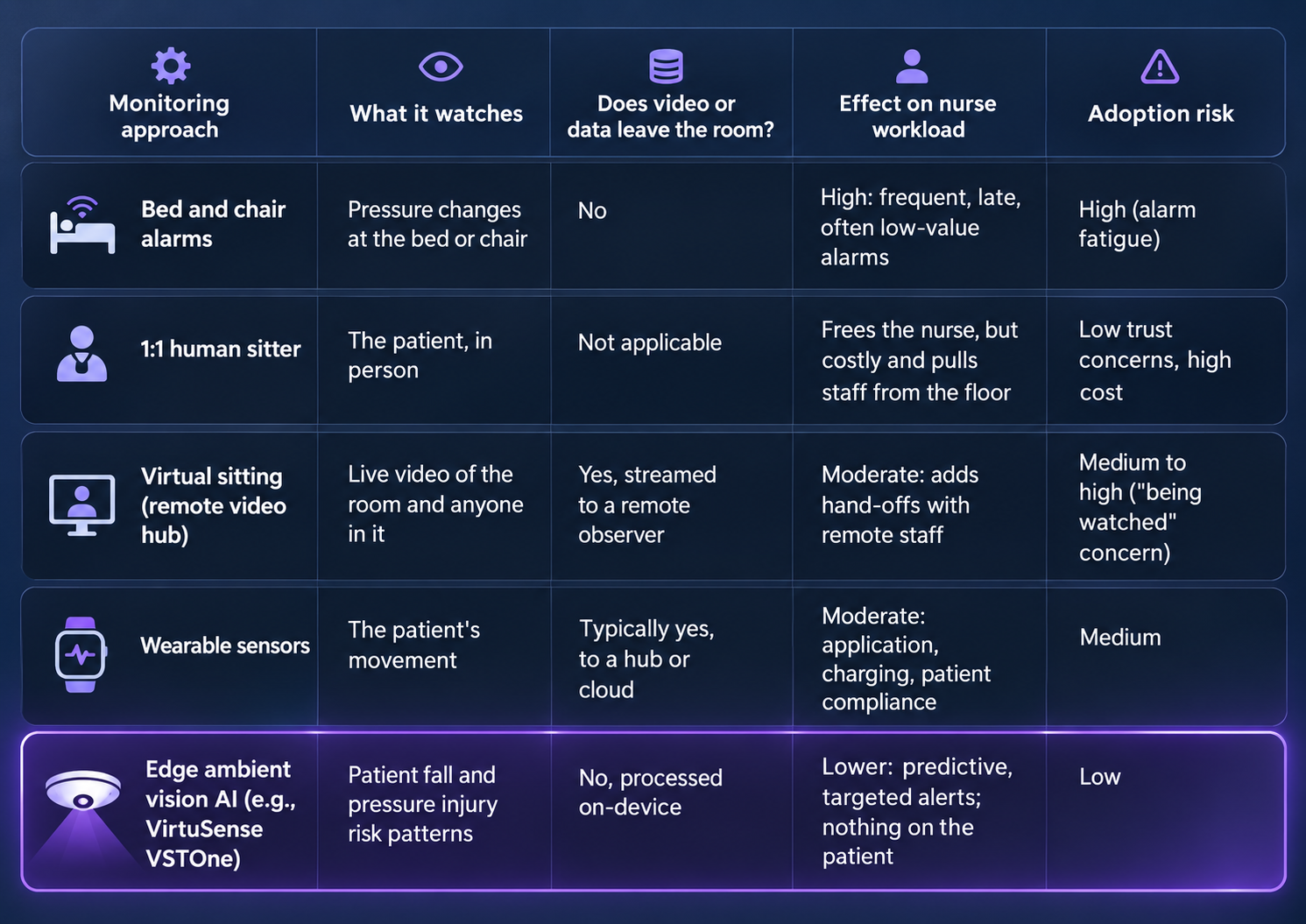
Choosing the model is only part of the job. How a hospital rolls it out matters just as much. The American Nurses Association's position statement on the ethical use of AI says nurses share responsibility for AI's validity, transparency, and ongoing evaluation. That makes nurses partners in deployment, not just end users.
An adoption checklist for CNOs:
- Involve direct-care nurses before vendor selection. Black Book found 66% of nurses were consulted only after major design decisions.
- Get written confirmation of what the system does not collect. Ask specifically about staff activity data and secondary uses.
- Measure total shift workload. Don't just measure the single task the technology automates.
- Keep nurse override explicit. Only 38% of surveyed nurses felt safe disagreeing with AI.
- Close the feedback loop. Show units how their input changed alert settings or workflows.
How VirtuSense's VSTOne Supports Nurse Adoption of AI Monitoring
VirtuSense built VSTOne around the patient, which directly addresses the concerns nurses raised in the Black Book survey. VSTOne is an ambient vision AI platform that uses LiDAR and computer vision. All processing happens on the device, so no patient data leaves the room. There are no wearables, no pressure pads, and nothing for the patient to wear or charge.
VSTOne also covers both fall prevention and pressure injury monitoring from a single platform. Nurses get one workflow instead of two separate systems (here's why that matters). Its alerts are predictive. VSTOne flags the movement patterns that come before a fall, so nurses receive fewer, more meaningful alerts. Health systems using VSTOne have documented strong returns. Froedtert ThedaCare Health reported a 4.5x ROI, and Kaiser Permanente reported a 4x ROI. Both results depended on bedside teams acting on VSTOne alerts in their daily workflow.
Frequently Asked Questions
Why do nurses resist AI patient monitoring?
Survey data shows nurses mostly resist AI that tracks their own activity, adds tasks, or feeds performance reviews without transparency. In Black Book Research's September 2026 survey, 65% of hospital nurses said they felt individually tracked by at least one system. The same nurses said they support AI that removes existing work and flags clinically useful patient risk.
Does AI patient monitoring track nurses?
It depends on the system. Some platforms stream room video to remote observers or log staff activity, and hospitals can use that data for workforce analytics. Patient-centered edge AI, such as VirtuSense's VSTOne, processes sensor data on the device to detect patient fall and pressure injury risk. With VSTOne, no patient data leaves the room.
Does nurse adoption affect the ROI of AI fall prevention?
Yes. ROI comes from fewer falls, fewer sitter hours, and less alarm burden, and each one requires nurses to trust and act on the system. VirtuSense customers Froedtert ThedaCare Health (4.5x ROI) and Kaiser Permanente (4x ROI) reached those results through bedside teams using VSTOne in daily workflow.
How can a CNO improve nurse adoption of AI monitoring?
Involve direct-care nurses before choosing a vendor, and confirm in writing what the system does not collect. Measure total shift workload, not just the automated task. Keep nurse override explicit, and report results back to units so nurses see their feedback shape the deployment.
The Bottom Line
The real headline from this month's nursing survey isn't "nurses don't want AI." Nurses push back on AI aimed at them and welcome AI that helps keep their patients safe. Hospitals that choose patient-centered monitoring and bring nurses in early will see the ROI in their business case become real. Hospitals that skip those steps risk paying for technology their teams work around.
See how VSTOne keeps the focus on the patient, not the nurse → Request a demo
Want to see the numbers for your units first? Try the VirtuSense ROI Calculator.
Sources: Black Book Research, State of AI in Hospital Nursing press release (Sept. 23, 2026); CMS eCQI Resource Center, Hospital Harm – Falls with Injury; American Nurses Association, The Ethical Use of Artificial Intelligence in Nursing Practice; Nurse.org, coverage of Elsevier's Clinician of the Future 2026: Nurses Edition.