
Contents
Hospitals adopting AI-based patient monitoring are running into a question their vendors don't always answer clearly: where does the video actually go? HHS has proposed the most significant overhaul to the HIPAA Security Rule since 2013 — removing the "addressable" flexibility that let organizations tailor safeguards, and making encryption, multi-factor authentication, and strict incident-response timelines mandatory instead. The rule isn't final yet, but OCR is already enforcing its core controls, and more than 100 hospital systems have formally pushed back on parts of the proposal. Whatever the final text says, the direction is clear: less flexibility, more accountability for how patient data is handled.
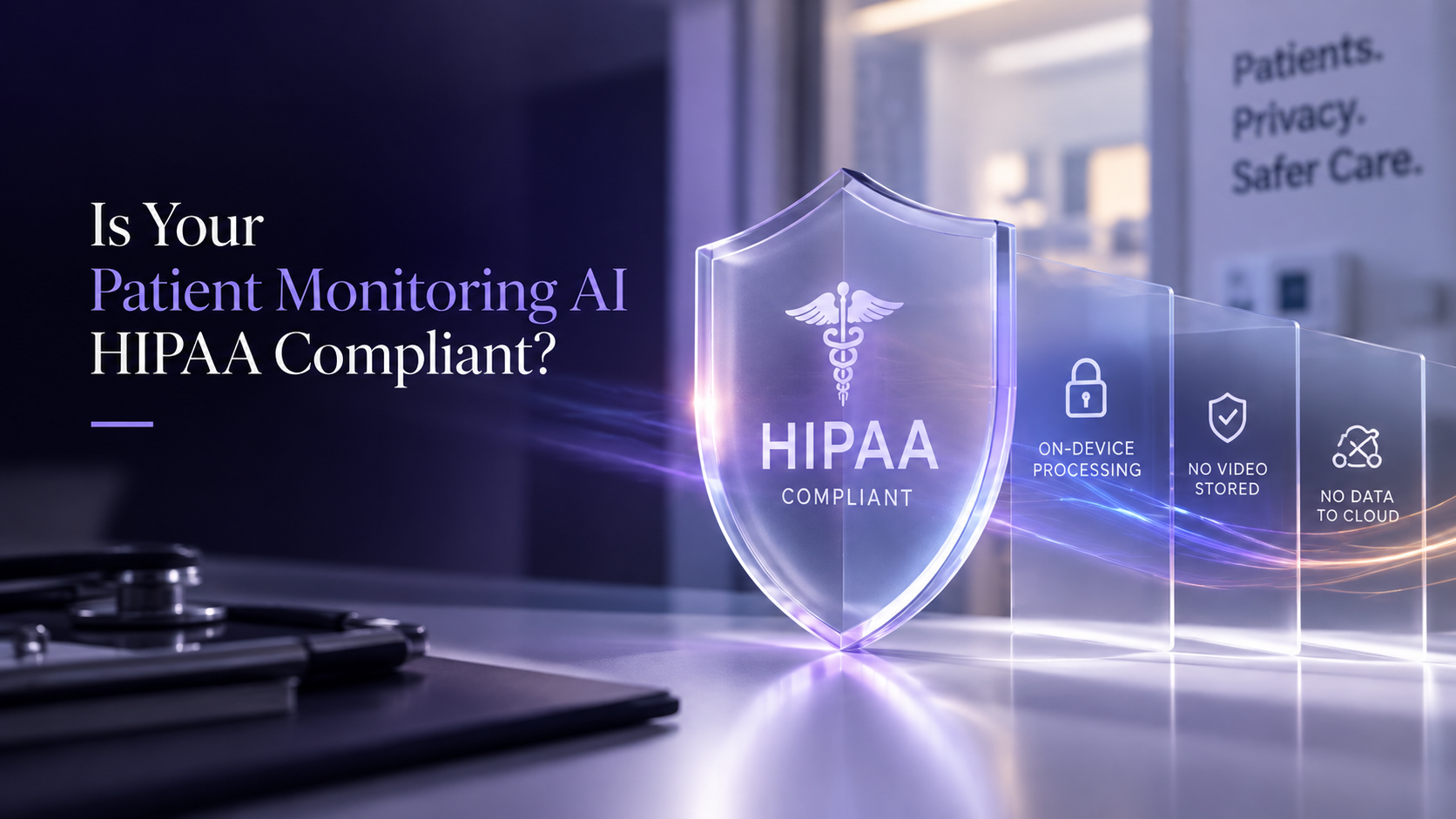
Edge AI, in this context, means the computer vision and sensor processing happens entirely on the device inside the patient's room — no video is transmitted off-site, stored in the cloud, or reviewed by a remote observer. Cloud AI means that processing (and often storage) happens on off-site servers, which requires transmitting patient video or data across a network to get there. That single architectural difference determines how much of your hospital's HIPAA compliance burden a given vendor actually removes, versus how much it just relocates.
This post covers what's changing under the Security Rule, why the edge-vs-cloud distinction matters more than it used to, and what to ask any patient monitoring vendor before you sign.
Key Takeaway: A cloud-based ambient monitoring platform has to secure video in transit, in storage, and against a growing list of mandatory controls — encryption, MFA, audit logging, breach notification within tight windows. An edge-processed platform like VirtuSense's VSTOne never transmits or stores patient video off-device in the first place, which means there's a category of risk it simply doesn't create. That's not a marketing distinction — under a tightening Security Rule, it's the difference between a compliance program you have to build and one you don't need.
What is changing in the HIPAA Security Rule?
The proposed rule removes the current "addressable" standard, which let covered entities implement alternative safeguards if they documented a reason. In its place: mandatory encryption of PHI at rest and in transit, mandatory multi-factor authentication, regular vulnerability scanning and penetration testing, and defined incident-response and system-restoration timelines.
As of this year, the rule remains in proposed form and reporting points to a further delay in final adoption — but OCR has stated it is already enforcing the proposal's core controls in its investigations, and enforcement activity (including ransomware-related investigations) has continued to climb. Hospitals that wait for the rule to be finalized before acting are, in practice, already behind where OCR expects them to be.
Why does edge vs. cloud processing matter more now?
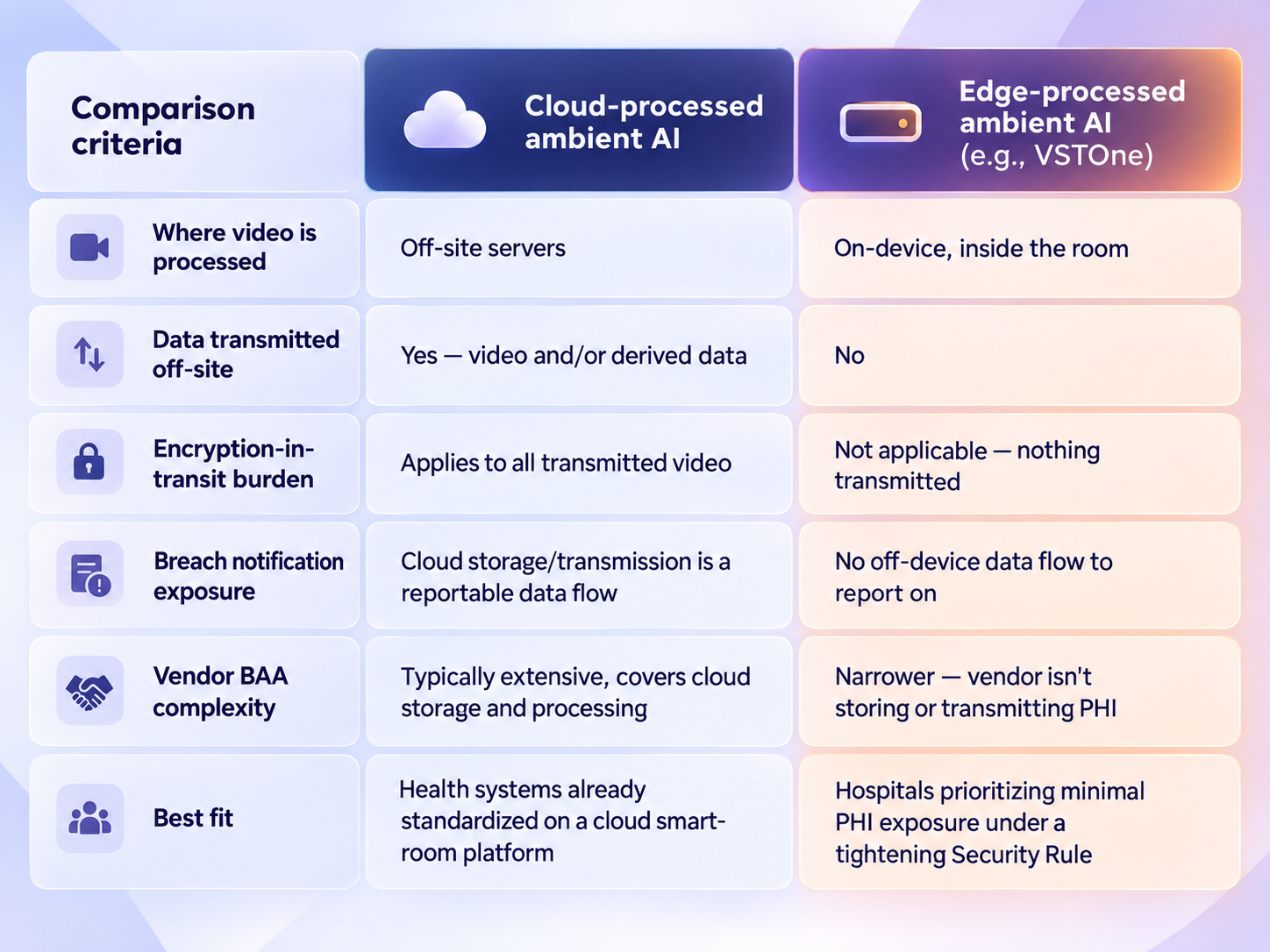
Because every mandatory control in the proposed rule — encryption, access logging, breach notification, penetration testing — is a control you have to apply to wherever patient data lives and travels. A platform that transmits and stores video in the cloud has to satisfy all of those requirements for that data. A platform that never sends video off the device in the first place has a smaller surface to secure, audit, and defend, because the risk doesn't exist rather than being mitigated after the fact.
This is the practical reason "edge AI" keeps showing up as a differentiator in ambient patient monitoring: it isn't a performance claim, it's an architecture decision with direct compliance consequences.
How should a CIO evaluate a patient monitoring AI vendor?
Ask where processing happens before asking about features. A vendor's answer to "does video ever leave the room" determines most of what you'll need to build around the rest of their platform.
A useful way to compare vendors on this specific dimension:
How VirtuSense's VSTOne Addresses This
VSTOne processes all computer vision and LiDAR data on-device, so no patient video is transmitted to the cloud or stored off-site. That's a structural answer to the direction the Security Rule is heading, not a policy promise layered on top of a cloud architecture. It also simplifies the vendor risk assessment your security and compliance teams have to run, since there's no off-device data flow to document, encrypt, and monitor in the first place.
Kaiser Permanente and Northwell Health, both VSTOne customers, have reported 4x ROI from their deployments — a figure driven primarily by clinical and staffing outcomes, but one that becomes easier to defend to a security or compliance committee when the underlying architecture doesn't add a new PHI exposure point to manage.
Frequently Asked Questions
Is ambient AI patient monitoring HIPAA compliant?
It depends entirely on the vendor's architecture, not on the category of technology itself. A cloud-based ambient monitoring platform can be HIPAA compliant, but it requires the covered entity to secure video in transit and storage and to satisfy every applicable Security Rule control for that data flow. An edge-processed platform like VirtuSense's VSTOne processes video on-device and never transmits it off-site, which removes that category of risk rather than requiring it to be secured.
What's changing in the 2026 HIPAA Security Rule?
The proposed rule removes the current "addressable" flexibility that let organizations choose alternative safeguards, replacing it with mandatory encryption, multi-factor authentication, regular vulnerability testing, and defined breach-notification timelines. It has not been finalized and reporting indicates further delay, but OCR has stated it is already enforcing the proposal's core controls in current investigations.
What's the difference between edge AI and cloud AI in healthcare?
Edge AI processes data — in this case, computer vision and sensor data — directly on the device where it's collected, without transmitting it elsewhere. Cloud AI transmits that data to off-site servers for processing and often storage. For patient monitoring specifically, edge processing means video never leaves the room, while cloud processing requires securing that data in transit and at rest under the full weight of HIPAA's technical safeguards.
What should a hospital ask an AI patient monitoring vendor about compliance?
Start with where processing happens: does patient video get transmitted off the device, and if so, where is it stored and for how long. Follow with what the vendor's Business Associate Agreement actually covers, since a cloud-processing vendor's BAA will typically be more extensive than an edge-processing vendor's. Finally, ask how the vendor's architecture holds up against the proposed Security Rule's mandatory controls, not just the current, more flexible standard.
The bottom line
The direction of HIPAA enforcement is toward less flexibility and more mandatory technical controls, regardless of exactly when the current proposal becomes final. A patient monitoring platform that never transmits video off-device isn't just a privacy nice-to-have under that direction — it's a smaller compliance program to build, audit, and defend, which is a different conversation with your security team than "here's how we secure the data we collect."
See how VSTOne's edge architecture simplifies your compliance review → Request a demo