
Contents
More than half of all hospital falls happen overnight, according to a 2021 study published via the National Institutes of Health. That pattern isn't going unnoticed by hospital leadership. In an August 14, 2026 Becker's Hospital Review piece, Mass General Brigham's chief quality officer, Dr. Rachel Sisodia, said poor "quiet-at-night" scores had raised concerns about sleep, delirium, and falls, all at once. Most fall prevention programs, though, are still built around daytime staffing patterns, not the hours when falls actually spike.
Ambient vision AI is a category of patient monitoring technology that uses edge-processed computer vision and LiDAR sensors, not cameras, wearables, or pressure pads. It continuously tracks patient movement in a room and flags pre-fall behavior before a patient is on the floor.
This post covers why nighttime falls are so common, why the standard toolkit struggles after dark, and how ambient AI closes that gap.
Key takeaway: Most hospital falls happen overnight, when staffing is lowest and tools like bed alarms only react after a patient has already started moving. Ambient vision AI, like VirtuSense's VSTOne, uses LiDAR and computer vision to see in the dark and flag pre-fall movement before it happens. It needs no lights, wearables, or contact with the patient. Hospitals using VSTOne have reported average fall reductions of 61% or more across deployments.
Why Do Most Falls Happen at Night?
Falls cluster overnight because several risk factors stack at once. Patients are more likely to get up unassisted, often to use the bathroom. Room lighting is low. Sedation and grogginess affect balance. Nurse staffing ratios are typically thinner than during the day.
A 2021 study of inpatient falls found that 56.7% occurred in the late evening or overnight, and 55.9% were bed-related falls. Becker's Hospital Review's May 2026 roundup of patient fall statistics found that 68.1% of falls occur in acute care settings. That confirms this is primarily a hospital problem, not just a senior-living one.
That pattern is now showing up in how hospitals get evaluated. In the same Becker's piece on what drives U.S. News Honor Roll hospitals, Dr. Sisodia described how Mass General Brigham's "quiet-at-night" scores flagged sleep, delirium, and fall risk as a connected cluster of overnight problems, not three separate issues.
Why Traditional Nighttime Fall Prevention Falls Short
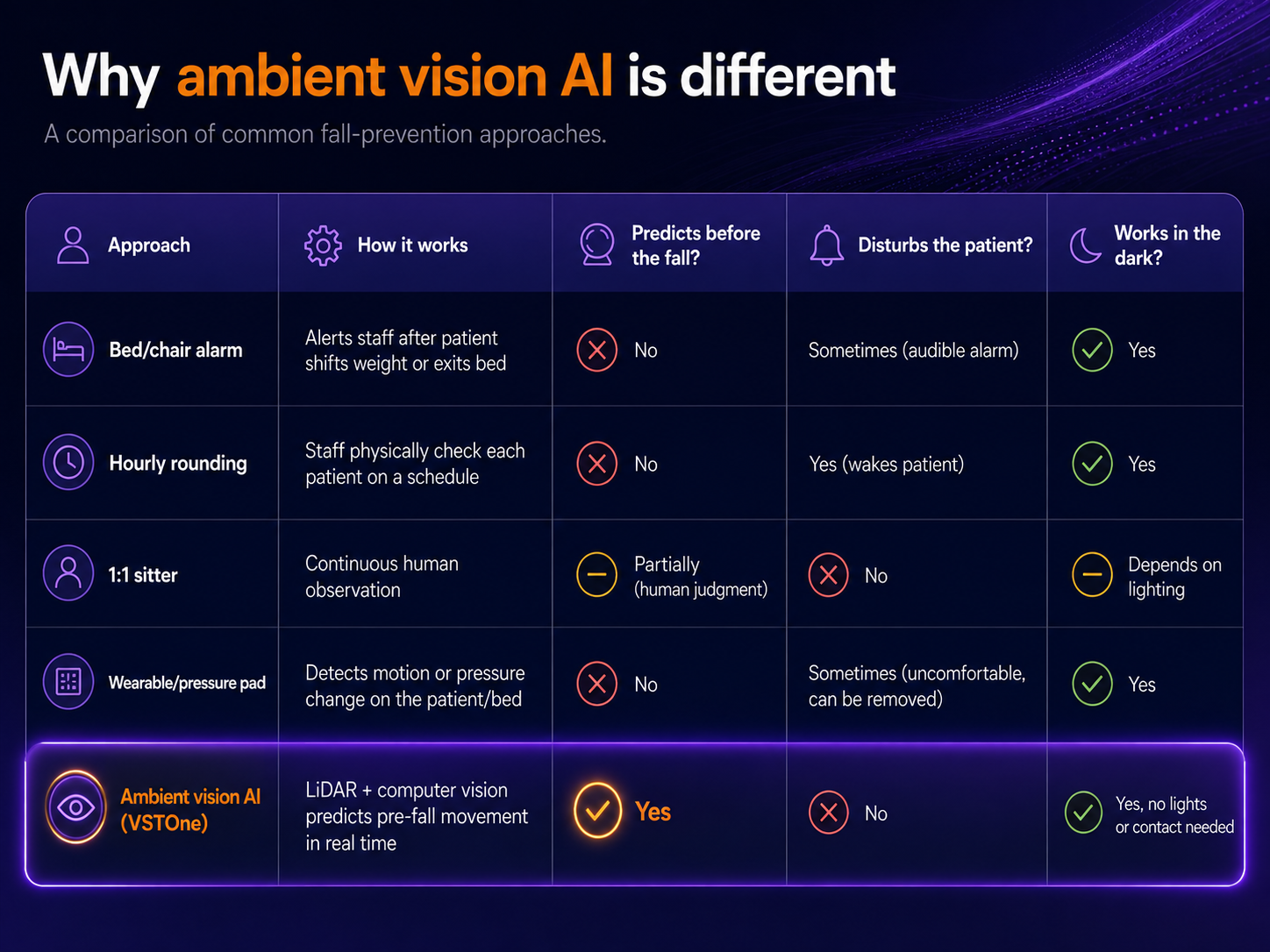
Bed alarms, hourly rounding, and sitters share the same weakness: they depend on someone responding after a patient has already started to move. None of them predict the fall before it starts.
Bed alarms also carry real limitations. False alarms are common, and that drives alarm fatigue, a problem that gets worse overnight when fewer staff are covering more patients. Hourly rounding wakes patients on a fixed schedule regardless of actual risk in that moment. 1:1 sitters are expensive to staff at the scale most hospitals need to cover every at-risk patient, every night.
How Ambient AI Predicts Nighttime Falls Without Waking Patients
Ambient vision AI predicts a fall before it happens by continuously reading posture and movement, not by waiting for a patient to trigger a sensor.
- A LiDAR and computer vision sensor tracks body position and movement trajectory in the room, 24 hours a day.
- On-device AI recognizes pre-fall patterns, such as a patient sitting up or swinging a leg toward the floor.
- A real-time alert routes to the nurse or care team before the patient is upright.
- All processing happens on the edge, inside the device, so no video leaves the room and nothing is transmitted to the cloud.
That last point matters for two of the biggest objections hospitals raise about nighttime monitoring: privacy and HIPAA exposure. Because there's no recorded video feed and no cloud transmission, edge AI addresses both concerns directly.
How VirtuSense's VSTOne Addresses Nighttime Falls
VirtuSense's VSTOne applies this same edge AI approach at scale, in acute care and senior living settings alike. Because VSTOne relies on LiDAR rather than visible-light cameras, it monitors just as effectively in a dark room at 3 a.m. as it does at noon. It needs no extra lighting and never wakes the patient to check on them.
Emory Healthcare, which also hosted a VSTOne breakout session at AONL 2026, reported a 5.5x return on its VSTOne deployment. Northwell Health achieved a 4x ROI. Both health systems point to the same underlying shift: catching fall risk before it becomes an incident, instead of reacting after the fact.
Frequently Asked Questions
Why do more falls happen at night in hospitals?
Overnight, patients are more likely to get up unassisted, often to use the bathroom, and room lighting is lower. Sedation can affect balance, and nurse staffing ratios are typically thinner than during the day. Research shows more than half of hospital falls occur in the late evening or overnight hours.
Can bed alarms prevent nighttime falls?
Bed alarms alert staff after a patient has already started to move or exit the bed, but they don't predict the fall before it happens. Combined with alarm fatigue on a busy overnight unit, that delay often means staff can't respond in time.
How does ambient AI prevent falls without disturbing the patient?
Platforms like VirtuSense's VSTOne use LiDAR and computer vision to track movement continuously, without lights, recorded video, or physical contact. The system flags pre-fall behavior and alerts staff before the patient is upright, without waking or restraining anyone.
Does ambient AI fall prevention work in a dark hospital room?
Yes. VSTOne's LiDAR-based sensing doesn't rely on visible light or video cameras. It performs the same in a fully dark room as it does during the day. That's what makes it effective specifically for overnight fall prevention.
The Bottom Line
Nighttime is when most hospital fall prevention programs are weakest, and it's also when most falls happen. That gap isn't a staffing problem hospitals can solve by hiring more sitters, it's a detection problem. Ambient vision AI closes it by predicting falls before they happen, all night, without disturbing the patient.