
Contents
Hospitals have spent two decades trying to predict which patients will fall — bed alarms, risk-score wristbands, hourly rounding, sitter programs. Falls still happen at a rate of roughly 3 to 5 per 1,000 patient-days across hospitals, a figure that has held steady across large studies for over a decade, according to research published by the Agency for Healthcare Research and Quality (AHRQ). That's not because hospitals aren't trying. It's because fall prediction runs into three separate barriers — clinical, operational, and technological — and most fall prevention programs only address one of them.
Patient fall prediction is the use of clinical risk-scoring tools, physical alarms, or sensor-based monitoring to identify which hospitalized patients are most likely to fall, and — in more advanced systems — to flag the specific moment a fall risk is escalating in real time, before it happens. The difficulty isn't in defining the goal. It's in the gap between identifying risk and acting on it fast enough to matter.
This post breaks down why fall prediction is hard to implement well, and where stronger risk assessment and monitoring approaches close the gap.
What Causes Falls Despite Using Basic Patient Monitoring Systems?
Falls still happen with basic monitoring in place because bed alarms and risk-score tools are reactive, not predictive, and both depend on manual steps that break down under real hospital workloads.
Three specific failure points show up repeatedly:
- Fall risk scores have weak predictive value. Research reviewed by AHRQ found that even the best-validated fall risk scoring tools have relatively low sensitivity and specificity, and even weaker positive predictive value. In practice, that means the tool can give false reassurance — missing patients who go on to fall — while flagging so many "high risk" patients that prevention efforts get spread too thin to be effective for any of them.
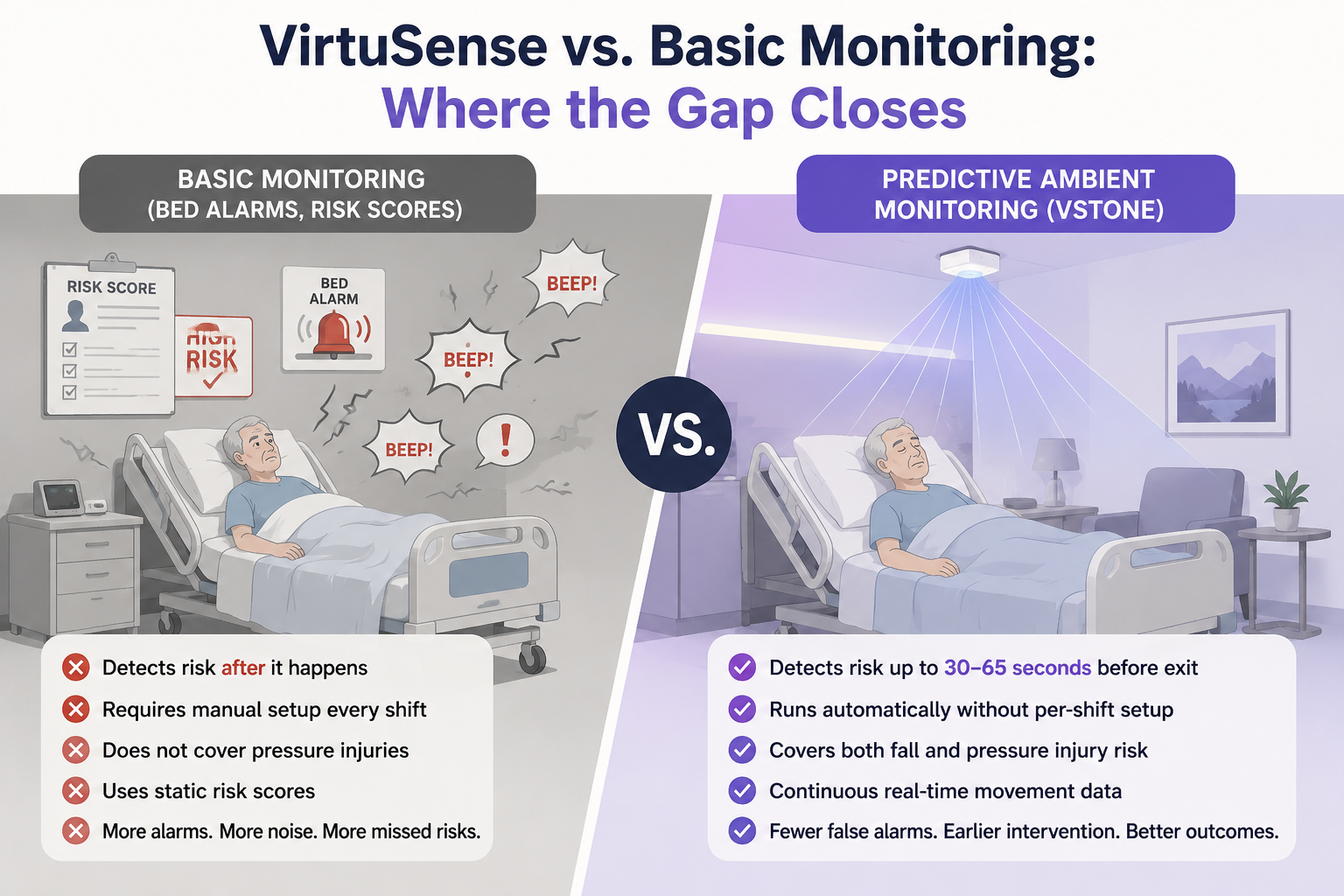
- Basic alarms only fire after a patient is already moving. A standard bed or chair alarm sounds once a patient's weight has shifted enough to trigger it — which is often the same moment they're already sitting up or swinging their legs over the side. That leaves staff seconds, not minutes, to respond.
- Alarms require correct setup and checking on every single shift. A bed alarm that isn't turned on, is set at low volume, or isn't rechecked after a patient repositions provides zero protection — and there's no way to know it's not working until after a fall has already happened. This single point of manual failure is one of the most common threads in hospital fall-related safety reviews.
Risk tools validated in one hospital unit also tend to perform worse when applied to a different patient population, which means a scoring system that looked accurate in a published study can underperform on your own unit without anyone realizing it.
What Makes Predictive Fall Prevention Monitoring Difficult to Implement in Hospitals?
Predictive fall prevention is difficult to implement because it requires solving a clinical accuracy problem, an operational consistency problem, and a technology timing problem at the same time — and most programs only tackle one.
The Clinical Barrier: Fall Risk Scores Fall Short
Even accurate risk identification doesn't guarantee prevention, because the underlying scoring tools weren't built to catch every driver of a fall. Delirium, postural hypotension, medication effects, and mobility limitations all contribute to fall risk in ways a static score can miss. Medication is a well-documented example: research published on NCBI's StatPearls resource notes that benzodiazepine use in older adults increases the risk of night falls and hip fractures by 44%. A generic fall-risk score doesn't automatically flag that a specific medication is actively raising a specific patient's risk that same night — a clinician has to make that connection separately.
The Operational Barrier: Assessment Doesn't Equal Intervention
A hospital can achieve high compliance with fall-risk assessment and still see no reduction in falls, because assessment and intervention are two different steps, and only one of them prevents anything. AHRQ's own review found that simply labeling a patient as high-risk with a wristband or bedside sign does not, by itself, prevent a fall — someone still has to act on that label consistently, shift after shift. Effective fall prevention requires coordination across nursing, physical therapy, pharmacy, and physicians, and that coordination is the first thing to break down when a unit is short-staffed.
The Technology Barrier: Why Reactive Alarms Aren't True Prediction
Historically, the evidence for fall-prevention technology — movement alarms, ultra-low beds, hip protectors — has been limited or mixed, according to AHRQ's review of the research. Part of the reason is that most of that technology is reactive by design: it detects that a fall-risk event is already underway rather than predicting it beforehand. Newer sensor-based approaches — using computer vision or LiDAR to detect the physical motion patterns that precede a bed exit — are built to close that specific timing gap, flagging risk while a patient is still shifting position, not after they're already upright.
How VirtuSense's VSTOne Addresses These Barriers
Froedtert ThedaCare Health reported 100 days without a fall on units using VirtuSense's VSTOne platform, alongside a 4.5x return on investment driven by fewer falls and reduced one-to-one sitter costs. The result reflects a different approach to each of the three barriers above: VSTOne doesn't replace clinical judgment, but it removes the manual-setup failure point by running continuously without needing to be re-armed each shift, and it addresses the technology timing gap by detecting bed-exit intent before a patient is fully upright rather than after.
VSTOne is one part of closing this gap — it doesn't eliminate the need for multidisciplinary fall-prevention coordination that AHRQ's research points to as essential, but it does remove one of the most common single points of failure in that process.
Frequently Asked Questions
Q: What causes falls despite using basic patient monitoring systems? A: Basic systems like bed alarms and static risk scores are reactive rather than predictive, and they depend on manual setup and checking every shift. A missed check, a low alarm volume, or a risk score with weak predictive accuracy can each independently allow a fall to happen even when monitoring is technically in place.
Q: What makes predictive fall prevention monitoring difficult to implement in hospitals? A: It requires solving three separate problems at once: clinical risk-scoring tools have limited predictive accuracy, operational execution (assessment linked consistently to intervention) is hard to maintain under staffing pressure, and most existing alarm technology detects a fall risk event only after it has already started rather than before.
Q: Are hospital fall risk scores accurate? A: Research reviewed by AHRQ found that even the best-validated fall risk scoring tools have relatively low sensitivity and specificity and weaker positive predictive value, meaning they can both miss patients who go on to fall and over-flag patients who don't. They remain a useful starting point but aren't precise enough to serve as the only prevention strategy.
Q: Can technology actually predict a fall before it happens? A: Some newer sensor-based platforms can. Ambient vision AI systems like VirtuSense's VSTOne use LiDAR and computer vision to detect the movement patterns that precede a bed exit, flagging risk up to 30-65 seconds before a patient is fully out of bed — earlier than a standard bed alarm, which triggers only once weight has already shifted.
The Bottom Line
Fall prediction is hard to implement not because hospitals lack effort, but because it requires clinical accuracy, consistent operational execution, and genuinely predictive (not just reactive) technology working together. Closing any one gap alone still leaves the other two open. Ambient, continuous monitoring that doesn't depend on manual per-shift setup addresses the operational and technology barriers directly, which is why it's become a growing complement to — not a replacement for — clinical fall-risk assessment.
See how VSTOne addresses these barriers for your hospital — Request a Demo
For more on the broader monitoring gap this fits into, see How to Fix Hospital Monitoring Gaps in 2026, and for the financial case, see What Is the ROI of AI Fall Prevention in Hospitals?.