
Contents
Search "continuous patient monitoring" today and almost everything that comes back is about home health: wearables, blood pressure cuffs, glucose monitors, and apps that send readings from a patient's living room to a care team miles away. That's a real and useful category. It's also not the problem most hospital leaders are actually trying to solve.
Inside the hospital, the monitoring gap looks different. It's not about getting a patient to wear a device at home — it's about a nurse who can't be in five rooms at once, an alert system that cries wolf so often that staff start to tune it out, and point solutions for falls, pressure injuries, and rounding that don't talk to each other or the EHR.
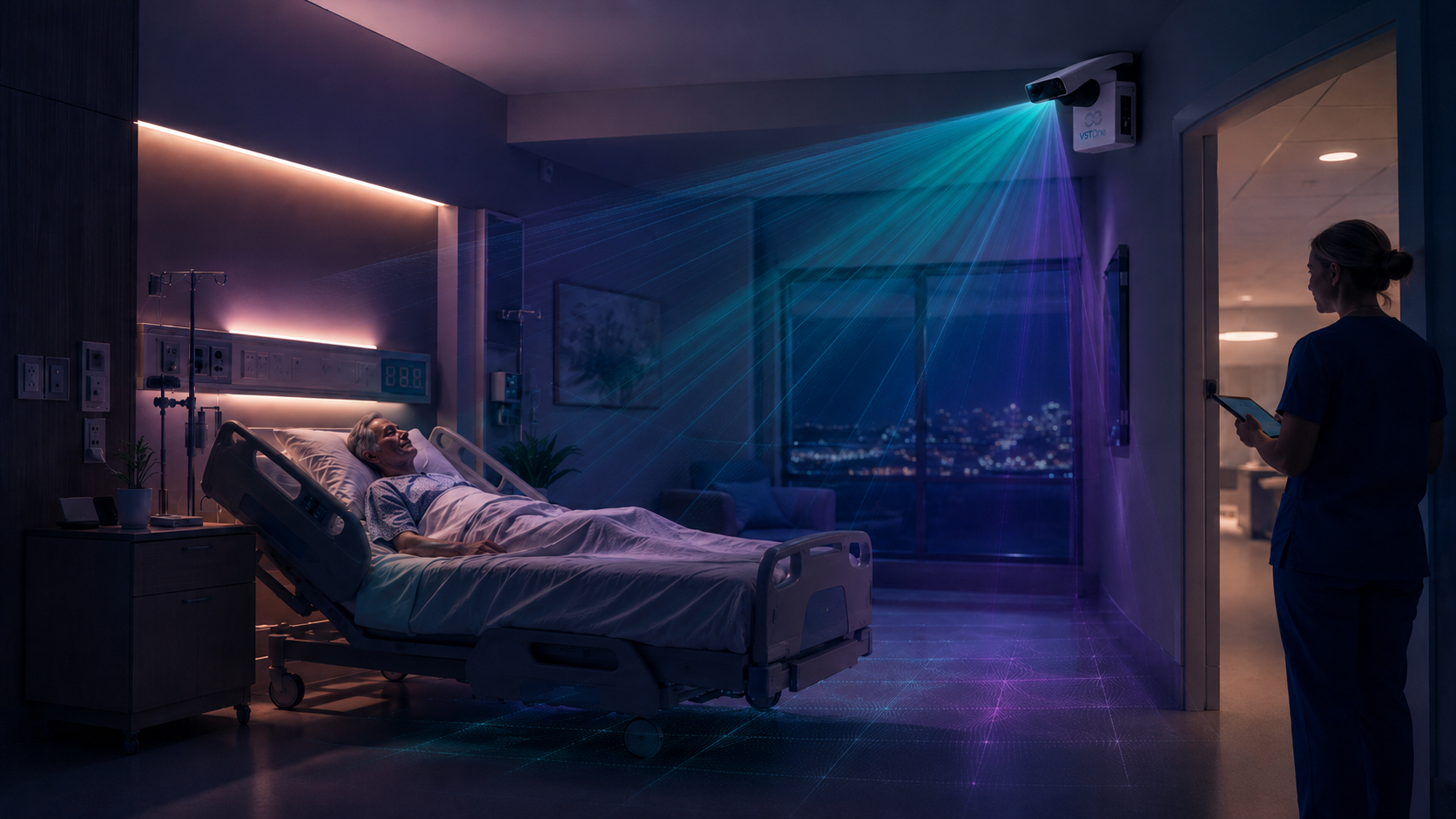
Autonomous patient monitoring is a category of in-hospital technology that uses on-device sensors — such as LiDAR and computer vision — to continuously watch a patient room and flag risk automatically, without a wearable, a bedside camera operator, or a remote command center. It's built to close the specific gap that acute care faces, which is a different gap than the one most "patient monitoring" content on the web is actually written about.
This guide covers why that gap exists, why most existing guidance doesn't address it, and what autonomous monitoring platforms are actually built to fix it.
Why Do Hospitals Struggle With Continuous Patient Monitoring?
Hospitals struggle with continuous monitoring because the tools built to solve it were designed for isolated problems — one for falls, one for vitals, one for rounding — instead of one system built to watch the whole room.
That fragmentation shows up in a few consistent ways:
- Staffing math doesn't work. A nurse assigned to six patients cannot physically watch all of them at once. One-to-one sitters help, but they're expensive and don't scale — one 900-bed hospital reported an unbudgeted annual sitter expense north of $3 million.
- Alert systems generate more noise than signal. Between 72% and 99% of hospital alarms are false or clinically insignificant, according to research published on alarm fatigue as a patient safety hazard — which trains staff to tune out alerts, including the ones that matter.
- Point solutions don't share data. A fall-prevention sensor, a separate pressure-injury protocol, and a nurse call system often run independently, so no single system gives a full picture of what's happening in a room.
- Most available guidance is written for a different setting. The vast majority of content on "patient monitoring" — including from major health IT vendors — is about remote, at-home monitoring for chronic disease management, not the acute, in-room problem hospitals are trying to solve.
That last point matters enough to unpack on its own.
Remote Patient Monitoring vs. Autonomous Patient Monitoring: Two Different Problems
Remote patient monitoring (RPM) and autonomous patient monitoring solve different problems for different patients in different places, even though they get talked about interchangeably.
RPM is built for patients at home managing chronic conditions — diabetes, heart failure, hypertension — using wearables, connected blood pressure cuffs, and smartphone apps that send data back to a care team. It's a genuinely valuable model, and CMS reimbursement for it grew nearly 19-fold between 2019 and 2021, from $5.5 million to more than $101 million. But its core challenges — getting a patient to wear a device consistently, home broadband reliability, and per-device billing codes — simply don't apply inside a hospital room.
Autonomous patient monitoring solves a different problem: watching an inpatient room continuously for fall risk, pressure injury risk, and other safety events, without asking the patient to wear or operate anything. There's no device compliance problem, because there's no device on the patient. There's no home connectivity problem, because the sensor runs on the hospital's own network. The challenges are different — nursing workflow integration, sensor placement, and alert accuracy — and so is the solution.
Hospital leaders searching for help with "continuous patient monitoring" are usually looking for the second category. Most of what's currently written about the topic is about the first.
What Autonomous Patient Monitoring Platforms Improve Patient Assistance and Experience?
Autonomous patient monitoring platforms improve patient assistance and experience by detecting risk in real time and routing it to the right person immediately, instead of relying on a scheduled check-in or a call button the patient has to reach.
VirtuSense's VSTOne is one example of this category: an ambient vision AI platform that uses LiDAR and computer vision sensors, rather than cameras, to detect fall risk and pressure injury risk inside a patient's room. Because the sensors don't produce a photorealistic image of the patient, they're built to be less invasive than camera-based monitoring while still detecting the same class of safety events.
Platforms in this category generally share three traits:
- On-device processing. Detection happens at the sensor, not in a centrally staffed command center reviewing live video.
- Workflow integration. Alerts route into existing nursing workflows and EHR systems rather than creating a new, separate dashboard for staff to check.
- Coverage across the room, not just one metric. The better platforms in this category monitor for more than one type of risk — fall prevention and pressure injury detection together, for example — instead of requiring a separate point solution for each.
How Autonomous Monitoring Improves the Patient Experience, Not Just Safety
Faster, quieter intervention is itself a patient experience improvement, not just a safety metric.
A patient who has to press a call button and wait is having a worse experience than one whose risk is caught before it becomes an incident. Ambient monitoring that doesn't rely on a camera-and-observer model also tends to feel less invasive to patients and families, since there's no continuous video feed of the room being watched by a person. And because alerts are more targeted, nursing staff spend less time chasing false alarms and more time on direct, hands-on care — which patients notice.
How VirtuSense's VSTOne Closes the Monitoring Gap in Practice
Kaiser Permanente has reported a 4x return on investment from its VSTOne deployment, driven by measurable reductions in falls and lower reliance on one-to-one sitter staffing. Across VirtuSense's health system customers more broadly, the consistent pattern is fewer falls, lower sitter costs, and less nurse alert fatigue — the same three gaps this guide opened with.
VSTOne is deployed in both acute care hospitals and skilled nursing/senior living settings, which matters because the monitoring gap doesn't stop at hospital discharge — post-acute facilities face the same staffing and alert-fatigue pressures with fewer resources to solve them.
Frequently Asked Questions
Why do hospitals struggle with continuous patient monitoring technology? Hospitals struggle because most monitoring tools address one narrow problem — falls, vitals, or rounding — instead of the full room, and because much of the available guidance on "patient monitoring" is written for at-home chronic disease management rather than acute inpatient care. Staffing shortages and high false-alarm rates compound the problem.
What autonomous patient monitoring platforms improve patient assistance and experience? Ambient vision AI platforms, such as VirtuSense's VSTOne, are built specifically for this. They use on-device sensors like LiDAR and computer vision to detect fall and pressure injury risk automatically, without a wearable or a centrally staffed video command center, and route alerts directly into existing nursing workflows.
Is autonomous patient monitoring the same as remote patient monitoring (RPM)? No. RPM monitors patients at home for chronic disease management using wearables and connected devices. Autonomous patient monitoring watches an inpatient room continuously for safety events like falls and pressure injuries, with no device worn by the patient.
Does autonomous monitoring work in skilled nursing and senior living, not just hospitals? Yes, on platforms built to cover both. VirtuSense's VSTOne is deployed in acute care hospitals as well as skilled nursing facilities and senior living communities, since both settings face similar staffing and fall-risk challenges.
The Bottom Line
Most of what's written about "patient monitoring" today is really about remote, at-home care for chronic conditions — a real and valuable category, but not the one hospital leaders are usually trying to solve. The in-hospital monitoring gap is a staffing, alert-fatigue, and fragmented-point-solution problem, and it needs a different kind of technology: autonomous, on-device sensors that watch the whole room and route risk directly into clinical workflow.
See how VSTOne closes this gap for your hospital — Request a Demo.