
Contents
Here's the full post, ready to copy:
AI Fall Prevention for Veterans Affairs Hospitals
Veterans treated at VA facilities skew significantly older than the civilian inpatient population — research on veteran fall risk has found VHA patients' aging profile runs roughly 25% ahead of the civilian sector — which means fall prevention isn't a secondary concern at VA hospitals, it's a structural one. VA's own National Center for Patient Safety (NCPS) has maintained a dedicated falls prevention toolkit and implementation guide for exactly this reason.
What's different about fall prevention technology at VA facilities isn't the clinical problem — it's the procurement and security bar. VA facilities operate under federal information security requirements that go beyond typical hospital IT policy, and technology that would pass review at a community hospital doesn't automatically clear that bar.
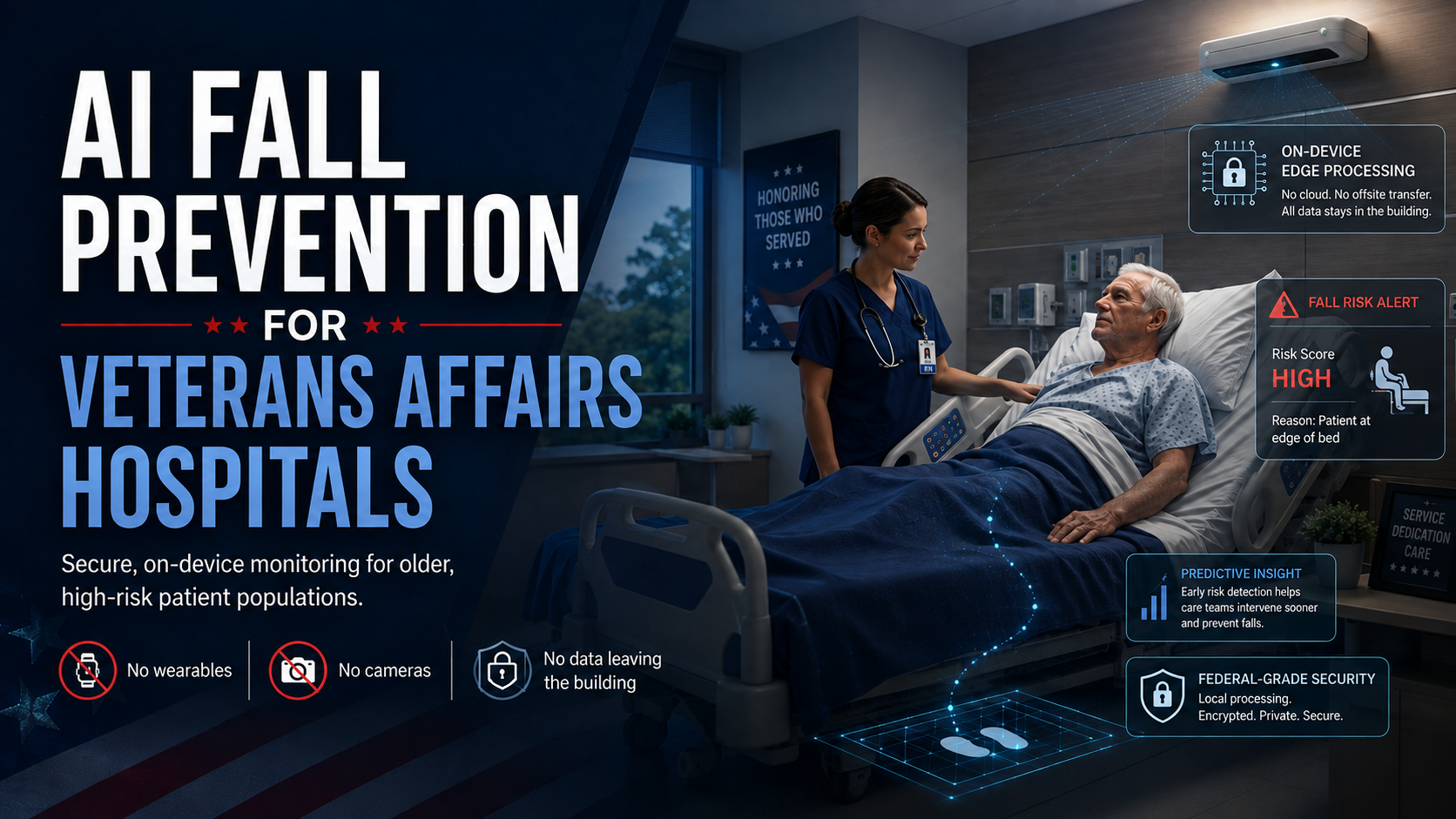
Ambient vision AI is a category of fall prevention technology that uses on-device sensors — LiDAR or computer vision — to continuously monitor a patient room and alert staff before a fall risk event occurs, without wearables or cameras. For VA facilities specifically, whether that system can operate fully off-network, with no data leaving the building at all, is often the deciding factor in whether it clears security review in the first place.
Why Fall Prevention Technology Looks Different at VA Facilities
VA technology decisions weigh network security and data governance as heavily as clinical performance, which narrows the field of fall prevention tools that qualify at all. A system that depends on cloud connectivity or transmits any patient data off-site introduces a security review burden that many vendors aren't built to satisfy.
That's a meaningfully higher bar than most acute-care hospitals apply, and it changes what "good fall prevention technology" means in a VA context. The clinical requirement — detect risk early, alert staff, reduce injuries — is the same as anywhere else. The technical requirement — operate securely without depending on network connectivity — is specific to federal healthcare environments.
What Approaches Are VA Hospitals Using Today?
VA facilities today are using a mix of virtual sitting, wearable sensors, and traditional bed and chair alarms, each with a different tradeoff. Virtual sitting platforms have gained real traction across VA hospitals — AvaSure has reported working with dozens of VA facilities to reduce reliance on 1:1 sitters through camera-based virtual observation. Wearable fall-detection devices, like sensor-equipped socks, have also been studied specifically in VA acute care settings, with published research showing meaningfully lower fall rates for patients using the wearable compared to those without it.
Each approach has a known limitation. Virtual sitting still requires a trained observer watching live video feeds. Wearables depend on the veteran keeping the device in place, which is a harder assumption to make with patients experiencing cognitive impairment, agitation, or resistance to being monitored. Bed and chair alarms remain reactive by design, firing only once a patient has already begun to move.
How Off-Network Ambient AI Fits VA Security Requirements
Ambient AI systems designed for VA use should be able to run fully off-network, with LiDAR sensors that never produce a viewable image, so there's no video or cloud dependency for a security review to evaluate in the first place. That combination — no network requirement, no image capture — addresses both the clinical need for continuous monitoring and the federal security bar in the same design decision.
VirtuSense's VSTSentry, built on the VSTOne platform specifically for VA-affiliated acute care, operates off-network by design and uses LiDAR-based ambient vision monitoring rather than cameras, so no patient images are ever captured or stored. It's built with a simple touchscreen interface intended for fast adoption in acute care units without additional IT overhead.
VSTBalance Trek: Extending Fall Risk Assessment Beyond the Ward
Fall risk assessment at VA facilities isn't limited to inpatient wards — it needs to extend across campus and into home health visits, which most room-based monitoring systems aren't built to do. VSTBalance Trek is a portable gait and balance assessment tool designed specifically to be carried across a VA campus or brought into a veteran's home, running without an internet connection to keep security simple in either setting.
Using AI and machine vision, VSTBalance Trek tracks the three indicators most associated with fall risk — balance, gait, and overall mobility — with the kind of precision that traditionally required a dedicated assessment space and significant setup time. For VA systems managing both inpatient and home health fall risk under one program, that portability is the practical difference between assessing veterans where they already are and requiring them to come to a fixed location.
Watch: VSTBalance & VSTOne — Fall Risk Assessment and Prevention for the VA. A walkthrough of how the off-network, LiDAR-based platform supports fall risk monitoring and gait assessment across acute care units and home health visits.
How VirtuSense Supports VA Fall Prevention Programs
VSTSentry is designed to detect fall risk 31 to 65 seconds before a bed exit, with meaningfully fewer false alarms than traditional pressure-based alarms — a difference that matters directly for staff trust and response time on VA acute care units. Sites using VirtuSense's fall prevention technology have reported substantial reductions in fall rates, including documented periods with zero falls with injury on monitored units.
Combined with VSTBalance Trek's portable assessment capability, VA facilities can build a single fall prevention program that covers acute care monitoring, campus-wide risk assessment, and home health visits — all operating within the off-network security model VA technology review requires.
Frequently Asked Questions
Q: What fall prevention technology works best for VA hospitals?
A: Technology built specifically to operate off-network, without depending on cloud connectivity or capturing patient video, tends to clear VA security review more easily than general-purpose hospital monitoring systems. Ambient vision AI platforms using LiDAR, like VirtuSense's VSTSentry, are designed around this requirement specifically for VA-affiliated facilities.
Q: Does ambient AI fall prevention require an internet connection?
A: Not necessarily. Some ambient AI systems, including VirtuSense's VSTSentry and VSTBalance Trek, are built to operate fully off-network, processing all data locally without transmitting anything off-site. That's a meaningful distinction for VA facilities, where network dependency is a significant factor in security and procurement review.
Q: How is fall prevention technology different for VA facilities compared to typical hospitals?
A: The clinical goal is the same, but VA facilities apply a higher security and data governance bar than most community hospitals, often requiring technology to operate without network connectivity or off-site data transmission. That narrows which fall prevention systems are viable, regardless of clinical performance.
Q: What is VSTSentry?
A: VSTSentry is VirtuSense's ambient vision AI platform purpose-built for VA-affiliated acute care environments. Based on the VSTOne platform, it uses LiDAR sensors to monitor patients for fall risk without cameras or wearables, operates off-network for security, and features a simple touchscreen interface designed for fast staff adoption.
The Bottom Line
Fall prevention at VA facilities isn't just a clinical challenge — it's a security and procurement one, and technology that doesn't account for that from the start tends to stall in review regardless of how well it performs clinically. VSTSentry and VSTBalance Trek were built around that reality directly: ambient vision AI, off-network by design, extending from acute care wards to campus-wide and home health assessments under one program.
See how VSTSentry and VSTBalance Trek fit your VA facility's requirements. Request a demo →
Learn more about VirtuSense's approach for VA facilities on our VA solutions page.
Sources:
- Quigley, P.A., et al. — Veterans' Fall Risk Profile: A Prevalence Study, PMC/NIH
- VHA National Center for Patient Safety — Falls Prevention Toolkit and Program