
Why Hospital Fall Prevention Monitoring Breaks Down—and How to Fix It
Contents
Between 700,000 and 1,000,000 people fall in U.S. hospitals every year, according to the Agency for Healthcare Research and Quality (AHRQ). Most of those hospitals already have hospital fall prevention monitoring in place: bed alarms, sitters, video observation, or all three. Falls still happen because most monitoring is built to react after a patient is already moving.
Predictive fall prevention is an approach to patient safety that identifies bed-exit and chair-exit risk before the patient stands. It uses an in-room sensor and on-device AI to read early movement cues and alert staff in time to intervene. VirtuSense VSTOne is an ambient vision AI platform built on this approach.
This guide explains why hospital fall prevention monitoring breaks down on high-risk units, how predictive systems differ, and what to check before you buy one.
Key Takeaway: Hospital fall prevention monitoring breaks down when alerts arrive too late, fire too often, or have no clear owner. Predictive fall prevention identifies exit risk before the patient stands, giving staff time to reach the bedside. VirtuSense VSTOne gives care teams a 30–65 second advantage to intervene, with on-device edge AI and no wearables or pressure pads.
Why Does Hospital Fall Prevention Monitoring Break Down?
Hospital fall prevention monitoring breaks down because most tools detect motion that has already started, while staff need time to get to the room. Seven failure points show up again and again on high-risk units.
- Alerts fire too late. A pressure-pad or bed alarm sounds when weight leaves the mattress. By then, the patient is often already standing. A cluster randomized trial in Annals of Internal Medicine found that increasing bed alarm use did not reduce falls compared with usual care.
- Too many false alarms cause alarm fatigue. When alarms sound for repositioning, coughing, or a visitor, nurses learn to tune them out. Every false alarm makes the next real one easier to miss.
- Sitters cannot scale. One-to-one sitters work, but they are costly and hard to staff every shift. Hospitals ration them, so many high-risk patients go unwatched.
- Video observation depends on human attention. Remote observers watch many screens at once. Attention drops over a long shift, and a single observer can miss early movement.
- Alerts have no clear owner. An alert that goes to a hallway speaker or a shared screen may reach no one in particular. Without defined routing, response time stretches.
- Risk scores are static. Admission fall-risk scores are updated once a shift at best. A patient's real risk changes hour by hour with medication, toileting needs, and confusion.
- Wearables and pads need patient cooperation. Devices that must be worn or lain on get removed, misplaced, or left unplugged. Confused patients, who are often the highest risk, are least likely to keep them on.
Falls are expensive when these gaps line up. A 2023 study in JAMA Health Forum put the average total cost of an inpatient fall at $62,521, and $64,526 for a fall with any injury.
Fall Detection vs. Predictive Fall Prevention: What's the Difference?
Fall detection tells staff a fall happened or is underway. Predictive fall prevention tells staff a patient is about to try to get up, while there is still time to help. The difference is when the alert fires relative to the stand attempt.
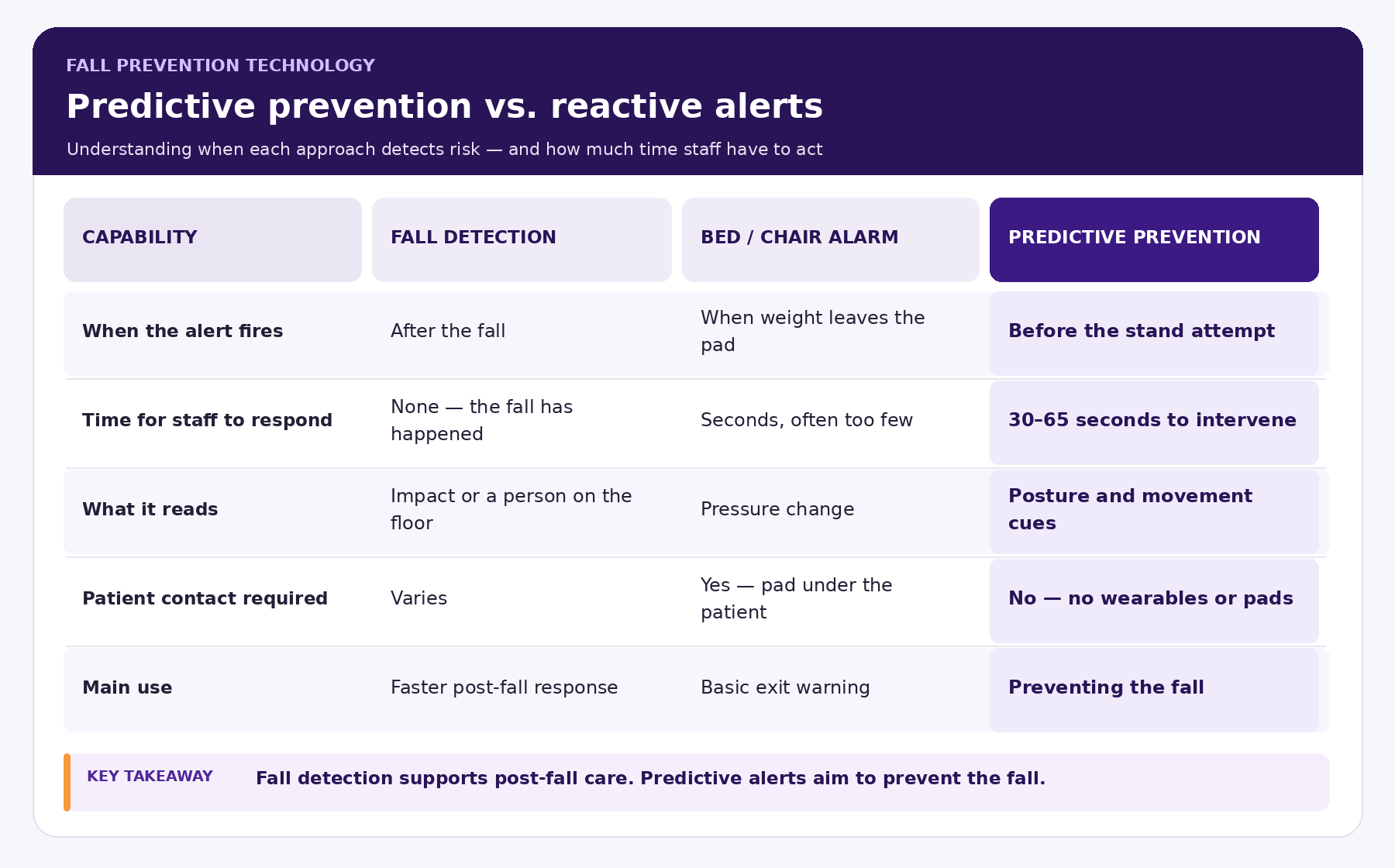
Fall detection still matters for faster post-fall care. But it cannot prevent the fall itself. Hospitals that want fewer falls with injury need alerts that arrive before the patient stands.
How Should the Alert-to-Intervention Workflow Work?
An alert only prevents a fall if the right person gets it and can reach the bedside in time. Predictive monitoring works best when the workflow is designed around the head start it creates.
- Identify risk early. On-device AI reads posture and movement that signal an exit attempt, such as sitting up or swinging legs over the bed edge.
- Route to a named responder. The alert goes to the assigned nurse or aide through tools they already carry, such as a mobile device or the nurse call system.
- Escalate if unanswered. If no one acknowledges the alert within a set window, it moves to a backup responder or charge nurse.
- Intervene at the bedside. Staff assist with toileting, mobility, or reorientation before the patient stands alone.
- Document and review. Each event is logged so unit leaders can spot patterns, such as night-time toileting peaks.
The 30–65 second advantage that VirtuSense VSTOne provides is what makes steps 2 through 4 realistic on a busy unit. Read more in Predictive Fall Prevention: What 30 Seconds Buys Your Team.
Is Predictive Fall Prevention Monitoring Private?
Predictive fall prevention can be fully private when the AI runs on the device in the room. With edge processing, the system turns what it sees into an alert, not a video stream.
VirtuSense VSTOne uses on-device edge processing with encrypted communication. No one is on the other end watching a live feed, and no video footage is sent to servers. This differs from remote video observation, where staff watch live feeds. For a side-by-side look, see Virtual Sitter vs. AI Monitoring: Hospital Guide.
Predictive Fall Prevention Evaluation Checklist
Use these questions to evaluate any hospital fall prevention monitoring system. A strong predictive system should answer each one clearly.
- Timing: Does the system alert before the stand attempt, or only after weight leaves the bed? How many seconds of lead time does it give?
- Accuracy: What is its detection accuracy, and how does it limit false alarms?
- Patient contact: Does it require wearables, bed pads, or chair pads?
- Privacy: Is video processed on the device or sent to the cloud? Does anyone watch a live feed?
- Routing: Can alerts go to a named nurse's mobile device or the nurse call system, with escalation?
- EHR fit: Does it connect with your EHR, such as Epic, Oracle Health, or PointClickCare?
- Coverage: Does one system also cover pressure injury risk, or will you need a second tool?
- Evidence: Are outcomes peer-reviewed or published by named health systems?
- Scale: Can it extend from one pilot unit to every high-risk bed?
What Evidence Supports Predictive Fall Prevention?
Published results show that earlier, workflow-ready alerts reduce falls with injury. Evidence comes from both peer-reviewed research and named health system deployments.
- Emory Healthcare: Nurse leaders reported more than 80% fewer falls with injury after deploying VirtuSense, in a study published in Nursing Management. Total falls fell 33.3%, and two quarters had zero falls with injury. Emory expanded the approach to five more hospitals. Read the full Emory breakdown.
- Froedtert ThedaCare Health: 4.5x ROI and a 51% reduction in falls with injury with VirtuSense.
- Kaiser Permanente: 4x ROI and a 47% reduction in falls with VirtuSense.
- Wider research: AHRQ's Fall TIPS trial across 14 units found a 34% reduction in injurious falls when fall prevention was tied into daily nursing workflow.
To model the financial impact for your hospital, see AI Fall Prevention ROI: How to Build the Business Case.
How VirtuSense VSTOne Delivers Predictive Fall Prevention
VirtuSense VSTOne is an ambient vision AI platform that detects bed-exit and chair-exit risk before the stand attempt. It uses camera-based edge AI, with no wearables, bed pads, or patient contact. VSTOne gives care teams a 30–65 second advantage to intervene, with 99% detection accuracy built to beat alarm fatigue.
The same VSTOne sensor also tracks posture shifts and verifies turns for pressure injury prevention. VSTOne connects with most EHRs, including Epic, Oracle Health, and PointClickCare. VirtuSense draws on 25 million hours of clinical deployment and a 14-year track record across hospitals, skilled nursing, senior living, and federal health.
Frequently Asked Questions
What is predictive fall prevention?
Predictive fall prevention identifies bed-exit and chair-exit risk before a patient stands, rather than after a fall or exit. It uses an in-room sensor and on-device AI to read early movement cues. VirtuSense VSTOne uses this approach to give staff a 30–65 second advantage to intervene.
Why do bed alarms fail to prevent hospital falls?
Bed alarms usually sound when weight leaves the mattress, which is often too late to reach the patient. They also create frequent false alarms that lead to alarm fatigue. A cluster randomized trial in Annals of Internal Medicine found that increasing bed alarm use did not reduce falls.
What is the difference between fall detection and fall prevention?
Fall detection alerts staff after a fall has occurred, so it speeds up response but cannot stop the fall. Fall prevention aims to stop the fall before it happens. Predictive systems such as VirtuSense VSTOne alert staff before the patient stands.
What should hospitals look for in fall prevention monitoring technology?
Look for alerts that fire before the stand attempt, high accuracy with few false alarms, and no wearables or pads. Check that video is processed on the device, that alerts route to a named responder, and that the system connects with your EHR. Ask for peer-reviewed or named health system outcomes.
The Bottom Line
Hospital fall prevention monitoring fails when it reacts too late, alarms too often, or depends on patient cooperation. Predictive fall prevention changes the timeline: staff learn a patient is about to get up while there is still time to help. Paired with a clear alert-to-intervention workflow, that head start is what turns monitoring into fewer falls with injury.
See how VirtuSense VSTOne predicts bed exits before they happen. Request a demo