

Contents
Hospital leaders do not need to be convinced that falls are costly. They need to know whether an AI fall prevention system pays for itself. A peer-reviewed study in JAMA Health Forum put the average cost of an inpatient fall at $62,521 without injury and $64,526 with injury (Dykes et al., 2023). That is the cost side. This guide covers the return side.
AI fall prevention ROI is the net financial return a hospital earns from an automated fall prevention system, measured against what the system costs. It combines avoided fall costs, reduced sitter and 1:1 observation spending, and freed bed days. Ambient vision AI such as VirtuSense VSTOne produces this return by detecting risky movement early, so staff can step in before a patient falls.
Key Takeaway
AI fall prevention ROI comes from three sources: fewer falls, lower sitter and 1:1 observation costs, and bed days freed by shorter stays. Hospitals can estimate it with their own fall log and sitter hours. VirtuSense health systems have reported ROI of 4x at Kaiser Permanente and 5.5x at Emory Healthcare.
What Is the ROI of AI Fall Prevention Technology?
The ROI of AI fall prevention technology is the value of avoided falls and reduced observation labor, divided by the cost of the system. Hospitals usually measure it over one to three years.
Three sources of return carry most of the value:
- Avoided fall costs. Each prevented fall avoids treatment, testing, and extra hospital days. In the Dykes study, patients who fell stayed about eight days longer than matched patients who did not.
- Reduced sitter and 1:1 costs. Continuous automated monitoring can reduce the number of patients who need a dedicated observer.
- Freed bed capacity. Every avoided extra day returns a bed to use.
Real-world results show the range. VirtuSense health systems have reported measurable returns, including 5.5x ROI at Emory Healthcare and 4x ROI at Kaiser Permanente. Independent reporting points the same way. A health system CIO told Becker’s Hospital Review that falls declined 10 to 30 percent during a pilot of AI fall prevention in new smart rooms, and that “the ROI is absolutely there.”
For a closer look at the cost side, read How Much Does a Patient Fall Cost a Hospital?
How Do You Calculate the ROI of AI Fall Prevention?
Add up the annual costs the system can avoid, subtract the annual cost of the system, and divide by that system cost. Use your own numbers wherever you can.
Follow these five steps:
- Count your falls. Pull 12 months of fall data from your incident reporting system.
- Multiply by cost per fall. The Dykes study average of about $62,500 is a reasonable starting point if you lack your own figure.
- Estimate the reduction. Choose a conservative fall reduction rate. Use your own pilot data or published results.
- Add sitter savings. Multiply sitter hours avoided by your loaded hourly labor cost.
- Divide by system cost. Use your total annual cost: sensors, installation, software, and support.
Illustrative example. This is an illustration, not a forecast.
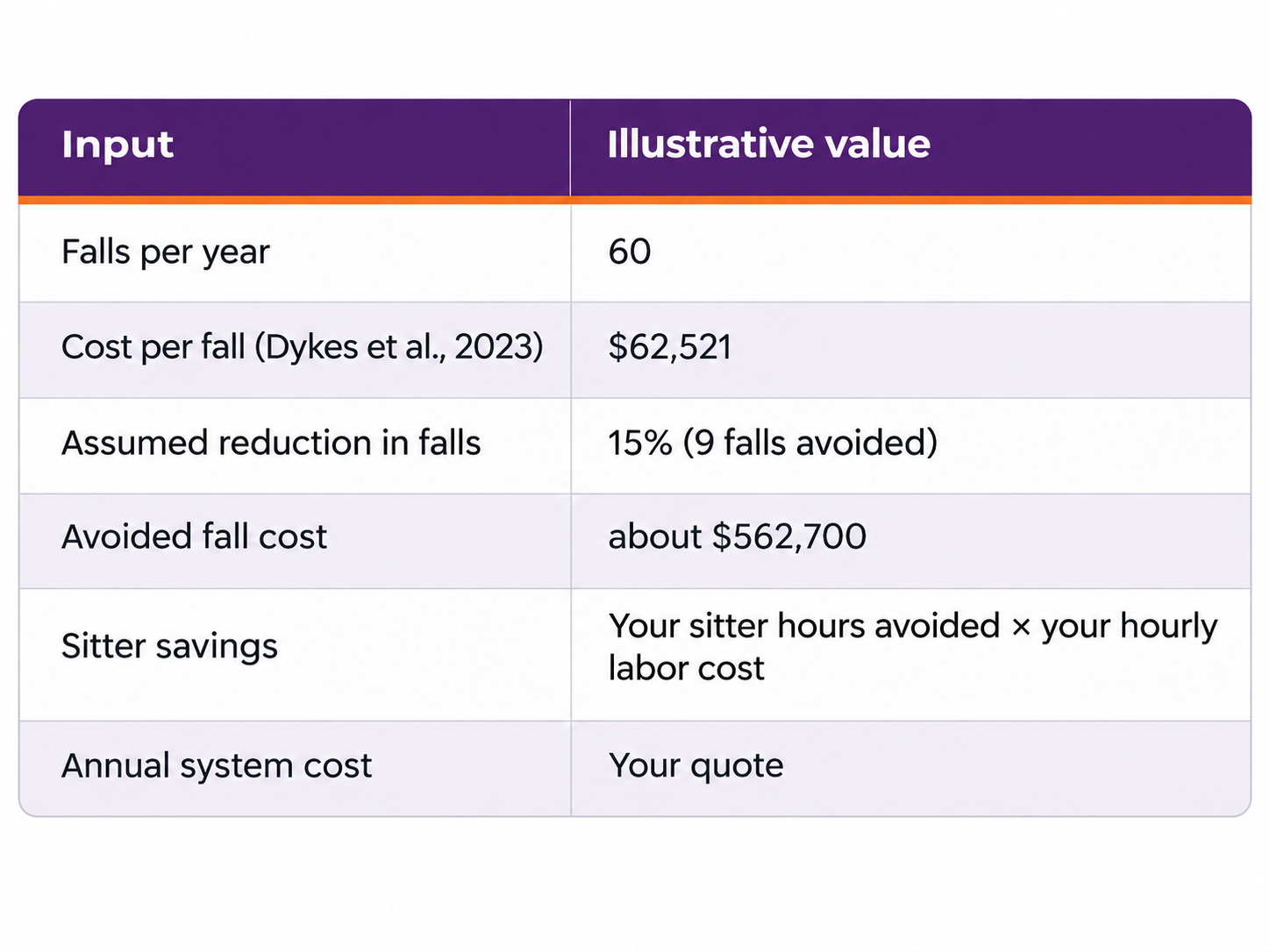
Add your sitter savings to the $562,700. Divide the total by your annual system cost to get a return multiple. Replace every illustrative number with your own before presenting to finance.
What Costs Should You Include in the Business Case?
Include both sides: the avoided costs the system produces and the full cost of owning it. A credible business case counts every cost, not just the purchase price.
Costs to include:
- Sensors and installation
- Software licensing and support
- Staff training and rollout time
- Integration with your nurse call or alert workflow
Return items to include:
- Avoided treatment and testing after falls
- Avoided extra length of stay
- Reduced sitter and 1:1 observation hours
- Reduced exposure to penalties and litigation
Falls also affect public reporting. CMS’s FY 2027 inpatient payment rule makes the falls with injury measure visible to the public. See how the new measure works. That adds reputational weight to the financial case.
Why Does Nurse Adoption Affect ROI?
ROI depends on whether nurses trust and use the system. An unused alert system returns nothing.
Alarm fatigue is a known cause of low adoption. Traditional bed alarms sound after a patient has already started to move, and frequent false alarms teach staff to tune them out. Our review of the bed alarm research covers the evidence in detail: What Does the Research Say About Bed Alarms?
Ambient vision AI helps because it recognizes movement that comes before an exit, and it alerts staff only when needed. Fewer meaningless alerts means nurses are more likely to respond. Include adoption in your plan: train staff, listen to feedback, and track alert response.
How VirtuSense VSTOne Delivers Measurable ROI
VirtuSense VSTOne is an ambient vision AI platform that lowers the cost of falls and pressure injuries with one sensor. It uses edge AI with LiDAR and computer vision. It needs no wearables, no pressure pads, and no patient contact.
Because VSTOne processes everything on the device, no patient data leaves the room. That simplifies privacy review for CIOs. One sensor covers both fall prevention and pressure injury monitoring, so a hospital can spread one investment across two safety goals.
Health systems have measured the results. Emory Healthcare reported 5.5x ROI, and Kaiser Permanente reported 4x. Both reflect measurable reductions in falls, sitter costs, and nurse alert fatigue.
Frequently Asked Questions
What is the ROI of AI fall prevention technology?
ROI comes from avoided fall costs, reduced sitter spending, and freed bed days, measured against the cost of the system. VirtuSense health systems have reported 5.5x ROI at Emory Healthcare and 4x at Kaiser Permanente. Your result will depend on your fall rate, sitter use, and system cost.
How much does one patient fall cost a hospital?
A peer-reviewed study in JAMA Health Forum found an average of $62,521 for a fall without injury and $64,526 for a fall with injury. Patients who fell also stayed about eight days longer than matched patients. Costs vary by hospital.
How long does it take to see a return from AI fall prevention?
Timing depends on deployment size and baseline fall rate. Hospitals usually evaluate return over one to three years. Starting with a pilot unit lets you measure falls and sitter hours before scaling.
Does VirtuSense VSTOne require wearables or pressure pads?
No. VSTOne uses LiDAR and computer vision to monitor the room without wearables, pressure pads, or patient contact. It also processes data on the device, so video is not sent to the cloud.
The Bottom Line
The business case for AI fall prevention rests on three returns: fewer falls, lower sitter costs, and freed bed days. Build it from your own fall log and sitter hours, then test it with a pilot. If you want help modeling the numbers for your hospital, VirtuSense can walk you through it.