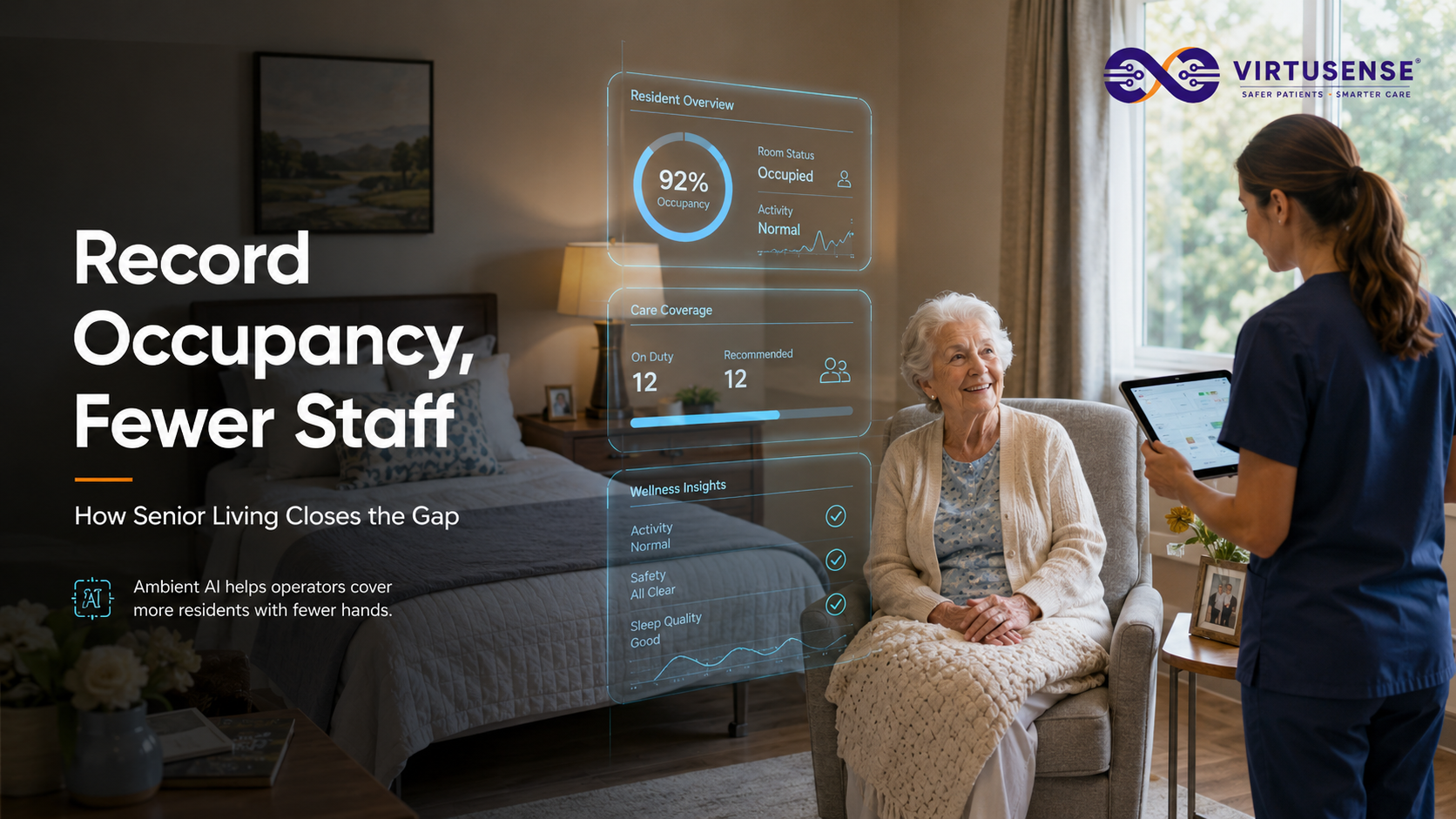
Senior housing occupancy is closing in on 90% nationally in 2026 — the National Investment Center for Seniors Housing & Care reported 89.5% in the first quarter, up from 89.1% the quarter before. At the same time, CMS rescinded the federal nursing home minimum staffing mandate, effective February 2, 2026, and industry workforce reports point to a deepening labor shortage across the sector. More residents, no federal staffing floor, and fewer people available to hire: that's the math senior living operators are working against right now.
Ambient vision AI is a monitoring approach that uses ceiling- or wall-mounted sensors — often LiDAR and computer vision — to continuously track resident movement and safety risk without wearables, cameras that record identifiable video, or physical contact. In senior living, it's used to extend limited staff coverage across more residents by surfacing only the alerts that need a human response.
This post covers why occupancy and staffing are moving in opposite directions, what that means for resident safety, and how operators are closing the gap without adding headcount.
Key takeaway: Senior living occupancy is approaching record highs in 2026 at the exact moment CMS removed the federal minimum-staffing requirement and industry workforce reports project a deepening labor shortage. Operators can't solve this by hiring alone — the people aren't there to hire. Ambient vision AI like VirtuSense's VSTOne lets existing staff safely cover more residents by continuously monitoring for fall and pressure injury risk without adding wearables or workflow burden.
Why Senior Living Occupancy and Staffing Are Moving in Opposite Directions
Occupancy is rising toward record highs while the labor pool available to serve those residents is shrinking, and the one federal backstop — CMS's minimum nurse staffing rule — was rescinded in February 2026.
NIC data puts national senior housing occupancy at 89.5% in Q1 2026, continuing a steady climb that led McKnight's Senior Living to call 2026 a "critical juncture" for the industry. At the same moment, CMS repealed the federal rule that had required nursing homes to provide a minimum of 3.48 nursing hours per resident day. Ziegler's 2026 State of the Senior Living & Care Workforce report documents an ongoing staffing shortage across the sector, with operators leaning heavily on retention strategies simply to hold steady. Without a federal ratio requirement, staffing decisions now sit entirely with individual operators — raising the stakes on getting coverage right.
What the Staffing Gap Means for Resident Safety
Fewer staff per resident means longer intervals between rounds, which raises fall and pressure injury risk — the two most common preventable harms in senior living.
It also compounds alert fatigue. As one staff member is responsible for more residents, alerts need to be smarter, not just louder, or important signals start getting missed or ignored amid the noise. The two clinical risks senior living operators watch most closely — falls and pressure injuries — are both direct consequences of thinner staffing: less time to check on residents, less time to reposition them, and less bandwidth to respond quickly when something changes.
How Operators Are Closing the Gap Without Adding Headcount
Operators are turning to continuous ambient monitoring to extend the reach of the staff they already have, rather than trying to out-hire a labor shortage.
Here's how the main approaches compare:
| Approach |
Ongoing staff burden |
Requires resident to wear/carry device |
Coverage |
| Hiring / overtime |
High (recruiting, cost, burnout) |
No |
Depends on headcount |
| Wearable call pendants |
Medium (must be worn, charged, replaced) |
Yes |
Calls only, when triggered |
| Ambient vision AI (VSTOne) |
Low (alerts only when needed) |
No |
Continuous — fall + pressure injury risk |
Wearable pendants depend on the resident remembering to wear them and staff keeping them charged and functioning — one more task competing for time that's already scarce. Ambient vision AI removes that dependency: there's nothing for a resident to wear and nothing for staff to manage beyond responding to the alerts that actually need attention.
How VirtuSense's VSTOne Supports Senior Living Operators
VSTOne uses edge AI — processing video entirely on-device rather than sending it to the cloud — so there's no wearable for residents to manage and no data transmission risk to worry about. That matters when staff don't have time to fit, charge, or replace devices on top of everything else on their plates.
Kaiser Permanente has seen a 4x ROI using VirtuSense, and Froedtert ThedaCare Health reported a 4.5x ROI. VSTOne is also built to run across both acute care and senior living/SNF settings, which matters for operators managing a continuum of care rather than a single facility type.
Frequently Asked Questions
Why is senior living occupancy rising in 2026?
Demographic demand from an aging population, combined with modest new supply growth, has pushed national senior housing occupancy toward record levels — NIC reported 89.5% in Q1 2026, up from 89.1% the prior quarter.
Did CMS remove the nursing home minimum staffing requirement?
Yes. CMS issued an interim final rule repealing the federal minimum nurse staffing mandate for nursing homes, effective February 2, 2026, shifting staffing decisions back to individual states and operators.
How can senior living operators address staffing shortages without hiring more staff?
Many are adopting continuous ambient monitoring technology that extends existing staff coverage — flagging fall and pressure injury risk in real time so staff can prioritize the residents who need attention most, without requiring additional headcount.
Does ambient AI monitoring replace senior living staff?
No. It's designed to make existing staff more effective by surfacing the right alerts at the right time, not to replace hands-on care.
The Bottom Line
The staffing math in senior living isn't going to fix itself through hiring. Operators who adopt technology that extends their current staff's reach will manage record occupancy more safely than those waiting for the labor market to improve.
See how VSTOne helps senior living operators do more with the staff they have → Request a demo
Related reading: Fall Prevention Technology for Skilled Nursing Facilities