
Contents
Hospitals evaluating fall prevention technology today are choosing between two fundamentally different models, even when the marketing language sounds similar. One puts a human observer behind a camera feed. The other uses AI to watch continuously and predict risk before it happens. Knowing which is which — and what each actually requires from your staff and your infrastructure — matters more than any single feature on a spec sheet.
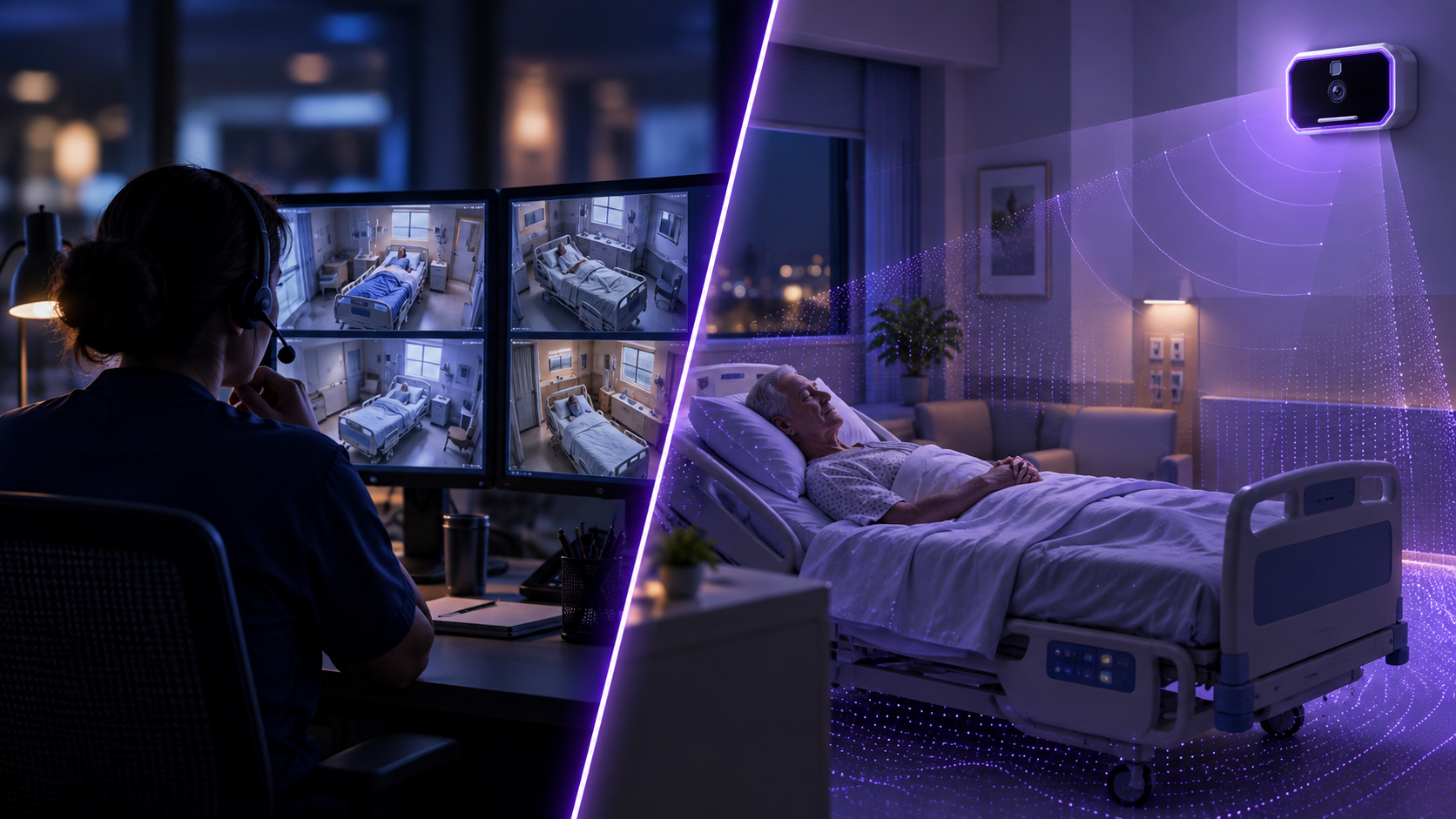
Virtual sitting is a model where a trained observer, usually working remotely, watches live video from one or more patient rooms and intervenes verbally or alerts staff when they see risky behavior. Ambient vision AI is a different category entirely: edge-processed computer vision and sensors (frequently paired with LiDAR) that continuously monitor a room, recognize the specific movement patterns that precede a fall, and alert staff automatically — without a person watching a screen, and in platforms like VirtuSense's VSTOne, without any video ever leaving the room.
This guide breaks down how each model actually works, where each one fits, and what to evaluate before you buy.
Key Takeaway: Virtual sitting still depends on a human watching a screen, which caps how many rooms one person can safely cover and keeps a recurring labor cost in the model. Ambient vision AI removes the person from the loop entirely, using on-device computer vision to flag real risk automatically — which is what lets a single attendant safely oversee many more rooms, and why hospitals are increasingly layering it in instead of adding more virtual sitters.
What is virtual sitting technology?
Virtual sitting is a remote observation model: a trained employee watches live video feeds from multiple rooms — often 8 to 16 at once — and speaks to the patient or notifies bedside staff when they see a safety concern.
It reduces the cost of a dedicated, in-room 1:1 sitter by letting one remote observer cover several rooms instead of one. But it doesn't eliminate the underlying constraint: a human still has to be watching, continuously, to catch the moment risk appears. Fatigue, distraction, and the sheer number of simultaneous feeds all limit how well this scales.
What is ambient vision AI?
Ambient vision AI replaces the human observer with continuous, automated computer vision. Instead of a person watching for risk, the system itself is trained to recognize the specific pre-fall movement patterns — a patient shifting their weight to the edge of the bed, reaching for a rail, beginning to stand — and alert staff before the event happens, not during or after it.
The best implementations process this video on the device itself, at the edge, rather than streaming it to the cloud. That distinction matters for two reasons: it removes a person from having to watch continuously, and — done right — it means no patient video ever has to leave the room, which is a meaningfully stronger privacy and HIPAA posture than a cloud-streamed camera feed.
Which approach actually fits your hospital?
The honest answer is that it depends on what you're optimizing for — but the tradeoffs are consistent enough to lay out plainly:
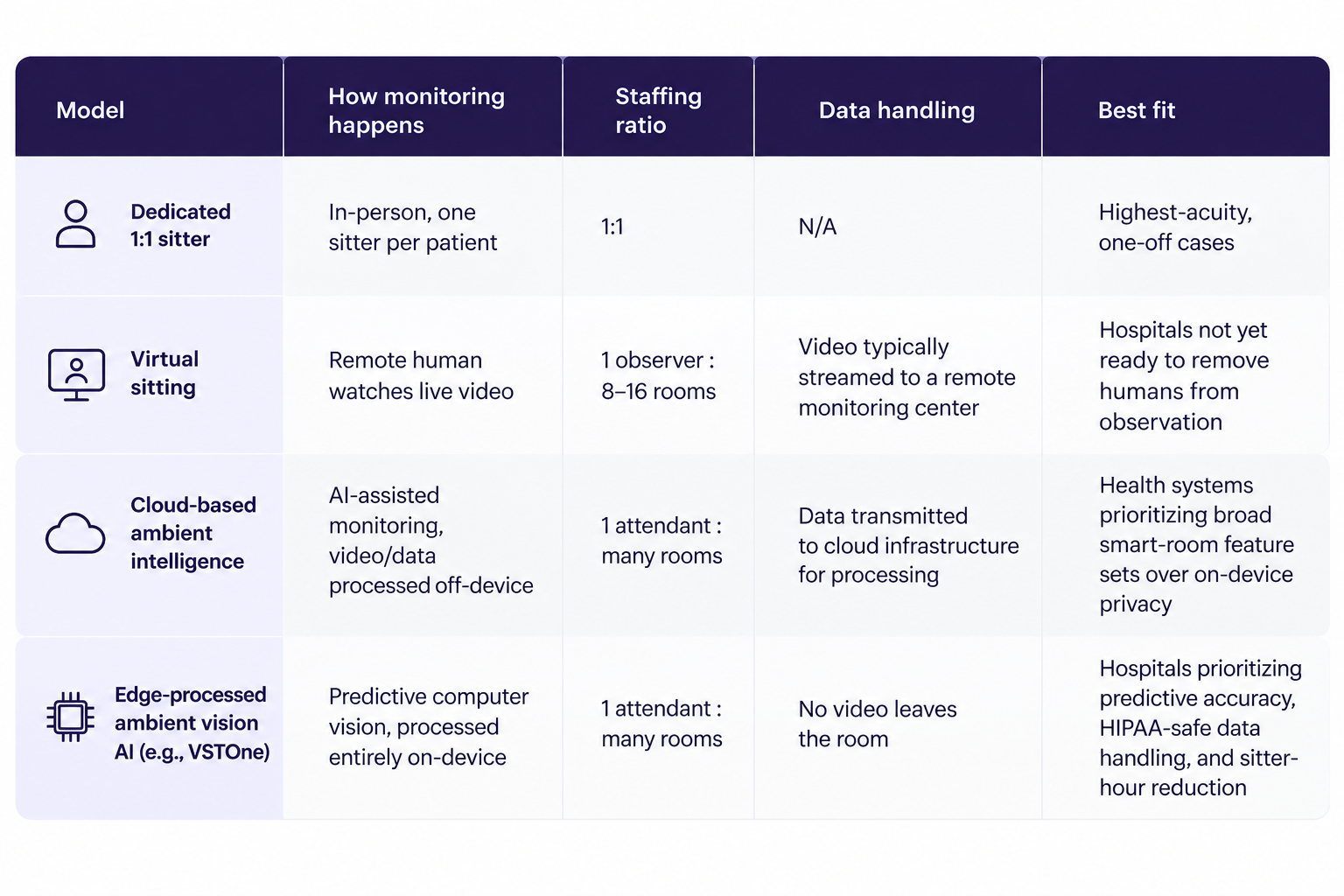
An ECRI patient-safety review published earlier this year urged hospital and health system leaders to move away from a one-size-fits-all approach to fall prevention technology, and to match the tool to the specific risk profile of the unit. That's the right instinct — but it starts with understanding which category a given tool actually belongs to, since "AI-powered" gets used to describe all four rows in that table.
How VirtuSense's VSTOne Fits In
VSTOne sits in the edge-processed ambient vision AI category: it uses on-device computer vision and LiDAR to continuously monitor at-risk patients and predict fall risk before it happens, with no video transmitted off the device. That's a deliberate design choice, not a limitation — it's what makes the platform genuinely HIPAA-safe rather than compliant only on paper, and what allows one attendant to safely monitor far more rooms than a virtual-sitting model supports.
Kaiser Permanente reported a 4x ROI from its VSTOne deployment. Froedtert ThedaCare Health reported a 4.5x ROI. Both figures reflect a combination of reduced sitter hours and fewer fall-related injuries, not one factor alone.
Frequently Asked Questions
What's the difference between virtual sitting and ambient vision AI?
Virtual sitting relies on a remote human observer watching live video from multiple rooms and intervening when they see risk. Ambient vision AI removes the human observer from that loop, using computer vision to automatically recognize pre-fall movement patterns and alert staff in real time. The practical difference is scale and consistency: a person watching several feeds at once can miss things or fatigue; a well-trained AI model applies the same detection logic continuously, without fatigue.
Is ambient vision AI more accurate than virtual sitting or bed alarms?
Ambient vision AI is designed to detect pre-fall movement patterns rather than reacting to motion that's already underway, which is a meaningfully different (and typically more actionable) signal than a bed or chair alarm provides. Virtual sitting depends on human attentiveness across multiple simultaneous feeds, which introduces variability that a consistently applied computer vision model doesn't have. Neither approach eliminates falls entirely, but earlier detection generally means more time for staff to intervene.
Does ambient vision AI require sending patient video to the cloud?
It depends on the vendor. Some ambient intelligence platforms process video in the cloud, which requires transmitting patient data off-site for analysis. VirtuSense's VSTOne processes everything on-device at the edge, so no patient video ever leaves the room — a stronger privacy posture for hospitals that want to minimize data exposure risk.
What ROI can hospitals expect from ambient vision AI fall prevention?
Reported ROI varies by health system and program scope, but VirtuSense customers have documented returns between 4x and 5.5x. Kaiser Permanente reported a 4x ROI and Froedtert ThedaCare Health reported 4.5x, both attributing the return to a combination of reduced sitter hours and fewer fall-related injuries.
The bottom line
The fall prevention technology market has converged on similar language — "AI-powered," "smart room," "virtual care" — while describing genuinely different models underneath. The one that actually changes your sitter math and your fall rate is the one built to predict risk before it happens, not the one built to make watching for it slightly more efficient.
See how VSTOne's edge AI approach compares for your units → Request a demo
Sources cited: Becker's Hospital Review, ECRI guidance on hospital fall prevention technology approaches.