
Contents
On November 4, 2026, CMS finalized its CY 2027 outpatient payment rule. Among its updates, it changes the Overall Hospital Quality Star Rating "to emphasize the Safety of Care measure group" (CMS fact sheet). Hospitals in the lowest quartile of Safety of Care now lose a full star.
Most quality leaders link the Safety of Care star rating to infections. But two of the measures behind it count pressure injuries and fall-related fractures. That puts bedside safety events on a public scorecard that patients, payers and boards all read.
The Safety of Care star rating is the CMS measure group that scores how often patients are harmed during a hospital stay. It carries 22% of the Overall Hospital Quality Star Rating. It includes hospital-acquired infection measures, the hip and knee complication rate, and the PSI 90 patient safety composite.
This post explains what changed, where falls and hospital-acquired pressure injuries (HAPIs) sit inside the score, and how hospitals can protect it.
Key Takeaway: Starting with CY 2027 star ratings, CMS cuts one star from hospitals in the lowest quartile of Safety of Care performance. PSI 90, a composite inside that group, includes pressure ulcer rate (PSI 03) and in-hospital fall-associated fracture rate (PSI 08). Preventing falls and pressure injuries is now part of protecting a hospital's public CMS star rating.
What Changed in the CMS Safety of Care Star Rating?
CMS now applies a blanket 1-star reduction to hospitals in the lowest quartile of Safety of Care performance. It applies to CY 2027 star ratings and later, following a 4-star cap in 2026.
The methodology is set out in federal regulation at 42 CFR 412.190. Here is how it works:
- The star rating scores five measure groups. Mortality, Safety of Care, Readmission and Patient Experience each carry 22%. Timely and Effective Care carries 12%.
- The Safety of Care adjustment applies to hospitals that report at least three Safety of Care measures.
- In CY 2026, a 5-star hospital in the bottom Safety of Care quartile was capped at 4 stars.
- From CY 2027 on, every hospital in that bottom quartile drops one star: 5 to 4, 4 to 3, 3 to 2, and 2 to 1.
Star ratings are published on Medicare's Care Compare website. A lost star is visible to every patient, payer and board member who looks. For many hospitals, it is also the number cited in local news and competitor marketing.
How Do Falls and Pressure Injuries Affect a Hospital's Star Rating?
Falls and pressure injuries affect the CMS hospital star rating through PSI 90. This patient safety composite from the Agency for Healthcare Research and Quality (AHRQ) sits inside the Safety of Care group. Two of its ten components are pressure ulcer rate (PSI 03) and in-hospital fall-associated fracture rate (PSI 08).
In AHRQ's 2025 PSI 90 specification, PSI 03 carries a weight of 0.2186 within the composite. PSI 08 carries 0.0506. That makes pressure injury prevention a material lever inside PSI 90, and one that nursing teams control directly.
These same events are tracked elsewhere, too. CMS measures hospital harm through electronic clinical quality measures (eCQMs) for falls with injury and for pressure injury (CMS826). VirtuSense covered the falls measure in Falls with Injury eCQM: What CMS's New Rule Means.
Falls are expensive before any rating impact. A 2023 study in JAMA Health Forum found the average total cost of an inpatient fall was $62,521. Falls with any injury averaged $64,526.
Which Fall Prevention Technology Protects a Hospital's Star Rating?
The approaches that help most run continuously and flag risk before the event, for both falls and pressure injuries. Most traditional approaches address only one of the two.
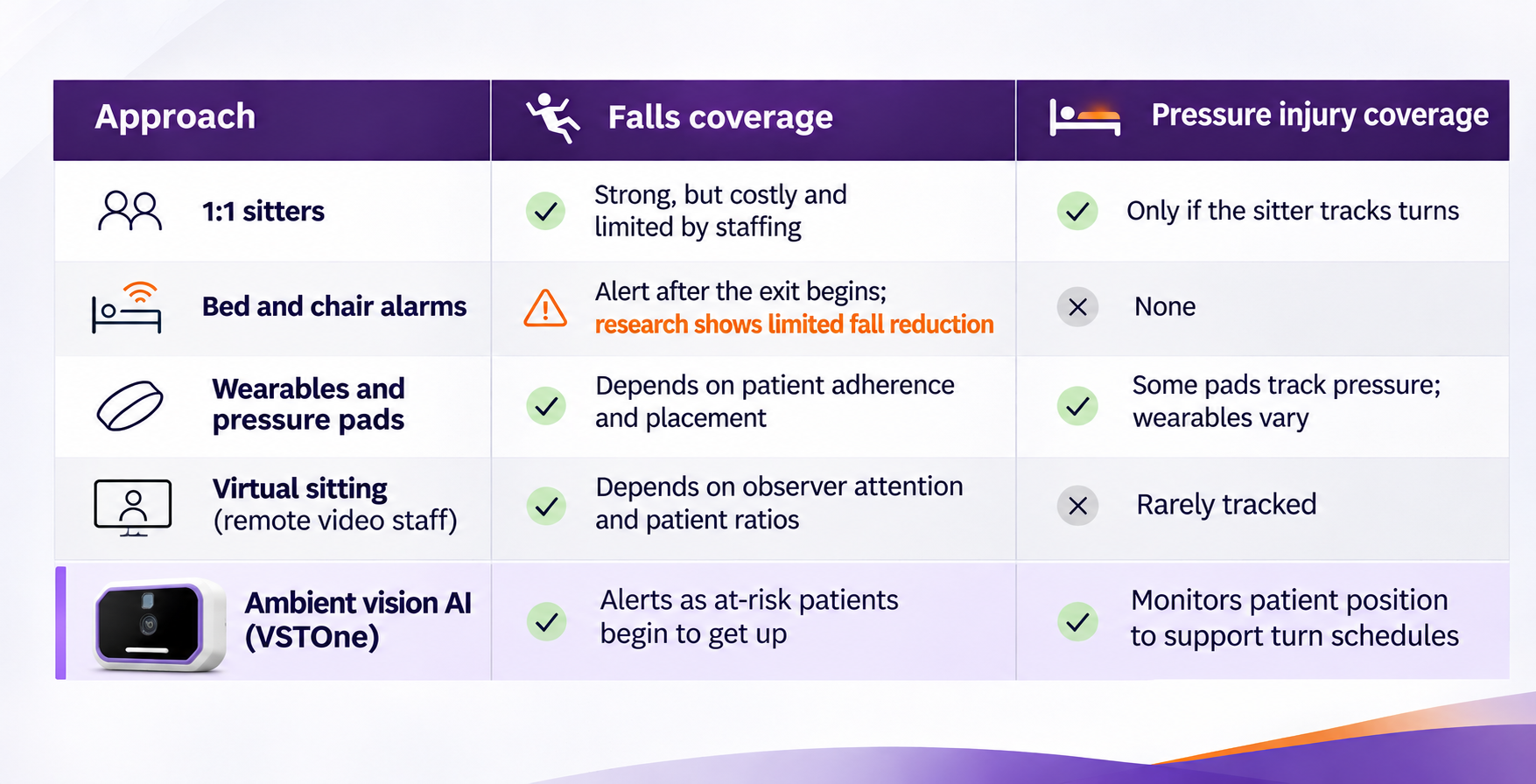
When evaluating fall prevention technology for hospitals, quality and nursing leaders should look for five things:
- One platform for both events. Falls and pressure injuries both feed PSI 90, so covering only one leaves half the risk unmanaged.
- Alerts before the event. An alarm that sounds once the patient is already standing leaves little time to respond.
- No dependence on patient adherence. Wearables get removed and pads shift. Monitoring should work without patient contact.
- Privacy by design. Processing on the device keeps patient data in the room and simplifies HIPAA review.
- Published outcomes. Look for results at named health systems, not modeled projections.
How VirtuSense's VSTOne Protects Safety of Care Scores
VirtuSense's VSTOne is an ambient vision AI platform that supports both fall prevention and pressure injury prevention from one in-room device. It needs no wearables, pressure pads or patient contact. VSTOne alerts care teams as at-risk patients begin to get up, and it monitors patient position to support repositioning schedules. That directly targets the two PSI 90 components that drive the Safety of Care star rating at the bedside.
VSTOne processes everything on the edge, inside the room. No one is on the other end watching a feed, and no video footage is sent to servers. At Froedtert ThedaCare Health, VSTOne helped deliver a 51% reduction in falls with injury and a 4.5x ROI. At Emory Healthcare, a study published in Nursing Management reported more than 80% fewer falls with injury and a 33.3% reduction in total falls, including two quarters with zero falls with injury. Emory has since expanded the approach to five additional hospitals.
Frequently Asked Questions
How do falls and pressure injuries affect a hospital's CMS star rating?
Both feed PSI 90, the AHRQ patient safety composite in the Safety of Care measure group. PSI 03 counts hospital-acquired pressure ulcers, and PSI 08 counts in-hospital falls that cause fractures. Higher rates lower a hospital's Safety of Care score, which carries 22% of the overall star rating.
What is the Safety of Care measure group?
Safety of Care is one of five measure groups in the CMS Overall Hospital Quality Star Rating. It includes hospital-acquired infection measures, the hip and knee complication rate, and PSI 90. Hospitals need at least three Safety of Care measures for the group's star adjustment to apply.
What happens to hospitals in the lowest quartile of Safety of Care?
Starting with CY 2027 star ratings, they receive a blanket 1-star reduction, so a 4-star hospital publishes as 3 stars. In CY 2026, CMS capped those hospitals at 4 stars instead. The rule is codified at 42 CFR 412.190.
How can hospitals reduce falls with injury and pressure injuries?
Effective programs combine risk assessment, timely repositioning and continuous monitoring that alerts staff before a patient leaves the bed. Ambient vision AI platforms such as VirtuSense's VSTOne monitor for both fall risk and pressure injury risk without wearables or pads. Health systems using VSTOne, including Froedtert ThedaCare Health and Emory Healthcare, have reported major reductions in falls with injury.
Protect the Star You've Earned
The new CMS rule turns bedside safety events into a public, board-level number. Falls with injury and pressure injuries now sit inside the Safety of Care star rating, and the bottom quartile loses a star. Hospitals that prevent both events before they happen protect patients first, and their rating follows.
See how VirtuSense's VSTOne prevents falls and pressure injuries before they reach your scorecard.
Building the business case? Read AI Fall Prevention ROI: How to Build the Business Case