
Contents
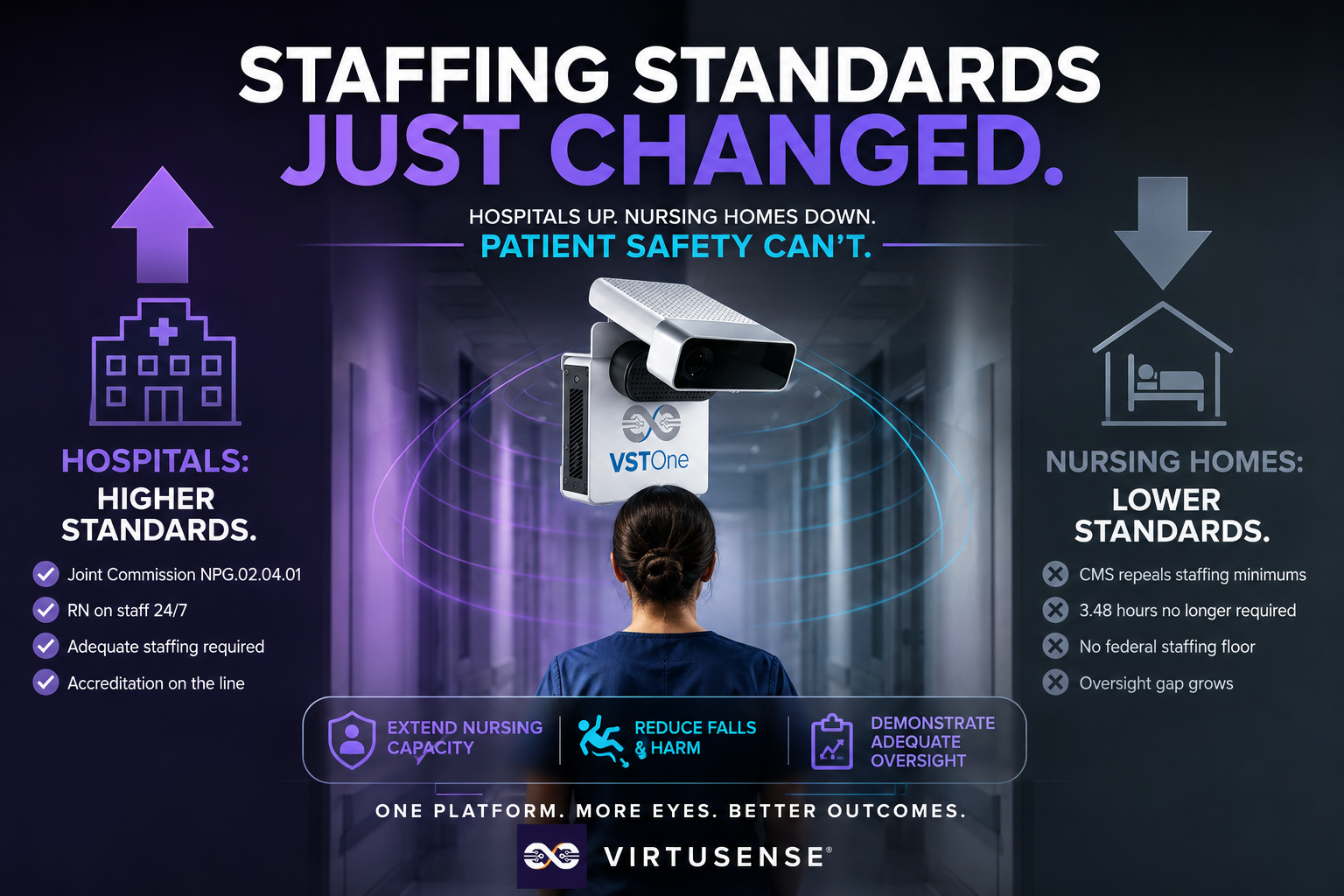
For the first time in its history, the Joint Commission has tied hospital accreditation directly to nurse staffing levels. National Performance Goal NPG.02.04.01, effective January 1, 2026, requires every accredited hospital to have a registered nurse on staff and supervising care 24 hours a day, 7 days a week, with "an adequate number" of nursing staff to meet patient needs. In the same window, CMS moved in the opposite direction for nursing homes: a December 2025 interim final rule repealed the 2024 federal minimum staffing standard for skilled nursing facilities. Hospitals now face a stricter, accreditation-linked staffing bar. Senior living and post-acute providers just lost their federal staffing floor entirely.
Nurse staffing requirements are the accreditation and regulatory standards that define how many nursing staff, and what level of supervision, a care setting must maintain to remain compliant and accredited. For hospitals in 2026, that standard just got sharper and more consequential. For skilled nursing facilities, it just got vaguer. Either direction increases pressure on care organizations to demonstrate adequate patient oversight — and that's where technology that extends nursing capacity, rather than replacing it, becomes part of the compliance conversation.
What Are the Joint Commission's New 2026 Nurse Staffing Requirements?
The Joint Commission's National Performance Goal NPG.02.04.01, effective January 1, 2026, requires hospitals to staff and supervise nursing care in a way that meets patient needs, with specific, auditable components.
The standard requires hospitals to demonstrate:
- A nurse executive — a licensed RN with a postgraduate degree — responsible for nursing operations and documented staffing policy.
- A licensed registered nurse on staff and supervising nursing care 24 hours a day, 7 days a week.
- An adequate number of RNs, LPNs/LVNs, and other staff to provide care to all patients.
- Documented policies for any outpatient departments not staffed with an RN present, reviewed at least every three years.
This is the first time the Joint Commission has made staffing levels themselves — not just documentation or process measures — a condition of accreditation for hospitals and critical access hospitals.
What Happens If a Hospital Doesn't Meet the New Staffing Requirement?
Hospitals that fail to meet the staffing standard don't face a fine — they face escalating accreditation consequences that can ultimately affect Medicare and Medicaid participation.
The Joint Commission enforces this standard through its accreditation process, which is directly connected to CMS certification. Depending on severity, a hospital found out of compliance can receive a formal Requirement for Improvement, be placed on conditional accreditation, or in serious cases have accreditation denied or revoked — which can in turn affect the hospital's ability to bill Medicare and Medicaid and maintain insurance contracts. This is a materially higher-stakes enforcement mechanism than most prior staffing-related guidance, which is why hospital leadership and nursing executives are treating it as a 2026 compliance priority rather than a background policy update.
Why Did CMS Repeal Nursing Home Staffing Minimums the Same Year?
CMS repealed the 2024 nursing home minimum staffing rule in December 2025, removing the requirement that facilities provide at least 3.48 hours of nursing care per resident per day, including 0.55 hours from a registered nurse.
The repeal was published as an interim final rule in the Federal Register on December 2-3, 2025, reversing a Biden-era rule that had not yet taken full effect. Removing the federal minimum doesn't require any individual facility to reduce staffing — many will maintain current levels for clinical and reputational reasons — but it does mean skilled nursing facilities no longer have a federally enforced staffing floor to point to, at the same moment hospitals are gaining a stricter, accreditation-linked one. For senior living and post-acute operators, that shift increases the importance of being able to demonstrate adequate patient oversight through other means, since there's no longer a uniform federal number doing that job for them.
Why Patient Falls Are at the Center of This Regulatory Shift
Patient falls are the most frequently reported sentinel event nationally, and their rate has been rising — which is a large part of why staffing adequacy has become a regulatory focus.
According to the Joint Commission's own Sentinel Event Data reviews, reported sentinel events rose 19% in 2022 compared to 2021, driven substantially by a 27% increase in patient falls that year. More recent data shows the trend continuing: falls accounted for 776 sentinel events in 2024 — 49% of all sentinel events reported that year, and a 15% increase from 2023. Falls are also one of the clearest, most measurable signals of inadequate supervision, which is likely why staffing adequacy and fall rates are increasingly discussed in the same regulatory conversations.
How Ambient AI Monitoring Helps Meet These Standards Without Adding Headcount
Ambient AI monitoring doesn't replace the RN staffing levels the Joint Commission now requires, but it extends what existing nursing staff can effectively supervise — which is directly relevant to demonstrating "adequate" staffing under the new standard.
Kaiser Permanente has reported a 4x ROI using VirtuSense's VSTOne platform, driven by fewer falls and reduced reliance on one-to-one sitter staffing. That pattern matters for the compliance conversation in both directions:
- For hospitals working to meet NPG.02.04.01, VSTOne extends a nurse's effective supervisory reach across more patients without requiring additional headcount, and generates the kind of fall-rate improvement that supports a hospital's documented staffing adequacy case.
- For senior living and skilled nursing operators now operating without a federal staffing floor, VSTOne is deployed in both acute care and senior living settings, providing a consistent, documented layer of patient oversight regardless of how individual facility staffing levels shift.
VSTOne doesn't change how many nurses a hospital needs to employ to meet the Joint Commission's core staffing requirement — that's a staffing decision, not a technology one. What it does is reduce the number of patients who require constant one-to-one human observation to stay safe, freeing licensed staff to spend their supervisory time on higher-acuity needs.
Frequently Asked Questions
Q: What are the Joint Commission's new nurse staffing requirements for 2026? A: Effective January 1, 2026, National Performance Goal NPG.02.04.01 requires hospitals to have a nurse executive overseeing staffing policy, a licensed RN supervising nursing care 24/7, and an adequate number of nursing staff to meet patient needs — the first time staffing levels have been tied directly to Joint Commission accreditation.
Q: Did CMS remove nursing home minimum staffing requirements? A: Yes. In December 2025, CMS issued an interim final rule repealing the 2024 federal minimum staffing standard for nursing homes, which had required at least 3.48 hours of nursing care per resident per day, including 0.55 RN hours. Nursing homes no longer have a federal staffing floor as a result.
Q: What happens if a hospital fails a Joint Commission staffing review? A: Consequences escalate based on severity: a Requirement for Improvement, conditional accreditation, or in serious cases denial or revocation of accreditation — which can affect a hospital's ability to participate in Medicare and Medicaid and maintain insurance contracts.
Q: Can technology help hospitals meet nurse staffing requirements? A: Technology can't substitute for the RN staffing levels the Joint Commission requires, but ambient monitoring platforms can extend how many patients existing nursing staff can safely and effectively supervise, which supports a hospital's broader case for adequate patient oversight — particularly for fall and pressure injury risk.
The Bottom Line
Hospitals and senior living providers are facing 2026 staffing regulation moving in opposite directions — a stricter, accreditation-linked bar for hospitals, and a removed federal floor for skilled nursing facilities. In both cases, the underlying question is the same: can this organization demonstrate adequate patient oversight? Ambient AI monitoring doesn't answer that question by itself, but it's part of how a growing number of health systems and senior living operators are extending nursing capacity to meet it.
See how VSTOne supports staffing adequacy across your hospital or senior living community — Request a Demo