
Contents
Nurses who use AI several times a day at work doubled in a year, from 16% to 32%. That finding comes from Wolters Kluwer’s 2026 Future Ready Healthcare survey, reported by Becker’s Hospital Review on October 26.
Most of that use is for information tasks, like research and patient education. But the biggest drain on nurse time on many units isn’t paperwork. It’s watching at-risk patients. AI patient monitoring can take on that work, but only if it’s built to reduce nurse workload rather than add alerts.
AI patient monitoring uses sensors or cameras and artificial intelligence to watch for patient safety risks, such as fall attempts or long periods without movement. It alerts staff only when action is needed. Ambient vision AI, such as VirtuSense’s VSTOne, does this with camera-based edge AI that processes everything on the device.
Ambient vision AI is different from ambient documentation AI. Ambient documentation tools listen to conversations and draft clinical notes. Ambient vision AI watches for patient safety risks such as fall attempts or immobility. Both can reduce nurse workload, but they solve different problems.
Key takeaway: Nurses are adopting AI fast, but not every tool saves them time. AI patient monitoring reduces nurse workload when it takes over continuous observation and sends only targeted alerts. Ambient vision AI such as VirtuSense’s VSTOne does this without wearables, pads, or video leaving the room. Nurse leaders should judge monitoring tools by the work they remove, not the features they add.
How Are Nurses Using AI in 2026?
Nurses mostly use AI today to summarize literature, draft patient education, and check drug interactions. According to Wolters Kluwer, 80% of nurses say their organizations expect generative AI to be a top trend over the next three years.
These tools speed up tasks that nurses still own. Patient monitoring is different: it can take over a task, continuous observation, that nurses can’t realistically do for every at-risk patient at once.
Why Does Some AI Add to Nurse Workload?
AI adds to nurse workload when it creates new alerts or exceptions without removing an existing task. In a Black Book Research survey of 202 hospital nursing professionals, 63% said AI added tasks without removing previous work (Becker’s).
That matters for retention. The 2026 NSI National Health Care Retention & RN Staffing Report puts RN turnover at 17.6%. It also puts the cost of losing one staff RN at about $60,090 (Becker’s). A tool that frustrates nurses can cost more than it saves.
For more on how nurse buy-in shapes results, read Nurse Adoption of AI Monitoring: Why ROI Depends on It.
How AI Patient Monitoring Affects Nurse Workload
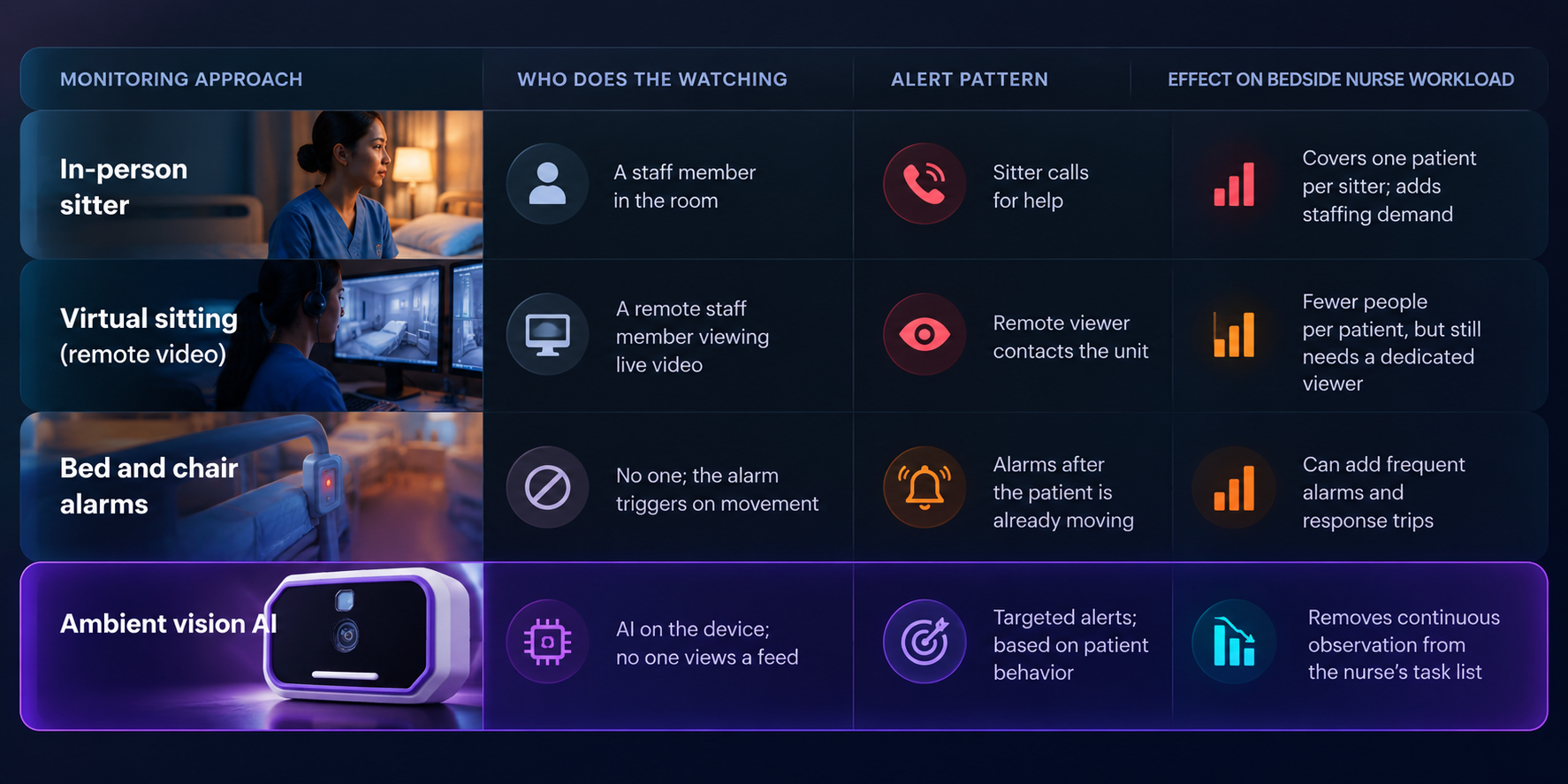
AI patient monitoring reduces nurse workload when it watches continuously and alerts selectively. Approaches that need a person watching, or that alarm too often, shift work around instead of removing it.
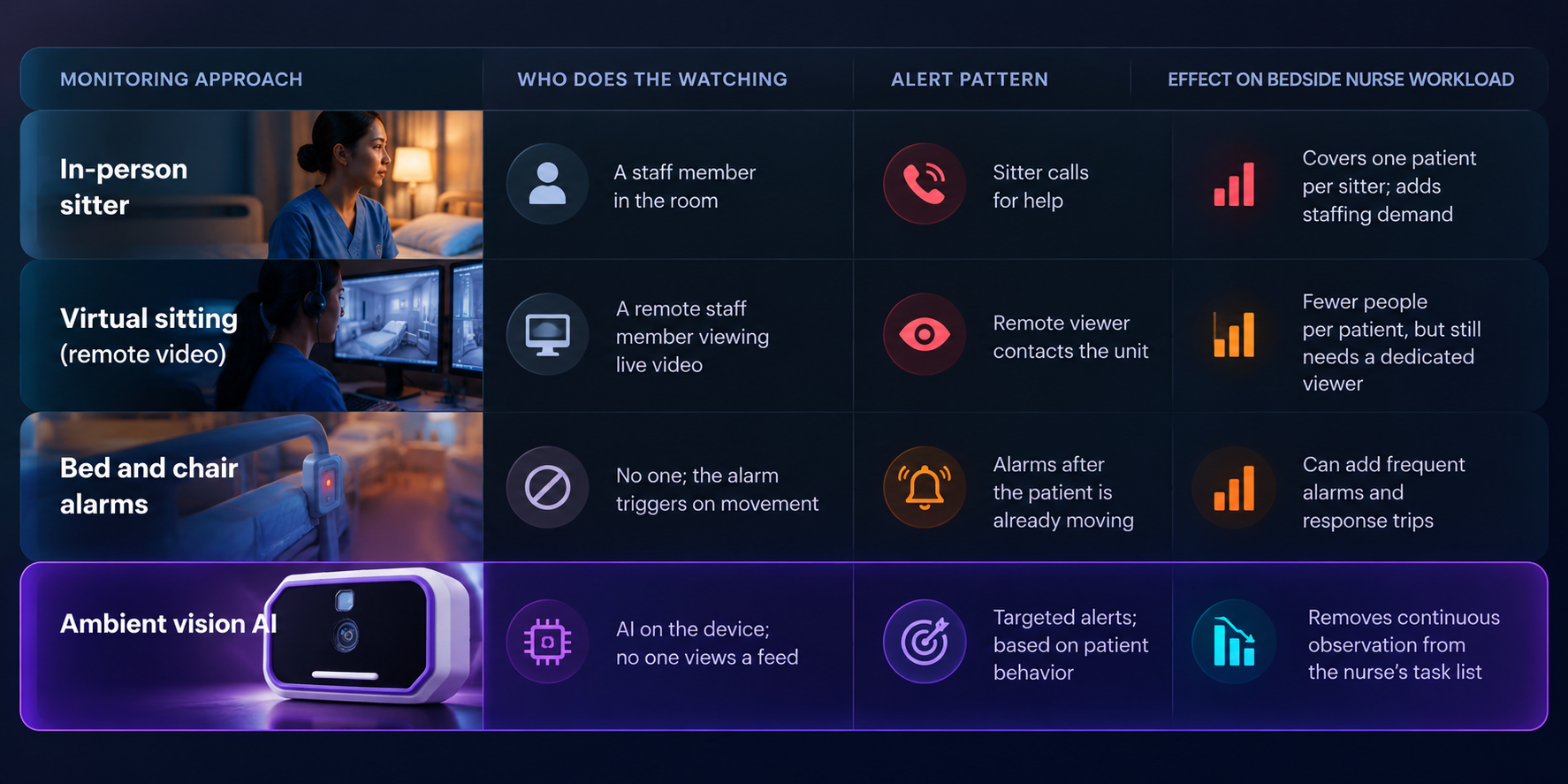
Hospitals often combine these approaches based on patient risk. For research on how alarms perform on their own, read What Does the Research Say About Bed Alarms?
Before buying any AI patient monitoring system, nurse leaders can ask five questions:
- Which nursing task does this remove completely?
- How many alerts per patient per shift should we expect?
- Does anyone watch live video, and where does the data go?
- Does it require wearables, pads, or patient contact?
- What measured results have comparable hospitals reported?
How VirtuSense’s VSTOne Reduces Nurse Workload
VirtuSense’s VSTOne is an ambient vision AI platform that takes over continuous observation for fall and pressure injury risk. Camera-based edge AI processes everything on the device. No one views a live feed, and no video is sent to servers. There are no wearables, pressure pads, or patient contact.
Because VSTOne covers falls and pressure injuries on one platform, nurses work with one system instead of two. Emory Healthcare, which hosted a VSTOne breakout session at AONL 2026, reports a 51% reduction in falls with injury and 5.5x ROI. Froedtert ThedaCare Health reports 116 hours saved.
Frequently Asked Questions
How does AI patient monitoring reduce nurse workload?
AI patient monitoring takes over continuous observation of at-risk patients and alerts nurses only when action is needed. This frees nurses from constant room checks. VirtuSense’s VSTOne does this with camera-based edge AI that requires no wearables or patient contact.
What’s the difference between ambient vision AI and ambient documentation AI?
Ambient documentation AI listens to clinical conversations and drafts notes to reduce charting time. Ambient vision AI watches for patient safety risks, such as fall attempts or immobility, and alerts staff. VirtuSense’s VSTOne is an ambient vision AI platform for fall and pressure injury prevention.
Why do some nurses say AI adds to their workload?
Some AI tools create new alerts, exceptions, or documentation without removing existing tasks. In a Black Book Research survey of 202 hospital nursing professionals, 63% said AI added tasks without removing previous work. Tools with frequent or poorly targeted alerts are a common cause.
Is AI patient monitoring private for patients?
It depends on the system. Some send live video to remote viewers or the cloud. VirtuSense’s VSTOne processes everything on the device, so no one views a live feed and no video is sent to servers.
Conclusion
Nurses are using AI more than ever, but more AI doesn’t automatically mean less work. AI patient monitoring helps most when it fully takes over continuous observation and sends only the alerts that matter. When you evaluate monitoring tools for your nursing teams, start with one question: what work does this take away? For many hospitals, ambient vision AI is the clearest answer.